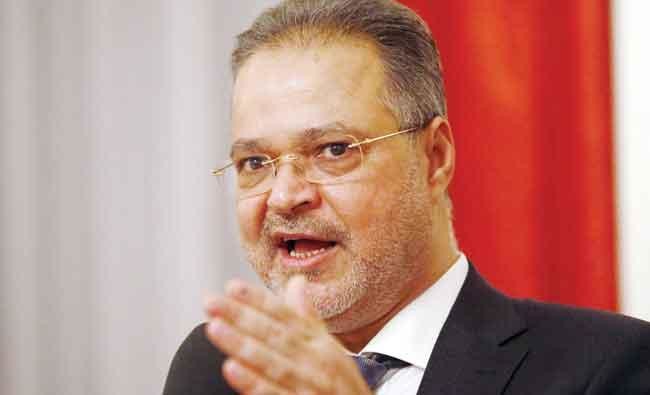
UNITED NATIONS: Yemen’s foreign minister blamed Iran and its support for Houthi Shiite rebels on Monday for causing the country’s civil war and said it can’t be part of the solution.
Abdulmalik Al-Mekhlafi said at a press conference that Iranian weapons are still being smuggled into Yemen.
Saudi Arabia’s UN ambassador, Abdallah Al-Mouallimi, whose country supports Yemen’s internationally recognized government, said Iran isn’t a neighbor or part of the Arabian Peninsula and he had a more direct message: “Iran should get the hell out of the area, period.”
The Saudi and Yemeni officials spoke to reporters after a presentation to UN diplomats on the path to peace and humanitarian aid to Yemen.
Yemen, which is on the southern edge of the Arabian Peninsula, has been engulfed in civil war since September 2014, when the Houthis swept into the capital of Sanaa and overthrew President Abed-Rabbo Mansour Hadi’s internationally recognized government.
In March 2015, a Saudi-led coalition began a campaign in support of Hadi’s government and against Houthi forces allied with ousted President Ali Abdullah Saleh. Since then, the Iranian-backed Houthis have been dislodged from most of the south, but remain in control of Sanaa and much of the north.
The war in Yemen has killed over 10,000 civilians and displaced 3 million people. UN humanitarian chief Stephen O’Brien said Friday that 17 million Yemenis don’t know where their next meal is coming from, nearly 7 million are facing the threat of famine and almost 16 million lack access to clean water and sanitation. The World Health Organization said last week that 2,000 people have been killed and an estimated 500,000 infected in a cholera outbreak.
Al-Mekhlafi said that “the Yemeni government ... will not be an obstruction to peace.” But he said the Houthis and Saleh “cannot monopolize power.”
The two diplomats reiterated Yemeni and Saudi support for a proposal by UN envoy Ismail Ould Cheikh Ahmed to reopen Sanaa airport for commercial flights and to hand over the port of Hodeida to a committee of “respected Yemeni security and economic figures” that would use the port revenues to pay civil servants.
The Houthis have not accepted the proposal, but Cheikh Ahmed said Friday he hopes their leaders will accept his invitation to meet in a third country to discuss the proposals.
The Saudi ambassador warned diplomats to beware of three “fallacies” about Yemen.
First, Al-Mouallimi said, supporting a cessation of hostilities “actually means the de facto partition of Yemen and the consolidation of a reactionary movement that is tied with Iran in the north part of Yemen and a weak Yemeni state in the southern part of Yemen.”
“This is no recipe for sustainable peace,” he said, stressing that any cease-fire has to be linked to implementation of a 2015 UN Security Council resolution demanding that the Houthis withdraw from all areas they captured, hand over arms seized from military and security institutions, and stop all actions falling within the authority of the legitimate government.
Al-Mouallimi said the second fallacy “is that we must all sit around the table and talk.” He said there have been talks “everywhere,” including Geneva, Kuwait, Moscow and Saudi Arabia. Yemen’s recognized government has shown willingness to move forward with a political settlement, Al-Mouallimi said, while the Houthis have rejected Cheikh Ahmed’s proposal and refused to meet him.
The third fallacy, he said, is that people often seem to think that “a disastrous humanitarian situation, a catastrophic spread of cholera” afflict all of Yemen. But “all of that is concentrated in one part of Yemen which is controlled by the Houthis,” he said. Al-Mouallimi said the entire world, especially Saudi Arabia, is ready to provide aid but he said the Houthis are unable or “sometimes maybe unwilling” to manage and distribute aid.
Looking ahead, Yemen’s foreign minister predicted that “in the end,” the parties will get to the place where they started — when the end of a national dialogue in January 2014 all political parties agreed on a road map for a political transition.
But unfortunately, to get there Yemenis will have “paid a high price for peace,” Al-Mekhlafi said.


Yemen blames Iran for war, says it can’t be part of solution
Yemen blames Iran for war, says it can’t be part of solution


Prosecutors indict 12 Israeli suspects in Gaza smuggling case
- A Justice Ministry statement said the suspects had been ‘willfully ignoring the direct contribution of this activity to the strengthening of terrorist organizations in the Strip,’ notably Hamas
JERUSALEM: Prosecutors on Wednesday filed charges against 12 Israeli suspects including reservist soldiers for offenses including “assisting the enemy in wartime,” over the alleged smuggling of prohibited goods into war-shattered Gaza.
Israel controls the entry of all goods and people into the besieged Palestinian territory, where humanitarian conditions remain dire despite a ceasefire between Israel and Hamas which came into effect on October 10.
A Justice Ministry statement said the smuggled goods were worth millions of Israeli shekels and included cartons of cigarettes, iPhones, batteries, communication cables, car parts and more.
It described the operation as a “serious case of organized, systematic, and sophisticated smuggling of various goods into the Gaza Strip for profit,” which began in the summer of 2025, when war was still raging in Gaza.
The Justice Ministry statement said charges had been filed against 12 individuals and one company.
A joint statement from the police and Israel’s Shin Bet domestic intelligence agency confirmed they had “arrested several Israeli citizens and Gaza Strip residents who smuggled goods prohibited from entering the Gaza Strip.”
It said those arrested included reservists in the Israeli military.
The statement added that the suspects had been “willfully ignoring the direct contribution of this activity to the strengthening of terrorist organizations in the Strip,” notably Hamas.
“This morning (Wednesday), the Southern District Prosecutor’s Office filed indictments against 12 of the suspects for offenses including assisting the enemy in wartime, performing actions with property for terrorist purposes, obtaining something by fraud under aggravated circumstances, bribery offenses, and economic offenses,” it added.
Israeli media reported that the brother of Israel’s Shin Bet chief, David Zini, was allegedly linked to smuggling cigarettes into Gaza.
Reports said that Bezalel Zini was expected to be indicted on Thursday.


