BEIRUT: The Lebanese military launched a massive ground and air attack at dawn on Saturday against 600 Daesh militants in 120 square km of the barren area straddling the northeast border with Syria.
Simultaneously, the Syrian Army and Hezbollah fighters also attacked the militants from the western Qalamoun area of Syria. Lebanese military sources said the two operations were not coordinated.
After several days of artillery bombardment, the Lebanese attack began at 5 a.m., targeting Daesh positions near Ras Baalbek with rockets, artillery and helicopters.
“In the name of Lebanon, the kidnapped soldiers, the blood of martyrs, and all the heroes of the Lebanese army, I hereby launch the Barrens’ Dawn operation,” army commander Gen. Joseph Aoun said.
The militants are entrenched on fortified high ground, in outposts and in caves. An army spokesman said a third of the area had been recaptured in the offensive, with 20 militants killed in direct combat, shelling or airstrikes. Ten Lebanese soldiers were wounded.
“The army has succeeded in eliminating a very large part of their men and equipment. We have tightened the noose around them and they have become much weaker,” Col. Nazih Jraish said.
Brig. Gen. Ali Qanso of Lebanese Army Command said the military had started to tighten a siege on Daesh in the area two weeks ago. “It’s the most difficult battle so far waged by the Lebanese Army against terrorist groups, because of the nature of the terrain and the enemy,” he told a televised press conference.
He spoke of “the great will of Lebanese soldiers to fight, and we have the weapons, ammunition and military planes. We will take our land back.”
Qanso described the Daesh fighters as “600 suicide bombers.” He said they were “divided into 47 infantry groups, supported by vehicles and motorcycles, and they are armed with heavy, medium and light weapons — mortars, guided missiles, anti-armor weapons, anti-aircraft weapons, sniper rifles, night spectroscopes and drones.”
He said the militants suffered from a lack of aerial cover and a lack of tanks. “However, they were experienced in suicide attacks, and have good knowledge of the terrain,” he said.
Qanso said there would be no negotiations until the fate of nine Lebanese soldiers taken captive by Daesh in 2014 was established. “The issue of the kidnapped soldiers takes full priority before any negotiations, and we shall prevail whatever it takes,” he said.
The threat of Daesh attacks in other parts of Lebanon was not being ignored, Qanso said. “There is concern about the possible presence of sleeper cells. The security forces and the military intelligence are doing their part, and they have already arrested many cells.”
Lebanese President Michel Aoun followed the progress of the operation from Lebanese Army Command.
He called the commander at the front and told him: “Our hearts and souls are with you. Lebanon as a whole is watching you and expecting your triumph. God willing, our battle will continue without losses whatever the conditions are. We’ll be with you all the time. May God protect you.”
Hezbollah forced Jabhat Fateh Al-Sham militants and Syrian opposition fighters to leave border strongholds in the area last month in a joint operation with the Syrian Army.
The Lebanese Army did not take part in the July operation, but it has been gearing up to assault the Daesh pocket in the same mountainous region.
Footage broadcast on Saturday by Hezbollah-run Al-Manar TV showed the group’s fighters armed with assault rifles climbing a steep hill in the western Qalamoun. It also later showed a group of Daesh fighters it said had handed themselves over to their forces.


![]()
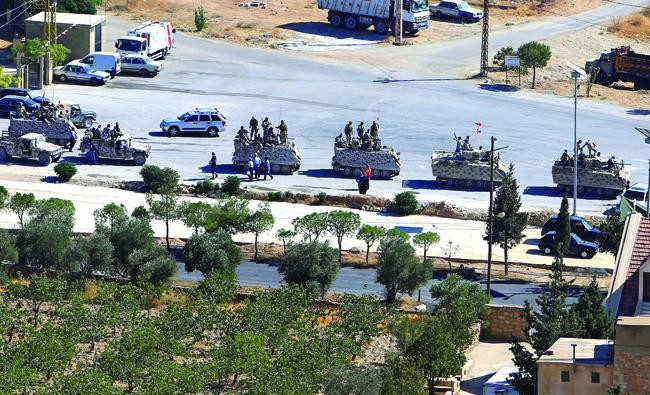
Lebanese army attack Daesh militants in border with Syria
Lebanese army attack Daesh militants in border with Syria

Latest updates


© 2026 SAUDI RESEARCH & PUBLISHING COMPANY, All Rights Reserved And subject to Terms of Use Agreement.