No coordination between Lebanon and Syrian armies against Daesh — Lebanese military source

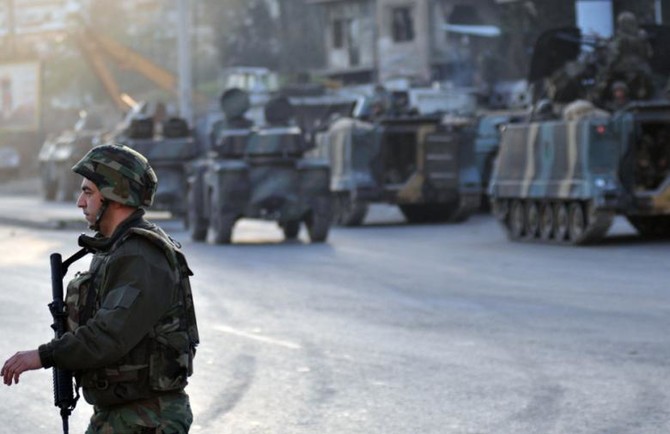
FILE - Lebanese army. (AFP)
Updated 05 August 2017
Follow

No coordination between Lebanon and Syrian armies against Daesh — Lebanese military source

BEIRUT: The Lebanese army will not coordinate with the Syrian army to fight against Daesh in the Lebanese-Syrian border zone, a military source told Reuters on Saturday, rejecting a local media report of direct military cooperation between the two.
The source said the Lebanese army had the military capability to confront and defeat the group without any regional or international support.
The presence of Daesh and Nusra Front militants in pockets on Lebanon’s border is the biggest military spillover into the country from Syria’s civil war.
An offensive launched last month by Lebanon’s Hezbollah — a key ally of Syrian President Bashar Assad — forced Nusra Front militants to leave for a rebel-held area in northwest Syria under an evacuation deal.
The Lebanese army did not take part in that offensive, but has been widely expected to lead an attack against the Daesh pocket.
On Friday Hezbollah leader Sayyed Hassan Nasrallah said an assault on Daesh militants in the border zone would begin in a few days.
He said the Lebanese army would attack Daesh from the Lebanese side of the border while Hezbollah and the Syrian army would simultaneously attack from the Syrian side.
Hezbollah has been fighting alongside the Syrian army against rebels including hard-line Sunni Islamists in Syria.
On Saturday Lebanese newspaper Al-Joumhouria reported from sources that direct military coordination had occurred between the Syrian and Lebanese armies regarding the upcoming offensive against Daesh.
The military source said the Lebanese army had been attacking Daesh for some time, by preventing it spreading further and cutting supply routes.
Lebanese state news agency NNA and a Hezbollah media unit said on Saturday the Lebanese army had shelled Daesh positions in the Ras Baalbek and Al-Qaa areas of northeast Lebanon.


Video footage appears to show a U.S. Tomahawk hitting near Minab girls' school, experts

Updated 8 min 31 sec ago
Follow

Video footage appears to show a U.S. Tomahawk hitting near Minab girls' school, experts

  • The girls’ school in the city of Minab was struck on Feb. 28 during the opening day of the war, killing hundreds

DUBAI: Questions are mounting over a missile strike that destroyed a girls’ school in southern Iran killing hundreds of school girls after new video evidence suggested a US-made Tomahawk cruise missile may have been involved, according to reporting by Reuters and The New York Times.

US President Donald Trump said the incident was under investigation when asked whether Washington would accept responsibility for the strike.

“Well, I haven't seen it,” Trump told reporters.

“And I will say that the Tomahawk, which is one of the most powerful weapons around, is used by, you know, sold and used by other countries. You know that. And whether it's Iran, who also has some Tomahawks, they wish they had more. But whether it's Iran or somebody else, the fact that a Tomahawk, a Tomahawk is very generic, it's sold to other countries. But that's being investigated right now.”

The girls’ school in the city of Minab in southern Iran was struck on Feb. 28 during the opening day of US and Israeli military attacks on Iran. Iran’s ambassador to the United Nations in Geneva, Ali Bahreini, said the strike killed 150 students, though Reuters said it could not independently confirm the death toll.

According to Reuters, two US officials said investigators believe it is likely US forces were responsible for the apparent strike, though they have not reached a final conclusion.

Reuters reported that it verified the location of the strike using video footage and satellite imagery. The agency matched buildings, trees, utility poles, walls and the layout of nearby roads with satellite images of the area. Coordinates from where the video was filmed were identified as 27.105714752109524, 57.08551574115519.

The timing of the footage was also confirmed using satellite imagery taken on the morning of Feb. 28, which showed the buildings intact before the attack. Smoke visible in the video before the missile strike appeared to be coming from the direction of the school, Reuters reported.

Two weapons experts cited by Reuters said the missile seen in the video appeared to be a Tomahawk cruise missile. Joseph Dempsey, a military analyst with the International Institute for Strategic Studies in London, told Reuters the weapon was “highly likely to be a variant of the Tomahawk missile” and did not appear to match other cruise missiles used by countries involved in the conflict.

Joost Oliemans, a Netherlands-based conflict analyst who specializes in military equipment, also told Reuters that there were no plausible alternative candidates based on the available footage and noted that neither Israel nor Iran operates missiles similar to the Tomahawk.

Additional evidence has emerged in reporting by The New York Times which said the footage shows “a Tomahawk cruise missile striking a naval base beside the school in the town of Minab on Feb. 28,” adding that “the U.S. military is the only force involved in the conflict that uses Tomahawk missiles.”

The Times said it verified the footage and analyzed a range of evidence including satellite imagery, social media posts and other videos.

“A body of evidence assembled by The Times - including satellite imagery, social media posts and other verified videos - indicates that the Shajarah Tayyebeh elementary school building was severely damaged by a precision strike that occurred at the same time as attacks on the naval base,” the report said.

The base, according to The New York Times, is operated by Iran’s Islamic Revolutionary Guard Corps.

The footage was filmed from a construction site opposite the base and shows features that match satellite imagery of the area, including a dirt path and debris piles visible in images taken after the strikes, the newspaper reported.

An analysis by The New York Times said the missile struck a building described as a medical clinic within the IRGC base.

“Plumes of smoke and debris shoot out of the building after it is hit as the distant screams of onlookers are heard,” the report said.

As the camera pans, the video also shows large clouds of dust and smoke already rising from the area around the elementary school. The Times reported this suggests the school had been hit shortly before the strike on the naval base.

Asked by a reporter from The New York Times whether the United States had bombed the school, Trump denied responsibility.

“No. In my opinion and based on what I’ve seen, that was done by Iran,” he said, adding that Iranian munitions were often inaccurate.

US Defense Secretary Pete Hegseth said the Pentagon was reviewing the incident.

“But the only side that targets civilians is Iran,” he said.

The New York Times also reported that the weapon visible in the footage was identified as a Tomahawk cruise missile by multiple experts, including Trevor Ball, a former US Army explosive ordnance disposal technician who works with the investigative group Bellingcat, and Chris Cobb-Smith, director of the security and logistics firm Chiron Resources.

According to the US Defense Department, Tomahawks are “long-range, highly accurate” guided cruise missiles capable of flying roughly 1,000 miles. The missiles are programmed with a flight path before launch and navigate themselves to their targets.

US military officials have acknowledged that Tomahawk missiles were widely used during the early stages of the conflict. Gen. Dan Caine, chairman of the Joint Chiefs of Staff, said US forces were conducting strikes in southern Iran at the time Minab was hit and that naval forces had launched Tomahawk missiles as part of the operation.

“The first shooters at sea were Tomahawks unleashed by the United States Navy,” Caine said in a Pentagon briefing cited by The New York Times.

Despite the growing body of evidence, the precise circumstances of the strike remain unclear. Determining exactly what happened has been complicated by the lack of weapons fragments and limited access for independent investigators at the site, according to The New York Times.