DUBAI/LONDON: Oil exports from Iraq’s southern terminals have fallen so far this month, suggesting the country is trying to step up compliance with Organization of the Petroleum Exporting Countries (OPEC) output cuts, but it has a long way to go to match its peers in the producer group.
Exports from southern Iraq — the outlet for most of the country’s crude — in the first 14 days of August aver- aged 3.15 million barrels per day (bpd), down 80,000 bpd from July, according to shipping data tracked by Reuters and independent tracking by an industry source.
If sustained, this would mean exports are down for a second month, giving weight to Iraq’s insistence it is comply- ing with OPEC’s curbs.
Still, a second industry source famil-
iar with Iraq’s exports said it was too early to tell whether shipments would be down over the whole month.
“Southern exports are expected to at least stay the same level as July, looking at the first couple of weeks so far, unless there is bad weather,” this source said. “But exports from the north will be lower.”
Iraq, OPEC’s second-largest producer, has adhered less to the supply deal with non-OPEC producers than OPEC peers such as Saudi Arabia and Kuwait.
OPEC, Russia and other producers are cutting output by about 1.8 million bpd until March 2018 to get rid of a glut and support prices.
Based on the most recent OPEC fig- ures, Iraq carried out only 28 percent of the 210,000-bpd supply cut it had pledged in July, versus more than 100 percent for top exporter Saudi Arabia.
Iraq was one of several countries that met a panel comprising Russia, Kuwait and Saudi Arabia, plus officials from OPEC’s Vienna headquarters, last week in Abu Dhabi to discuss ways to boost
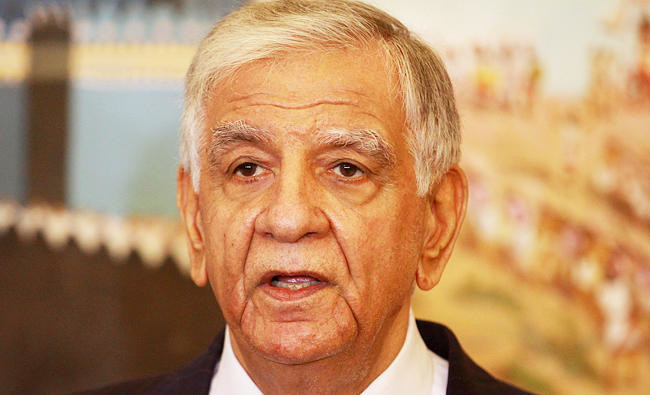
Iraqi Oil Minister Jabar Ali Al-Luaibi speaks during a media conference in Baghdad on May 22, 2017. (Reuters)
with production, Saudi Energy Minister Khalid Al-Falih said last month.
Iraqi and independent figures show southern exports are lower. Iraq said it exported 3.23 million bpd in July and 3.25 million bpd in June. That compares with 3.32 million bpd in January, when the cut took effect. Exports can be vola- tile day-to-day, affected by weather and technical snags.
Al-Falih, who met his Iraqi counter- part Jabar Ali Al-Luaibi last week in Saudi Arabia, said he was comfortable with Iraq’s commitment to the deal since its exports had fallen “in concrete quan- tities” in recent months.
Al-Luaibi confirmed Iraq’s commit- ment to the pact and its willingness to work with other producers to restore stability to global markets, Iraqi Oil Ministry spokesman Asim Jihad said.
“There was a message from the Iraqi prime minister conveyed by Mr. Luaibi to the officials of the Kingdom, in which he stresses Iraq’s keenness to enhance coop- eration in all fields, including the oil and gas sector and others, as well as to
confirm Iraq’s commitment to the deci- sions of OPEC,” Jihad said.
The export drop in recent months, industry sources say, also reflects season- ally higher domestic consumption.
Temperatures in Iraq can top 50 degrees Celsius, boosting demand for crude and products for power generation.
This could mean exports rise again in winter when seasonal domestic demand dips, unless Iraq caps foreign sales to comply with the OPEC agreement, the second industry source said.
Oil traders are skeptical Iraq would cut output much more, after it argued last year in negotiations on the OPEC deal that it should be exempt due to a need for cash to fight Daesh. The coun- try expanded output capacity in recent years.
“The Iraqis won’t cut. They need the money,” a trade source said.
The bulk of Iraq’s oil is exported via the southern terminals. Smaller amounts are shipped from northern Iraq via Ceyhan in Turkey.


![]()
Iraq’s August oil exports dip, still some way off OPEC compliance
Iraq’s August oil exports dip, still some way off OPEC compliance
Latest updates


© 2026 SAUDI RESEARCH & PUBLISHING COMPANY, All Rights Reserved And subject to Terms of Use Agreement.