TOKYO: When US Marine Marvin Strombo found a Japanese flag on the body of an enemy soldier during World War Two, he took and promised to one day return it to the family of his fallen foe.
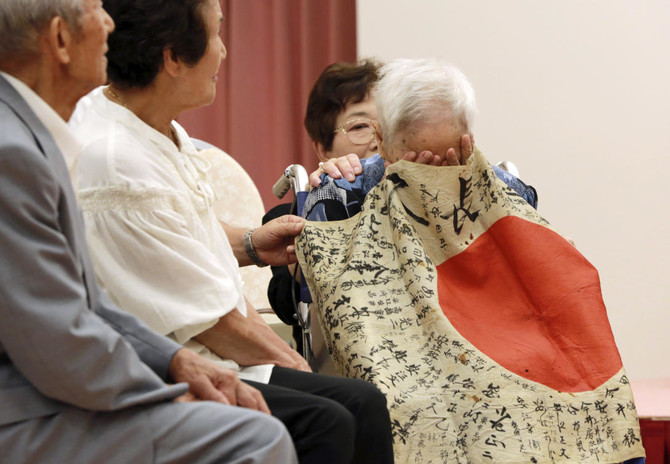
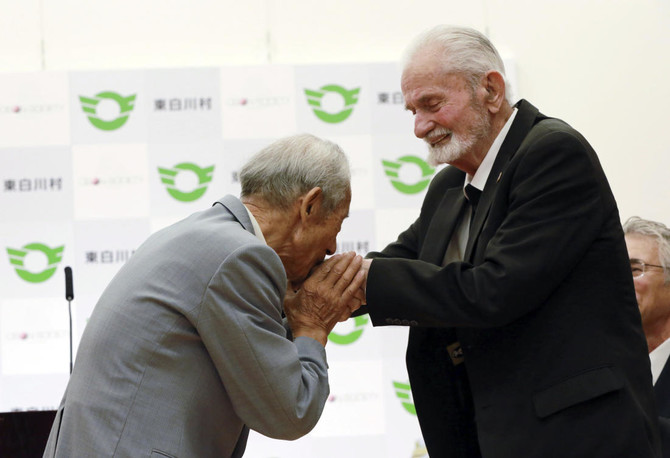
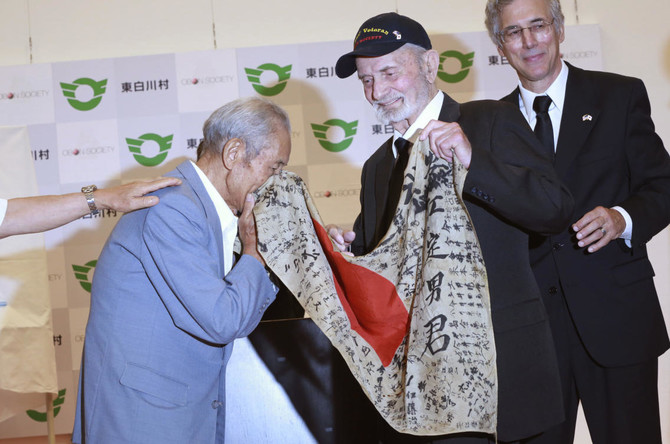
That vow was fulfilled on Tuesday, exactly 72 years after Japan’s surrender, when Strombo, 93, handed the flag to the brother and sisters of Sadao Yasue.
Yasue, the eldest of six children from a farming town in central Japan, followed a common practice of carrying into battle a Japanese flag covered with messages and the signatures of family and friends.
Strombo said he found the flag on Yasue’s body after a 1944 battle on the island of Saipan, the site of fierce fighting in the Pacific war.
“I finally realized that if I didn’t take it, somebody else would have and it would be lost forever,” Strombo said in an interview provided by US forces.
“So the only way I could do that, as I reached out to take the flag, I made a promise to him that some day I would try to return it,” said Strombo, who traveled to Japan from the US state of Montana.
Strombo said he had intended to return the flag soon after the war but did not know how. About five years ago he was put in touch with a non-profit group that helps US veterans return artifacts to relatives.
The group tracked down Yasue’s family, who welcomed the flag with tears.
“It was a very emotional moment,” Strombo said, noting that he was especially moved by the response of one of Yasue’s sisters.
“I saw her holding that flag, about broke my heart, you know,” he added. “That’s the reason I was glad I returned it too.”

US WW2 veteran returns flag to family of fallen Japanese soldier
Three Afghan migrants die of cold while trying to cross into Iran
- More than 1.8 million Afghans were forced to return to Afghanistan by the Iranian authorities between January and the end of November 2025
AFGHANISTAN: Three Afghans died from exposure in freezing temperatures in the western province of Herat while trying to illegally enter Iran, a local army official said on Saturday.
“Three people who wanted to illegally cross the Iran-Afghanistan border have died because of the cold weather,” the Afghan army official told AFP on condition of anonymity.
He added that a shepherd was also found dead in the mountainous area of Kohsan from the cold.
The migrants were part of a group that attempted to cross into Iran on Wednesday and was stopped by Afghan border forces.
“Searches took place on Wednesday night, but the bodies were only found on Thursday,” the army official said.
More than 1.8 million Afghans were forced to return to Afghanistan by the Iranian authorities between January and the end of November 2025, according to the latest figures from the United Nations refugee agency (UNHCR), which said that the majority were “forced and coerced returns.”
“These mass returns in adverse circumstances have strained Afghanistan’s already overstretched resources and services” which leads to “risks of onward and new displacement, including return movements back into Pakistan and Iran and onward,” UNHCR posted on its site dedicated to Afghanistan’s situation.
This week, Amnesty International called on countries to stop forcibly returning people to Afghanistan, citing a “real risk of serious harm for returnees.”
Hit by two major earthquakes in recent months and highly vulnerable to climate change, Afghanistan faces multiple challenges.
It is subject to international sanctions particularly due to the exclusion of women from many jobs and public places, described by the UN as “gender apartheid.”
More than 17 million people in the country are facing acute food insecurity, the UN World Food Programme said Tuesday.