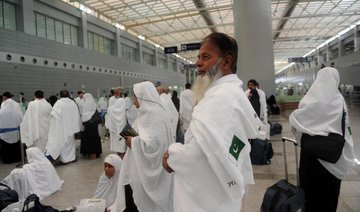
Egypt opens Gaza crossing for Hajj pilgrims

Palestinians wave to their relatives before leaving for Hajj, in Gaza City on Monday. (AP)
Updated 14 August 2017
Follow

Egypt opens Gaza crossing for Hajj pilgrims

GAZA CITY: Egypt reopened its border with the Gaza Strip Monday for the first time in months to allow Muslims from the blockaded Palestinian enclave to travel to Makkah for the Hajj pilgrimage, authorities said.
“The crossing was reopened this morning for four days in one direction for 2,500 pilgrims,” Hisham Adwan, director of information at the crossings authority of the Hamas-run Interior Ministry, said.
“About 800 pilgrims will leave the strip today,” he added, saying they had all already received Saudi visas.
The Rafah crossing with Egypt has been largely closed in recent years apart from occasional openings.
Israel has also maintained a crippling blockade on Gaza for a decade that it says is necessary to stop militant movement Hamas, which rules the strip, from obtaining weapons or materials that could be used to make them.
Egypt is the only other country with which the strip has a land border. Egyptian authorities accuse Hamas of supporting extremist factions in the country.
But Hamas has moved closer to the Egyptian government in recent months and officials privately hope the Rafah crossing will be at least partially reopened from next month.
One pilgrim who was waiting to cross the border told AFP he had been trying to travel to Makkah since 2014.


Yemen humanitarian crisis to worsen in 2026 amid funding cuts, says UN

Updated 5 sec ago
Follow

Yemen humanitarian crisis to worsen in 2026 amid funding cuts, says UN

  • Yemen has been the ‍focus of one of the world’s largest humanitarian operations in a decade of civil war that disrupted food supplies
GENEVA: The UN warned on Monday that the humanitarian situation in Yemen is worsening and that gains made to tackle malnutrition ​and health would go into reverse due to funding cuts.
“The context is very concerning... We are expecting things to be much worse in 2026,” Julien Harneis, UN Resident and Humanitarian Coordinator for Yemen, told reporters in Geneva.
Some 21 million people will need humanitarian assistance this year, an increase from ‌19.5 million the ‌previous year, according to the ‌UN ⁠The ​situation ‌has been aggravated by economic collapse and disruption of essential services including health and education, and political uncertainty, Harneis said.
Funding Yemen traditionally received from Western countries was now being cut back, Herneis said, pointing to hopes for more help from Gulf countries.
The US slashed its ⁠aid spending this year, and leading Western donors also pared back help ‌as they pivoted to raise defense ‍spending, triggering a funding ‍crunch for the UN
Yemen has been the ‍focus of one of the world’s largest humanitarian operations in a decade of civil war that disrupted food supplies. The country has also been a source of heightened tensions ​in recent months between Saudi Arabia and the United Arab Emirates.
“Children are dying and it’s ⁠going to get worse,” Harneis said. Food insecurity is projected to worsen across the country, with higher rates of malnutrition anticipated, he stated.
“For 10 years, the UN and humanitarian organizations were able to improve mortality and improve morbidity...this year, that’s not going to be the case.”
He said Yemen’s humanitarian crisis threatened the region with diseases like measles and polio that could cross borders.
In 2025 680 million dollars was afforded to ‌the UN in Yemen, about 28 percent of the intended target, Harneis said.