LONDON: For almost a decade, the image of Emirates has been intertwined with that of the double-decker jumbo jet, the Airbus A380.
It is an image that may need to be reviewed as doubts about the viability of the aircraft’s future mount.
“Emirates has not appeared likely to order anymore of the current A380. The A380 this year marks 10 years in service, so the aircraft’s design is getting old and thus efficiency is decreasing compared to newer aircraft,” said Will Horton, a senior analyst at Capa — Center for Aviation.
Launched in 2007, the A380 was at the cutting edge of technology due to its size and passenger comfort, with the plane able to carry more than 500 passengers on long-haul flights. The Dubai-based airline was quick to snap up as many aircraft as it could, acquiring its first one in 2008.
Emirates became the largest buyer for the aircraft, and currently operates a fleet of 96 A380s, with a total order backlog of 46 planes.
Total Emirates A380 orders account for nearly half of all the 319 orders Airbus has received, according to the plane manufacturer.
Close to 10 years on, Emirates has started to slow down the rate of A380 orders and deliveries, having last placed an order for just two of the aircraft in 2016. This compares to the 50 A380s it ordered at the Dubai Airshow in 2013.
Now questions are being asked about whether the carrier will eventually abandon the A380, and if so, how will it be replaced.
At the end of 2016, Emirates deferred delivery of 12 A380s that were due for delivery over the next two years. In its half-year results released in July, Airbus revised down its A380 delivery schedule for 2019 from the planned 12 aircraft to just eight planes.
The possible demise of the A380 comes as the Middle East aviation market grapples with poor market conditions, where improving fleet efficiency is paramount for the region’s airlines.
Factors such as Brexit, the struggling oil and gas industry and the (now-lifted) ban on personal electronic devices on flights from some Middle Eastern airports into the US have been blamed for slowing down demand. Passenger traffic growth across all airlines in the Middle East slowed in the first half of this year, recording the slowest first half growth since 2003.
Emirates’ finances have also come under pressure. It made a round of job cuts this year, and in May it reported a 70 percent decline in profits for the financial year 2016-17 compared to the previous year.
Operating planes as big as A380s is no longer seen as a cost-efficient option. “Nothing will replace the A380 because airlines do not want to operate such a big jet because of its high cost, limited second-hand appeal and failure to operate at every airport. Emirates’ use of the A380 via its Dubai hub has been unique for moving people around, but that model doesn’t work for everyone,” said San Ahmad, chief analyst at StrategicAero Research.
The fate of the A380 could be decided at the Dubai Airshow in November, where the market waits to see what deals Emirates will strike with both the A380 manufacturer Airbus and with its US rival Boeing.
Airbus confirmed that no Emirates orders for A380s have been made so far this year, although there are campaigns currently running.
Emirates will also be considering whether to take up Airbus up on its new range of A380 enhancements being explored under its A380 development study.
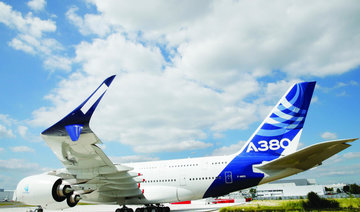
At the Paris Air Show in June, Airbus showcased winglets that improve the plane’s fuel efficiency, allowing for up to 4 percent fuel burn savings. “Added to an optimized A380 maintenance program and enhanced cabin features, the overall benefit is a 13 percent cost per seat reduction versus today’s A380,” according to an e-mail from Airbus’ Africa and Middle East office.
These additions are seen as a compromise option to keep the A380 program going, as Airbus has so far rejected requests from Emirates to develop a new so-called A380neo aircraft.
“It (Emirates) would certainly order more (A380s) if Airbus were to strengthen the specification of the aircraft as the airline has been seeking,” said John Strickland, an aviation consultant at JLS Consultancy. “It’s also interested to order more if the new fuel-saving winglets proposed by Airbus could be retrofitted to some of its current fleet.”
Others are skeptical that the A380 program can be kept alive at all. “I’m really baffled by all of this talk of another order. They (Emirates) haven’t been taking the ones they have on order already. The only point of another order would be as a last-ditch effort to save a dying program,” said Richard Aboulafia, an aviation analyst at Teal Group.
“As their A380s retire, they will gradually be replaced by smaller twin jets,” he said.
Emirates declined to comment on any potential new orders.
If Emirates was to move away from the A380 model, one alternative is to further ramp up its already significant investment in Boeing’s 777x family. Emirates has 168 Boeing airplanes on order as of June 30, including 150 777Xs. Out of those 150, 115 are the large 777-9 aircraft that are seen as the latest rival to the A380.
Yet replacing A380s with the 777-9s will raise capacity problems for the airline, says Horton. Although still a large plane, the 777-9 model is not as big as the A380, meaning that Emirates would have to increase the number of flights leaving airports to maintain the same capacity. This could cause logistical issues trying to securing the right slots and the right time.
There are signs, however, that Emirates is changing its growth strategy, shifting toward providing more flights and greater frequencies by using smaller and more cost-efficient jets, said Ahmad.
“That will make them easier to fill, easier to shift on routes where airport restraints are in place and also drive down costs since each 777 or 787 flight will be a drop in the ocean compared to the A380,” he said.
The tie-up with FlyDubai announced last month is evidence of this strategy, said Strickland. “It’s also likely that the planned partnership with FlyDubai will increase network flexibility due to the latter using smaller Boeing 737-800s and 737max aircraft,” he said.
The pact between the two airlines gives Emirates greater access to narrow-body planes, and it could help the pair reduce costs by eliminating duplicate routes.


![]()
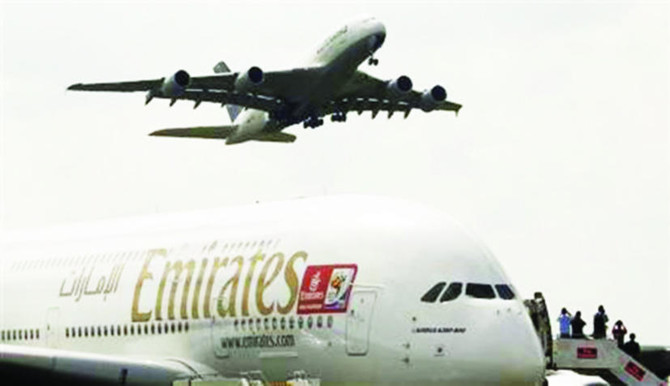
Emirates faces tough decisions over the future of the A380
Emirates faces tough decisions over the future of the A380

Latest updates


© 2026 SAUDI RESEARCH & PUBLISHING COMPANY, All Rights Reserved And subject to Terms of Use Agreement.