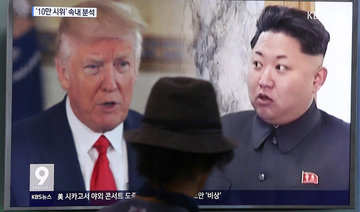
BEDMINSTER, USA: Not backing down, President Donald Trump warned Kim Jong Un’s government on Thursday to “get their act together” or face extraordinary trouble, and suggested his earlier threat to unleash “fire and fury” on North Korea was too mild.
“Maybe that statement wasn’t tough enough,” Trump said, in the latest US salvo in an escalating exchange of threats between the nuclear-armed nations.
A day after North Korea laid out plans to strike near Guam with unsettlingly specificity, there was no observable march toward combat, despite the angry rhetoric from both sides. US officials said there was no major movement of US military assets to the region, nor were there signs Pyongyang was actively preparing for war.
Trump declined to say whether the US is considering a pre-emptive military strike as he spoke to reporters before a briefing with his top national security advisers at his New Jersey golf resort.
The president insisted the North had been “getting away with a tragedy that can’t be allowed.”
“North Korea better get their act together, or they are going to be in trouble like few nations have ever been in trouble,” Trump said, flanked by Vice President Mike Pence. Accusing his predecessors of insufficient action, Trump said it was time somebody stood up to the pariah nation.
Though tensions have been building for months amid new missile tests by the North, the pace has intensified since the UN Security Council on Saturday passed sweeping new sanctions Trump had requested. The sanctions prompted the new heated volley of rhetoric.
In the latest move by North Korea, its military announced a detailed plan to fire four Hwasong-12 missiles over Japan and into waters around the tiny US territory of Guam, home to two US bases and 160,000 people.
North Korea said its military would finalize the plan by mid-August, then wait for Kim’s order. US allies Japan and South Korea quickly vowed a strong reaction if the North were to follow through.
Trump echoed that threat Thursday, insisting if North Korea took any steps to attack Guam, its leaders would have reason to be nervous.
“Things will happen to them like they never thought possible, OK?” Trump said. He did not specify what they might be.
Military analysts said it was unusual for Pyongyang to give such a precise target for a military action. Still, there were no signs that North Korea was seriously mobilizing its population for war, such as by pulling workers from factories or putting the army on formal alert.
“There’s a lot of theater to this whole thing,” said Bob Carlin, former Northeast Asia chief for the State Department’s intelligence arm.
Similarly, the US military gave no indications it perceived a seriously escalating threat from Pyongyang, such as moving to evacuate American personnel or their families from Guam, where there are 7,000 US troops, or South Korea, where there are 28,000.
And US officials insisted no significant number of troops, ships, aircraft or other assets were being directed to the region, beyond any that had been previously scheduled. The officials weren’t authorized to discuss military planning publicly and requested anonymity.
Trump said he would soon announce a request for a budget increase of “billions of dollars” for anti-missile systems.
But as it is, the US has a robust military presence in the region, including six B-1 bombers in Guam and Air Force fighter jet units in South Korea, plus other assets across the Pacific Ocean and in the skies above. Washington’s vast military options range from nothing to a full-on conventional assault by air, sea and ground forces. Any order by the president could be executed quickly.
Current and former US officials said if war did come, the US and its allies would likely hit hard and fast, using air strikes, drone operations and cyberattacks aimed at military bases, air bases, missile sites, artillery, communications, command and control headquarters and intelligence gathering and surveillance capabilities.
Key threats would be North Korea’s small but capable navy, including its submarines that can move quietly and attack. And Pyongyang also has significant cyber abilities, although not as sophisticated as America’s. The North has also been preparing for ground war for decades, and would be a formidable force on the border.
“Do I have military options? Of course I do. That’s my responsibility,” Defense Secretary Jim Mattis said Wednesday. But he said the Trump administration wants “to use diplomacy.”
To that end, Trump said he “of course” would always consider negotiations with North Korea, but added that talks have failed for the last 25 years. Secretary of State Rex Tillerson, in Asia this week, said North Korea could signal it was ready for such talks by halting any missile tests for an extended period.
North Korea’s specific threat affecting Guam said it would involve the Hwasong-12, an intermediate-range ballistic missile first revealed at a military parade in April and believed to have a radius of more than 3,700 kilometers (2,300 miles). The North said four of the missiles would hit waters 30 to 40 kilometers (18 to 24 miles) from Guam.
“We keep closely watching the speech and behavior of the US,” read a military statement carried by official state-run media.
Guam lies about 2,100 miles (3,400 kilometers) from the Korean Peninsula, and it’s extremely unlikely Kim’s government would risk annihilation with a pre-emptive attack on US citizens. It’s also unclear how reliable North Korea’s missiles would be against such a distant target, given that its military has struggled to target effectively in the past.