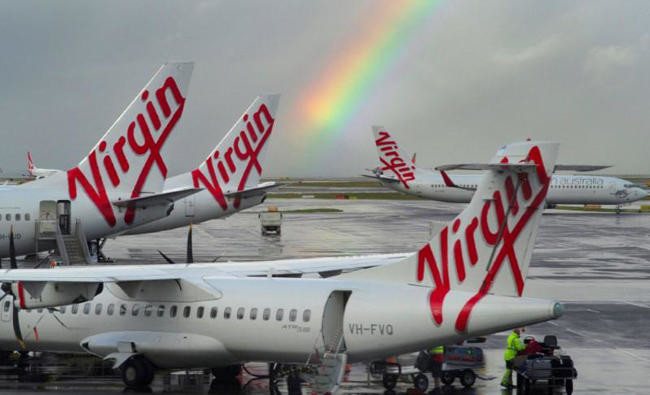
SINGAPORE: Virgin Australia Holdings, the country’s second-biggest airline, reported a smaller-than-expected annual loss and said its outlook had brightened with a surge in business confidence driving up corporate traffic.
In positive signs not only for Virgin but also larger rival Qantas Airways, Virgin CEO John Borghetti said the corporate market had improved in the fourth quarter ended June and the momentum was continuing in the current quarter.
A measure of Australian business conditions hit its highest since early 2008 in July as sales and profits stayed strong, while firms turned more confident the purple patch would last for some time yet.
“Business travel seems to have picked up more than leisure travel,” Borghetti told reporters. He said yields, a measure of ticket prices, were improving as a result.
Business travel tends to be more lucrative than leisure travel because of the higher ticket prices typically charged for bookings made closer to the flight date.
Virgin reported an underlying annual loss before tax of 3.7 million Australian dollars ($2.92 million), versus an average forecast for a 22 million Australian dollars loss from five analysts polled by Thomson Reuters.
The statutory net loss after tax for the year to June 30 was 185.8 million Australian dollars, versus a 224.7 million Australian dollars loss a year ago.
Virgin shares jumped 5.7 percent to close at an eight-week high, while the broader market eased 0.1 percent.
Qantas shares closed 2.5 percent higher, with Citi analysts saying the Virgin results were encouraging for the strength of the domestic market.
“We expect the domestic duopoly will likely continue with rational capacity management as well as fare increases over the next 12 months,” the analysts said in a note to clients.
Borghetti said Virgin, partly owned by British entrepreneur Richard Branson, was ahead of schedule on its cost-cutting program and was increasing its targeted savings by 50 million Australian dollars, to 350 million Australian dollars a year.
While business confidence is strong, Australian consumer sentiment slipped to its lowest rate in more than a year in August as worries over family finances swamped increasing optimism about the economic outlook.
Virgin and Qantas have cut capacity in response to weak domestic demand, while also adding routes to the lucrative China market.
Last month, the International Monetary Fund (IMF) revised up its economic growth forecast for China on expectations Beijing would maintain high levels of public investment.
In a separate statement, Virgin said it had received authorization from the Australian Competition and Consumer Commission for its alliance with HNA Aviation, Hong Kong Airlines and HK Express for a five-year term.
Virgin began flying from Melbourne to Hong Kong last month and plans to add routes to mainland China.

Virgin Australia posts narrower loss, corporate travel spike brightens outlook
First EU–Saudi roundtable on critical raw materials reflects shared policy commitment
RIYADH: The EU–Saudi Arabia Business and Investment Dialogue on Advancing Critical Raw Materials Value Chains, held in Riyadh as part of the Future Minerals Forum, brought together senior policymakers, industry leaders, and investors to advance strategic cooperation across critical raw materials value chains.
Organized under a Team Europe approach by the EU–GCC Cooperation on Green Transition Project, in coordination with the EU Delegation to Saudi Arabia, the European Chamber of Commerce in the Kingdom and in close cooperation with FMF, the dialogue provided a high-level platform to explore European actions under the EU Critical Raw Materials Act and ResourceEU alongside the Kingdom’s aspirations for minerals, industrial, and investment priorities.
This is in line with Saudi Vision 2030 and broader regional ambitions across the GCC, MENA, and Africa.
ResourceEU is the EU’s new strategic action plan, launched in late 2025, to secure a reliable supply of critical raw materials like lithium, rare earths, and cobalt, reducing dependency on single suppliers, such as China, by boosting domestic extraction, processing, recycling, stockpiling, and strategic partnerships with resource-rich nations.
The first ever EU–Saudi roundtable on critical raw materials was opened by the bloc’s Ambassador to the Kingdom, Christophe Farnaud, together with Saudi Deputy Minister for Mining Development Turki Al-Babtain, turning policy alignment into concrete cooperation.
Farnaud underlined the central role of international cooperation in the implementation of the EU’s critical raw materials policy framework.
“As the European Union advances the implementation of its Critical Raw Materials policy, international cooperation is indispensable to building secure, diversified, and sustainable value chains. Saudi Arabia is a key partner in this effort. This dialogue reflects our shared commitment to translate policy alignment into concrete business and investment cooperation that supports the green and digital transitions,” said the ambassador.
Discussions focused on strengthening resilient, diversified, and responsible CRM supply chains that are essential to the green and digital transitions.
Participants explored concrete opportunities for EU–Saudi cooperation across the full value chain, including exploration, mining, and processing and refining, as well as recycling, downstream manufacturing, and the mobilization of private investment and sustainable finance, underpinned by high environmental, social, and governance standards.
From the Saudi side, the dialogue was framed as a key contribution to the Kingdom’s industrial transformation and long-term economic diversification agenda under Vision 2030, with a strong focus on responsible resource development and global market integration.
“Developing globally competitive mineral hubs and sustainable value chains is a central pillar of Saudi Vision 2030 and the Kingdom’s industrial transformation. Our engagement with the European Union through this dialogue to strengthen upstream and downstream integration, attract high-quality investment, and advance responsible mining and processing. Enhanced cooperation with the EU, capitalizing on the demand dynamics of the EU Critical Raw Materials Act, will be key to delivering long-term value for both sides,” said Al-Babtain.
Valere Moutarlier, deputy director-general for European industry decarbonization, and directorate-general for the internal market, industry, entrepreneurship and SMEs at European Commission, said the EU Critical Raw Materials Act and ResourceEU provided a clear framework to strengthen Europe’s resilience while deepening its cooperation with international partners.
“Cooperation with Saudi Arabia is essential to advancing secure, sustainable, and diversified critical raw materials value chains. Dialogues such as this play a key role in translating policy ambitions into concrete industrial and investment cooperation,” she added.