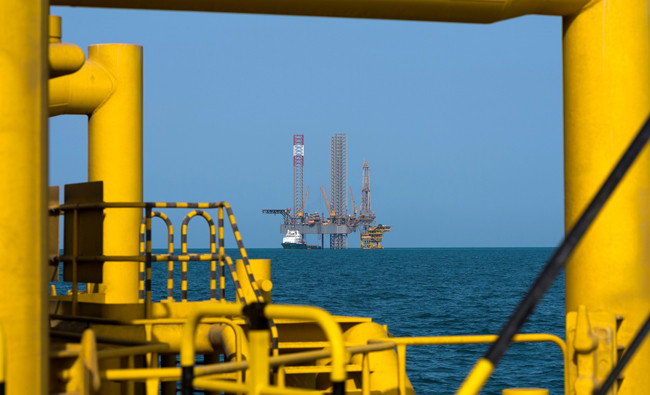


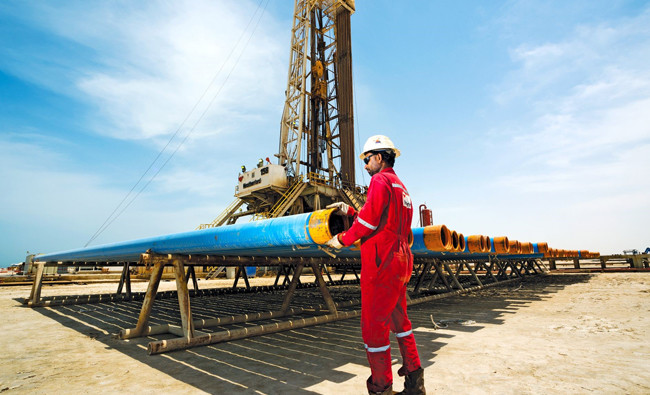
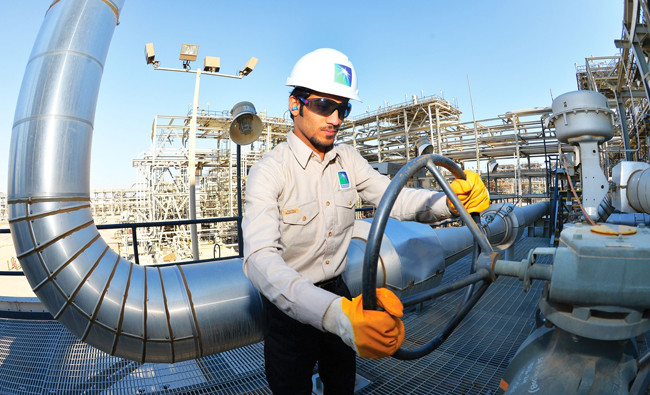
Manifa, Saudi Aramco’s oil field in the Arabian Gulf some 200 kilometers northwest of Dammam, is a standout on many fronts — not least for its unique combination of onshore and offshore development, a causeway and other environmentally friendly engineering solutions in a single, massively challenging and complex megaproject.
But while one of the world’s largest oil fields captures global attention for its ingenuity and record-breaking feats, Manifa represents much more.
Manifa is testament to Saudi Aramco’s energy commitment, helping economies around the world attain prosperity and people everywhere reach for a better standard of living. It reflects the company’s focus on making its resources more accessible, useful and sustainable. And it highlights the tremendous talent that made this miracle of environmentally sensitive engineering possible.
Black gold in the bay
In 1957, Aramco — the predecessor to Saudi Aramco — drilled Manifa No. 1, a wildcat well in the crystal waters of Manifa Bay. This exploratory venture resulted in the discovery of a field spanning 800 square kilometers and blanketed by a shallow sea teeming with marine life. Initially, Aramco accessed Manifa’s vast resources using traditional shallow-water offshore technologies, and within a decade the field was producing 125,000 barrels of oil per day. However, production was halted in 1984 due to low demand for Arabian heavy crude.
Twenty-one years later, a rise in global demand for oil — but now, especially Arabian Heavy crude — led to the field’s decidedly unconventional redevelopment.
Saudi Aramco was faced with a question: How to economically develop a multibillion barrel, near-shore oil field in a shallow bay while protecting the environment and the bay’s ecological diversity?
The solution was as simple as it is astonishing: Create an onshore field where an offshore field used to be.
Building a new archipelago
An intensive planning phase to develop the field in the most economical and environmentally friendly manner was initiated in 2006.
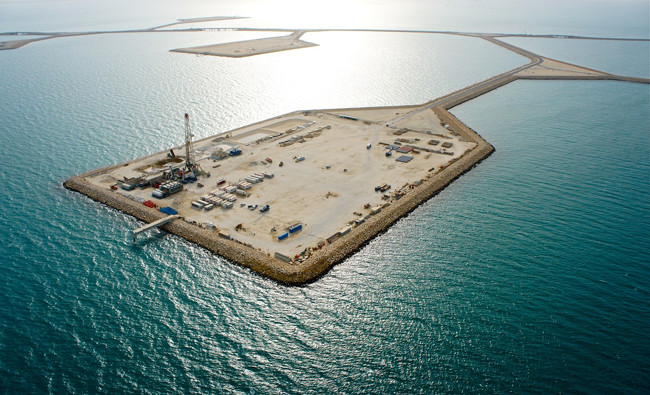
Taking into consideration shallow depth and the bay’s associated ecology, Saudi Aramco designers and engineers decided to convert more than 70 percent of the field to onshore, avoiding as far as possible the numerous offshore platforms and extensive dredging typically required in a coastal environment.
This conversion required the construction of 27 man-made islands, each the size of 10 soccer fields — and all connected by a 41-kilometer causeway. Ultimately, more than 45 million cubic meters of sand would be reclaimed from the seabed to create Manifa’s archipelago.
By 2010, construction of the islands and causeway was completed. In 2013, production at Manifa Bay began three months ahead of schedule – and ended under budget.
A world-class feat of engineering
Few companies possess this range of experience and expertise.
Given the difficulties in sustainably extracting hydrocarbons from an ecologically vital offshore environment, the project showcased Saudi Aramco’s command of leading technologies in infrastructure operations, drilling, and production — and its creative approach to problem-solving.
In roughly five years, Saudi Aramco created an “onshore” oil field capable of producing up to 900,000 barrels per day (bpd), with the ability to transport production seamlessly and safely back to shore for refining and processing. These and other milestones were realized while logging nearly 80 million injury-free working hours.
Preserving a highly sensitive ecosystem
Manifa Bay is a jewel of the Saudi Arabian coastline, its emerald waters host over 85 different species of fish and some 50 species of coral. In planning the Manifa mega-project, Saudi Aramco undertook a series of hydrodynamic and ecological studies to determine the best method of drilling and producing oil while maintaining this habitat, which has supported fishermen and pearl divers for centuries.
The causeway’s design has enhanced the natural circulation of tidal waters into and out of Manifa Bay. The time required to recirculate half the area’s nutrient- and oxygen-rich water was determined to be 17 days, but computerized modeling of the drilling islands and the location of the causeway and bridges actually decreased that flushing time. The results indicated higher dissolved-oxygen rates than prior to construction — and a healthier environment for fish and shrimp larvae.
In another innovation, the arteries connecting the islands act as a scaffold for marine life, attracting birds, crabs, and other creatures to the bay. As a result of this support, coral reefs have grown and seem to be spreading onto the rocks of the Manifa causeway itself. Seagrass meadows also have increased by some 70 percent. Besides protecting the delicate ecosystems of Manifa Bay, these and other environmental considerations provide enhancements to the fishing industry that remains a mainstay of the local economy.
Another sustainability breakthrough is the megaproject’s energy use — or lack thereof.
Manifa is Saudi Aramco’s first development where cogeneration of electricity not only allows for self-sufficient operations but also provides a power surplus — good stewardship that aligns with the company’s policy of conserving resources for future generations. In fact, the Manifa co-gen unit is the most efficient ever built in Saudi Arabia.
An investment in the future
As the world’s largest extended-reach hydrocarbon producer — with one of the industry’s lightest environmental footprints — Manifa field contributes considerably to Saudi Aramco’s energy leadership. But Manifa is also an investment in the Kingdom’s future.
From its textbook example of local-content development and creation of thousands of jobs to its contribution toward a technology-driven, diversified knowledge economy, Manifa reflects the transformative human ingenuity that makes the extraordinary possible.
• This report was prepared by Saudi Aramco