Lack of remorse could bite ‘Pharma Bro,’ say experts

1 / 2
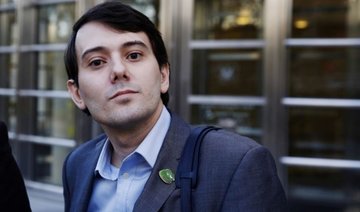
This file photo taken on June 26, 2017 shows Martin Shkreli, the former Turing Pharmaceuticals executive who became known as "Pharma Bro" arriving for the first day of jury selection in his federal securities fraud trial at United States District Court Eastern District of New York in Brooklyn. (AFP)
2 / 2
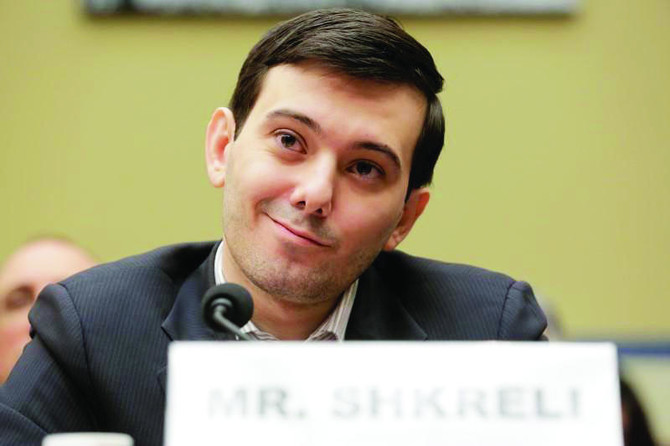
Less than an hour after a US jury convicted Martin Shkreli of securities fraud, the so-called ‘Pharma Bro’ was back at his New York City apartment trash talking in a live-stream on YouTube. (Reuters)
Updated 06 August 2017
Follow

Lack of remorse could bite ‘Pharma Bro,’ say experts

NEW YORK: Less than an hour after a US jury convicted Martin Shkreli of securities fraud, the so-called “Pharma Bro” was back at his New York City apartment doing what comes naturally: Trash talking in a live-stream on YouTube.
The brash former pharmaceutical CEO, who’s still out on bail, joked he won’t be going to a hard-core prison — “No shanks” — and predicted his acquittal on some charges Friday will help him recover tens of millions of dollars he claims he’s owed from a drug company he started.
“It doesn’t seem like life will change much for Martin Shkreli,” he said. “I’m one of the richest New Yorkers there is, and after today’s verdict, it’s going to stay that way.”
Shkreli’s trolling of his own trial has amused some onlookers. But legal experts say it could have serious consequences when it comes time for sentencing.
“No real good can come from going on YouTube after a guilty verdict,” said Robert Mintz, a former federal prosecutor now in private practice. “This is exactly the kind of behavior that got him in trouble in the first place.”
US District Judge Kiyo Matsumoto likely will factor in any lack of remorse and contrition at sentencing in federal court in Brooklyn, said Matthew Schwartz, a defense lawyer and former federal prosecutor who once worked for a Securities and Exchange Commission task force.
“Going into the trial, he had an audience of 12. Now he’s got an audience of one,” Schwartz said, referring to the jury and judge. “He’s putting himself at great risk for a higher sentence.”
The 34-year-old defendant faces up to 20 years in prison for his conviction on the most serious counts, though the term could be much lower under sentencing guidelines. Shkreli’s lawyer, Ben Brafman, said he would argue for no jail time. No sentencing date was set.
Shkreli was arrested in 2015 on charges he looted a drug company he founded, Retrophin, of $11 million in stock and cash to pay back investors in two failed hedge funds he ran.
Investors took the witness stand to accuse him of keeping them in the dark as his scheme unfolded, while the defense argued there wasn’t any harm done because all of them got rich off of Retrophin stock.
Before his arrest, Shkreli was best known for buying the rights to a life-saving drug at another company in 2014 and promptly raising the price from $13.50 to $750 per pill. He also had a reputation for attacking critics on social media and was barred from Twitter for posts about a female journalist.
Even during his trial, when most criminal defendants would lay low, Shkreli stayed online commenting about his own case.
After the verdict, Brafman once again raised hopes he could rein in his client.
“There is an image issue that Martin and I are going to be discussing in the next several days. Martin is a brilliant young man, but sometimes people skills don’t translate well,” he said.
Not much later, Shkreli’s was on YouTube, answering questions about the case and cracking jokes. During his lengthy livestream, he invited one reporter up to his apartment to ask him questions on camera.
“Ben probably wants me to act and look like your average CEO, but I’m a very individualistic person and I don’t sort of conform to what folks want me to do and not want me to do, and that’s what being an individual is all about,” he said. “As long as it doesn’t interfere with the legal case, it’s my life to live.”
Without more conformity, Shkreli’s lawyer will have his work cut out for him trying convince the court that he should be cut some slack as “someone who is not entirely normal,” said Schwartz, the former prosecutor. “Whether the judge will buy it or not is another question.”
The judge’s last words to the defendant as she left the bench offered no clues.
“I wish you well, Shkreli,” she said. “See you soon.”


RLC Global Forum helping retail experts exchange knowledge around new tech, industry leaders say

Updated 6 sec ago
Follow

RLC Global Forum helping retail experts exchange knowledge around new tech, industry leaders say

RIYADH: New technologies used to improve customer experience and day-to-day operations are driving Saudi Arabia’s retail transformation, industry leaders have told Arab News during a high-profile gathering in Riyadh.

On the sidelines of the RLC Global Forum, key players in the sector spoke to Arab News about how artificial intelligence is playing an increasingly important role as tech-savvy consumers look for integration between the virtual and physical worlds.

They also praised the role of the forum in bringing stakeholders together to exchange knowledge and ideas, which is driving forward retail offerings in the Kingdom and beyond.

The two-day RLC Global Forum started on Feb. 3 under the strategic theme “Growth Crossroads,” and brought together more than 2,000 global leaders, policymakers, and innovators from over 40 countries to define the next chapter of growth across retail, consumer, and lifestyle industries.

Speaking to Arab News, Majid Al-Gothmi, acting CEO of shopping centre management company Red Malls, said: “The Saudi retail sector is changing under Vision 2030. The transformation has helped our growth.”

He agreed that digital tools, AI, and new technologies are being used to improve customer experience and day-to-day operations.

“It’s helping us a lot in actually profiling our customers, understanding them, and providing better services to the younger generation,” said Al-Gothmi.

“Gen Z constitutes a major component of the retail market. We can see that 70 percent of the consumers are Gen-Z — they do most of their shopping online, over 60 percent of them,” he added, going on to say that his company’s focus is on “future proofing” shopping malls by integrating technology along with physical space that allows people to mingle comfortably and seamlessly.

Al-Gothmi described the RLC Global Forum as “an excellent platform gathering all the developers, retailers, brands, and most importantly, policymakers.”

He added: “This is a first, I think, where they share their insights, challenges, and exchange solutions, which helps the whole industry to move faster.”

Stefania Lazzaroni, CEO of Italian luxury brands association Altagamma Foundation, told Arab News that she expects steady growth for high-end products and experiences in the Kingdom.

She said: “There’s a new trend about hospitality, fine dining, longevity, and health spa beauty. These are the key factors that are growing. And we believe fine dining, hospitality and spa health as well will be a new trend even in this area. Honestly, they have been doing well for a couple of years.”

Stefania Lazzaroni, CEO of Altagamma Foundation. AN

Lazzaroni asserted that digital tools, AI and new technologies are being used to improve customer experience, as “the luxury client is very specific about what they want.”

She added: “Artificial intelligence is really perfect for us. We have a lot of counterfeiting all around the world, so technology can really support luxury brands in protecting their brands.

“So we are very pro artificial intelligence, which is changing the game and giving more strength and potential for luxury brands.”

The CEO explained that AI is also useful for talking to Gen Z, “which will be the clients of the future.”

She added: “So today with social media, TikTok, and so forth, there is an explosion of beauty, Gen Z is very much active on this.”

Abdel-Salam Bdeir, CEO at the Saudi Co. for Hardware, agreed that the retail sector is changing under Vision 2030 transformation.

He told Arab News: “We are building new technologies for AI to be used and demand planning and inventory optimization, marketing, and pricing optimization, margin, maximization.

“Even in security cameras, communication with customers, shopping behavior targeting certain sectors of customers, we are building all that as we speak.”

Bdeir believes technological progress brings both opportunities and challenges, among them the risk of fewer jobs.

He said: “With major international platforms entering the market, not only the jobs, but money goes to other markets. That’s why the United States, UK, France, Italy, Spain, and Germany put strict regulations on international platforms first to meet safety standards for the consumer and environmental standards, and second to secure jobs for locals.

“They also put higher tariffs, customs duties, on developing markets like India, Egypt, Turkiye, Brazil, Mexico, Vietnam, Indonesia, and Malaysia.”

Bdeir added: “So what is in my opinion, necessary is for the regulators to do what European countries and developing markets did to protect jobs, consumers and the economy.”