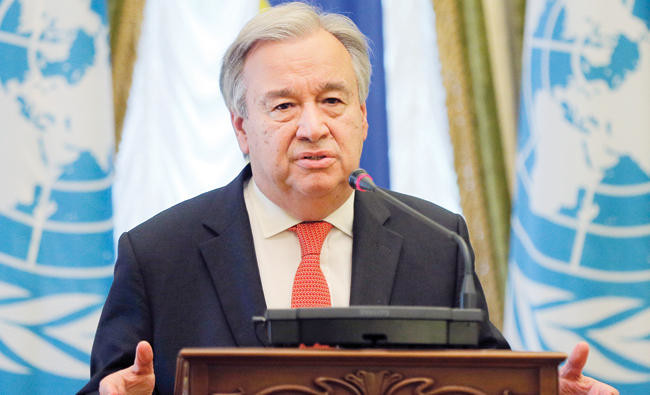
AMMAN: Palestinian officials at the UN have expressed their satisfaction at the Palestinian leg of the upcoming visit of UN Secretary-General Antonio Guterres, who will be traveling to Israel and Palestine at the end of August.
Riyad Mansour, the permanent observer of Palestine to the UN, told Arab News that the visit of the secretary-general will include meetings with Palestinians from all walks of life.
“We hope that this visit will allow the secretary-general to see first-hand the effects of Israel’s illegal settlements which the Security Council have opposed. UNSC 2334, which deals extensively with the illegal Israeli settlements, mandates the secretary to regularly report to the Security Council on steps taken to implement the resolution,” Mansour said, referencing the latest resolution passed by the Security Council.
To date, since the resolution was passed in December 2016, the mandated three-month reports have been presented by Guterres’ deputy.
“We have publicly called on the secretary to make these reports in writing so that they can become part of the official UN record,” said Mansour.
He told Arab News that Guterres will arrive in Ramallah on the morning of Aug. 28. He will meet with Palestinian tech entrepreneurs before laying a wreath at the grave of Yasser Arafat and visiting the Palestinian Museum. He will then have an official meeting with the Palestinian leadership to be followed by a joint press conference.
In addition, Mansour said, a meeting is also being arranged with independent Palestinian leaders and social activists in order to introduce Guterres to a wide spectrum of Palestinian thinking.
Guterres will also visit the besieged Gaza Strip to meet with Palestinians there, as well as members of the UN Relief and Works Agency which runs a lot of humanitarian programs in Gaza.
He will review attempts to rebuild Gaza, which — Mansour said — have been progressing “at an extremely slow rate.”
Mansour added that he hopes the secretary-general will reiterate his stated position that there is no Plan B to the two-state solution.
“If there is no Plan B, then the suspension of settlement activities throughout the occupied territories, including East Jerusalem, is essential,” he explained.
Guterres is making his first visit to the region since taking the UN helm, and will also meet Israeli officials and opposition leaders, as well as visiting Yad Vashem, the Holocaust memorial in Jerusalem.
A Palestinian Foreign Ministry official, who spoke to Arab News on condition of anonymity, said that the new secretary-general has a number of issues on his desk on which he has yet to state his position, even though they are clearly in sync with binding UN resolutions.
One of the obstacles to the work of the new secretary-general has been the pro-Israeli stance of US Ambassador to the UN Nikki Haley. In March, Haley blocked the appointment of former Palestinian Prime Minister Salam Fayyad from taking on a senior position as a peace envoy to Libya, adding that the UN was “unfairly biased in favor of the Palestinian Authority to the detriment of our allies in Israel.”
Haley later told a congressman from her state that she is against any Palestinian holding a senior position at the UN, because Palestine is not a recognized state.
American pressure on the UN secretary-general was also evident on March 17 when Guterres insisted that Jordanian diplomat Rima Khalaf withdraw a report which accused Israel of establishing “an apartheid regime that dominates the Palestinian people as a whole.”
Despite these issues, Palestinians in Ramallah and New York told Arab News that they are certain the secretary-general’s “heart is in the right place,” but that he has to always appear “balanced,” even if an issue is clear-cut.
Sources in New York also told Arab News that the UN chief’s biggest problem is not just that the US — under its current leadership — is pro-Israeli, but that it is also anti-UN.
Haley, they said, reflects the views of US President Donald Trump’s administration and other right-wing ideologues whom, the sources claimed, wish to see US contributions to the UN budget decrease and to see the UN’s power diminished.


Palestinian official hopes UN chief will see ‘effects of Israel’s illegal settlements’ during visit
Palestinian official hopes UN chief will see ‘effects of Israel’s illegal settlements’ during visit


Russian forces begin pulling out of bases in northeast Syria
- Despite having been on opposite sides of the battle lines during the civil war, the new rulers in Damascus have taken a pragmatic approach to relations with Moscow
QAMISHLI, Syria: Russian forces have begun pulling out of positions in northeast Syria in an area still controlled by the Kurdish-led Syrian Democratic Forces after the group lost most of its territory in an offensive by government forces.
Associated Press journalists visited one base next to the Qamishli airport Tuesday and found it guarded by SDF fighters who said the Russians had begun moving their equipment out in recent days.
Inside what had been living quarters for the soldiers was largely empty, with scattered items left behind, including workout equipment, protein powder and some clothing.
Ahmed Ali, an SDF fighter deployed at the facility, said the Russian forces began evacuating their positions around the airport five or six days ago, withdrawing their equipment via a cargo plane.
“We don’t know if its destination was Russia or the Hmeimim air base,” he said, referring to the main Russian base on Syria’s coast. “They still have a presence in Qamishli and have been evacuating bit by bit.”
A UN humanitarian convoy from Damascus reached Qamishli on Tuesday, UN spokesman Stéphane Dujarric said.
“It delivered food, warm clothes and blankets, among other supplies,” he told UN reporters. “More convoys are planned in the coming days.”
Dujarric said the UN is also continuing to distribute food, bread and cash elsewhere including displacement sites.
There has been no official statement from Russia about the withdrawal of its forces from Qamishli.
Russia has built relations with the new central Syrian government in Damascus since former President Bashar Assad was ousted in December 2024 in a rebel offensive led by now-interim President Ahmad Al-Sharaa — despite the fact that Moscow was a close ally of Assad.
Moscow’s scorched-earth intervention in support of Assad a decade ago turned the tide of Syria’s civil war at the time, keeping Assad in his seat. Russia didn’t try to counter the rebel offensive in late 2024 but gave asylum to Assad after he fled the country.
Despite having been on opposite sides of the battle lines during the civil war, the new rulers in Damascus have taken a pragmatic approach to relations with Moscow. Russia has retained a presence at its air and naval bases on the Syrian coast.
Al-Sharaa is expected to visit Moscow on Wednesday and meet with Putin.
Fighting broke out early this month between the SDF and government forces after negotiations over a deal to merge their forces together broke down. A ceasefire is now in place and has been largely holding.
After the expiration of a four-day truce Saturday, the two sides announced the ceasefire had been extended by another 15 days.
Syria’s defense ministry said in a statement that the extension was in support of an operation by US forces to transfer accused Daesh militants who had been held in prisons in northeastern Syria to detention centers in Iraq.


