HYNDMAN, Pennsylvania: Nearly three dozen cars of a freight train carrying hazardous materials careened off the tracks in a small Pennsylvania town Wednesday, igniting fires in some rail cars and a garage and forcing emergency officials to evacuate the whole town.
No injuries were reported.
At least 32 cars on the CSX freight train derailed about 5 a.m. in Hyndman, about 100 miles (161 kilometers) southeast of Pittsburgh, said CSX spokesman Rob Doolittle. The train was traveling from Chicago to Selkirk, New York.
At least one car containing liquid petroleum gas, and one containing molten sulfur leaked and caught fire, Doolittle said. A residential garage struck during the derailment also caught fire, officials said.
It was not immediately known what caused the train to run off the rails, and the fire continued to burn hours after the derailment.
The only confirmed structure fire was at the garage, but video from the scene seems to show more extensive damage.
Aerial footage of the derailment shows a number of cars stacked nearly perpendicular to the tracks while others landed in a burning, zig-zag pattern in a residential area where some structures seemed crushed and other ablaze.
Hyndman resident Jim Shaffer told the (Cumberland) Times-News he was awakened by the sound of crashing rail cars.
“It woke me up. It was louder than a thunderstorm,” he said. “I heard the cars banging into each other. Then I heard the fire whistle.”
Bedford County 911 coordinator Harry Corley said officials ordered everyone within a 1-mile radius of the derailment to leave hours after the derailment. The order encompasses the entire town of Hyndman, and residents have been directed to a local church for help with lodging and food.
Democratic Gov. Tom Wolf, in a phone interview from the evacuation center several miles away from the train, said some neighbors have refused to leave their homes.
“But everyone knows where they are and they’re safe at this point,” Wolf said Wednesday afternoon.
Only a few people were in the church, as most evacuees chose to go to hotels or the homes of friends or relatives, he said.
Wolf said officials were conducting air and ground studies to determine possible health effects.
He said area residents have “a lot of uncertainty and everyone’s hoping for the best, praying for the best.”
Asked about the risk of a propane explosion, Wolf said, “There’s always that possibility. I think, from what I hear, the potential of that happening has diminished somewhat.”
A number of roads are closed, and some flight restrictions are in place.
Amtrak suspended train service between Pittsburgh and Washington, D.C., providing buses to take passengers between the two stations.
“CSX apologizes for the impact that this incident is having on the residents of Hyndman,” Doolittle said.
Hyndman is a town of just over 800 residents near the Maryland border.
“CSX’s top priority is to work cooperatively with first responders and other officials to protect the public’s safety, and CSX personnel are on the scene assisting first responders, providing information about the contents of the train and expertise on responding to railroad incidents,” Doolittle said.


Town evacuated after freight train derails, catches fire
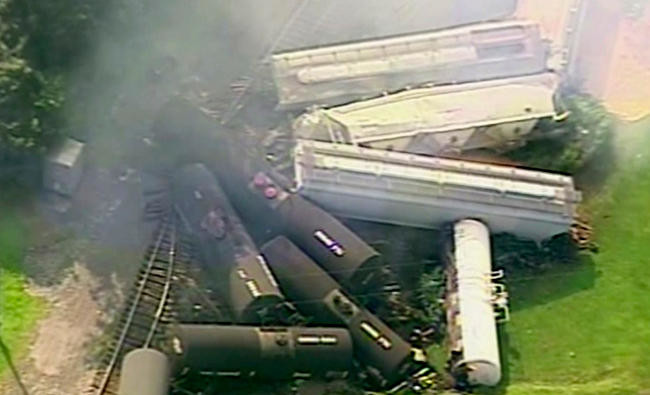
Town evacuated after freight train derails, catches fire



House Republicans barely defeat Venezuela war powers resolution to check Trump’s military actions
WASHINGTON: The House rejected a Democratic-backed resolution Thursday that would have prevented President Donald Trump from sending US military forces to Venezuela after a tied vote on the legislation fell just short of the majority needed for passage.
The tied vote was the latest sign of Republican House Speaker Mike Johnson’s tenuous hold on the majority, as well as some of the growing pushback in the GOP-controlled Congress to Trump’s aggressions in the Western Hemisphere. A Senate vote on a similar resolution was also tied last week until Vice President JD Vance broke the deadlock.
To defeat the resolution Thursday, Republican leaders had to hold the vote open for more than 20 minutes while Republican Rep. Wesley Hunt, who had been out of Washington all week campaigning for a Senate seat in Texas, rushed back to Capitol Hill to cast the decisive vote.
On the House floor, Democrats responded with shouts that Republican leaders were violating the chamber’s procedural rules. Two Republicans — Reps. Don Bacon of Nebraska and Thomas Massie of Kentucky — voted with all Democrats for the legislation.
The war powers resolution would have directed Trump to remove US troops from Venezuela. The Trump administration told senators last week that there are no US troops on the ground in the South American nation and committed to getting congressional approval before launching major military operations there.
But Democrats argued that the resolution is necessary after the US raid to capture Venezuelan leader Nicolás Maduro and since Trump has stated plans to control the country’s oil industry for years to come.
The response to Trump’s foreign policy
Thursday’s vote was the latest test in Congress of how much leeway Republicans will give a president who campaigned on removing the US from foreign entanglements but has increasingly reached for military options to impose his will in the Western Hemisphere. So far, almost all Republicans have declined to put checks on Trump through the war powers votes.
Rep. Brian Mast, the Republican chair of the House Armed Services Committee, accused Democrats of bringing the war powers resolution to a vote out of “spite” for Trump.
“It’s about the fact that you don’t want President Trump to arrest Maduro, and you will condemn him no matter what he does, even though he brought Maduro to justice with possibly the most successful law enforcement operation in history,” Mast added.
Still, Democrats stridently argued that Congress needs to assert its role in determining when the president can use wartime powers. They have been able to force a series of votes in both the House and Senate as Trump, in recent months, ramped up his campaign against Maduro and set his sights on other conflicts overseas.
“Donald Trump is reducing the United States to a regional bully with fewer allies and more enemies,” Rep. Gregory Meeks, the top Democrat on the House Foreign Affairs Committee, said during a floor debate. “This isn’t making America great again. It’s making us isolated and weak.”
Last week, Senate Republicans were only able to narrowly dismiss the Venezuela war powers resolution after the Trump administration persuaded two Republicans to back away from their earlier support. As part of that effort, Secretary of State Marco Rubio committed to a briefing next week before the Senate Foreign Relations Committee.
Yet Trump’s insistence that the US will possess Greenland over the objections of Denmark, a NATO ally, has alarmed some Republicans on Capitol Hill. They have mounted some of the most outspoken objections to almost anything the president has done since taking office.
Trump this week backed away from military and tariff threats against European allies as he announced that his administration was working with NATO on a “framework of a future deal” on Arctic security.
But Bacon still expressed frustration with Trump’s aggressive foreign policy and voted for the war powers resolution even though it only applies to Venezuela.
“I’m tired of all the threats,” he said.
Trump’s recent military actions — and threats to do more — have reignited a decades-old debate in Congress over the War Powers Act, a law passed in the early 1970s by lawmakers looking to claw back their authority over military actions.
The war powers debate
The War Powers Resolution was passed in the Vietnam War era as the US sent troops to conflicts throughout Asia. It attempted to force presidents to work with Congress to deploy troops if there hasn’t already been a formal declaration of war.
Under the legislation, lawmakers can also force votes on legislation that directs the president to remove US forces from hostilities.
Presidents have long tested the limits of those parameters, and Democrats argue that Trump in his second term has pushed those limits farther than ever.
The Trump administration left Congress in the dark ahead of the surprise raid to capture Maduro. It has also used an evolving set of legal justifications to blow up alleged drug boats and seize sanctioned oil tankers near Venezuela.
Democrats question who gets to benefit from Venezuelan oil licenses
As the Trump administration oversees the sale of Venezuela’s petroleum worldwide, Senate Democrats are also questioning who is benefiting from the contracts.
In one of the first transactions, the US granted Vitol, the world’s largest independent oil broker, a license worth roughly $250 million. A senior partner at Vitol, John Addison, gave roughly $6 million to Trump-aligned political action committees during the presidential election, according to donation records compiled by OpenSecrets.
“Congress and the American people deserve full transparency regarding any financial commitments, promises, deals, or other arrangements related to Venezuela that could favor donors to the President’s campaign and political operation,” 13 Democratic senators wrote to White House Chief of Staff Susie Wiles Thursday in a letter led by Democratic Sen. Adam Schiff of California.
The White House has said it is safeguarding the South American country’s oil for the benefit of both the people of Venezuela and the US


