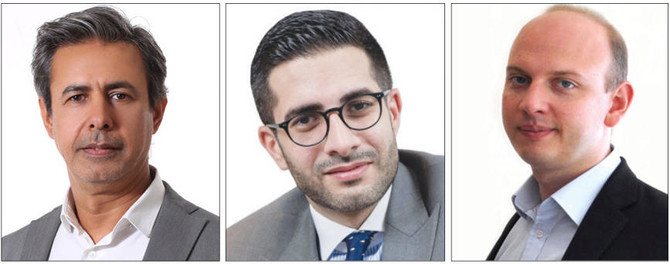
Arab News appoints Baker Atyani to run Asia operations, Ben Flanagan to run London bureau

Baker Atyani (left), Faisal J. Abbas (middle), and Ben Flanagan.
Updated 02 August 2017
Follow

Arab News appoints Baker Atyani to run Asia operations, Ben Flanagan to run London bureau

JEDDAH: Arab News, the Middle East’s leading English-language daily, has launched bureaus in Europe and Asia as part of its ongoing global, digital expansion.
The multimedia news-gathering hubs, run by two veteran journalists with decades of experience in the field, will contribute to the print edition and website www.arabnews.com.
Award-winning journalist Baker Atyani — an expert on terrorism and militant groups in Asia, having covered conflict zones on the continent for the past two decades — will lead the Southeast Asia bureau.
Throughout his career, Atyani has had several exclusives, including an interview with Al-Qaeda leader Osama bin Laden before the 9/11 terror attacks.
On assignment in 2012, Atyani was kidnapped by one of the sub factions of the Abu Sayyaf Group in the Sulu Islands in southern Philippines. He was held for 18 months before being freed in December 2013.
Atyani was honored by the UN in December 2013 for his contributions to journalism, while the May Chidiac Foundation (MCF) gave him the “Exceptional Courage in Journalism” award in September 2014. Atyani will spearhead Arab News’ coverage of Asia, across print, online and video with a particular focus on India, Pakistan, Afghanistan, Malaysia, Indonesia and the Philippines.
In addition, Arab News senior editor Ben Flanagan has been promoted to become the paper’s first London bureau chief. Upon being fully staffed, the London operation will cover the UK and Europe from an Arab perspective, with a particular focus on politics, business and investment. It will also serve as a digital hub for the newspaper.
Flanagan has 16 years’ experience working on national newspapers and news portals in Europe and the Middle East, and has reported from numerous countries including Saudi Arabia, the UAE, Lebanon, Singapore, India and the US.
He started his career in London at The Observer, part of the Guardian Media Group, and the world’s oldest Sunday newspaper.
Faisal J. Abbas, Editor-in-Chief of Arab News, said that the new bureaus support the newspaper’s “more digital, more global” strategy.
“It is a great pleasure for us to have these two exceptionally experienced, incredibly capable journalists heading up our crucial Asia and UK operations, this inevitably adds much value to our readers who will be sure to get the best relevant content and stories from these regions,” said Abbas.
Arab News is part of the regional publishing giant Saudi Research and Marketing Group (SRMG). It has been the English newspaper of record for Saudi Arabia and the region for over 40 years.


UK, France mull social media bans for youth as debate rages

Updated 19 January 2026
Follow

UK, France mull social media bans for youth as debate rages

  • Countries including France and Britain are considering following Australia’s lead by banning children and some teenagers from using social media

PARIS: Countries including France and Britain are considering following Australia’s lead by banning children and some teenagers from using social media, but experts are still locked in a debate over the effectiveness of the move.
Supporters of a ban warn that action needs to be taken to tackle deteriorating mental health among young people, but others say the evidence is inconclusive and want a more nuanced approach.
Australia last month became the first nation to prohibit people under-16s from using immensely popular and profitable social media platforms such as Instagram, Facebook, Tiktok and YouTube.
France is currently debating bills for a similar ban for under-15s, including one championed by President Emmanuel Macron.
The Guardian reported last week that Jonathan Haidt, an American psychologist and supporter of the Australian ban, had been asked to speak to UK government officials.
Haidt argued in his bestselling 2024 book “The Anxious Generation” that too much time looking at screens — particularly social media — was rewiring children’s brains and “causing an epidemic of mental illness.”
While influential among politicians, the book has proven controversial in academic circles.
Canadian psychologist Candice Odgers wrote in a review of the book that the “scary story” Haidt was telling was “not supported by science.”
One of the main areas of disagreement has been determining exactly how much effect using social media has on young people’s mental health.
Michael Noetel, a researcher at the University of Queensland in Australia, told AFP that “small effects across billions of users add up.”
There is “plenty of evidence” that social media does harm to teens, he said, adding that some were demanding an unrealistic level of proof.
“My read is that Haidt is more right than his harshest critics admit, and less right than his book implies,” Noetel said.
Given the potential benefit of a ban, he considered it “a bet worth making.”
After reviewing the evidence, France’s public health watchdog ANSES ruled last week that social media had numerous detrimental effects for adolescents — particularly girls — while not being the sole reason for their declining mental health.
Everything in moderation?
Noetel led research published in Psychological Bulletin last year that reviewed more than 100 studies worldwide on the links between screens and the psychological and emotional problems suffered by children and adolescents.
The findings suggested a vicious cycle.
Excessive screen time — particularly using social media and playing video games — was associated with problems. This distress then drove youngsters to look at their screens even more.
However, other researchers are wary of a blanket ban.
Ben Singh from the University of Adelaide tracked more than 100,000 young Australians over three years for a study published in JAMA Pediatrics.
The study found that the young people with the worst wellbeing were those who used social media heavily — more than two hours a day — or not at all. It was teens who used social networks moderately that fared the best.
“The findings suggest that both excessive restriction and excessive use can be problematic,” Singh told AFP.
Again, girls suffered the most from excessive use. Being entirely deprived of social media was found to be most detrimental for boys in their later teens.
’Appallingly toxic’
French psychiatrist Serge Tisseron is among those who have long warned about the huge threat that screens pose to health.
“Social media is appallingly toxic,” he told AFP.
But he feared a ban would easily be overcome by tech-savvy teens, at the same time absolving parents of responsibility.
“In recent years, the debate has become extremely polarized between an outright ban or nothing at all,” he said, calling for regulation that walks a finer line.
Another option could be to wait and see how the Australian experiment pans out.
“Within a year, we should know much more about how effective the Australian social media ban has been and whether it led to any unintended consequences,” Cambridge University researcher Amy Orben said.
Last week, Australia’s online safety watchdog said that tech companies have already blocked 4.7 million accounts for under 16s.