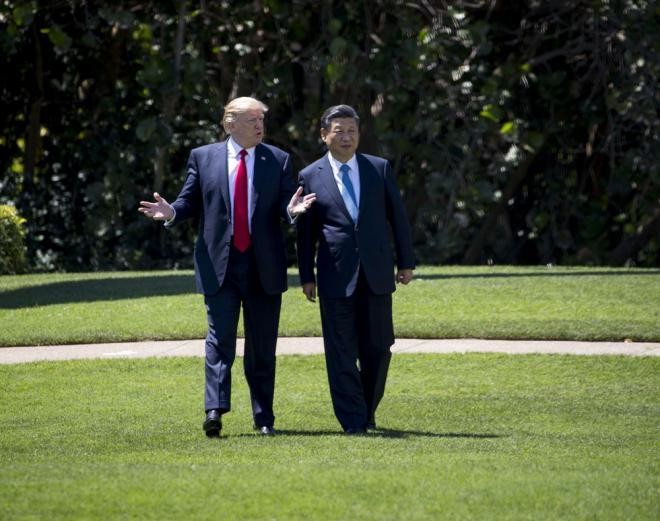
BEIJING: China said Monday the US should not link trade to discussions about North Korea’s nuclear program, after President Donald Trump accused Beijing of taking no action on Pyongyang despite profiting from business with America.
“We believe that the North Korea nuclear issue and China-US trade are two issues that are in two completely different domains,” Chinese Vice Minister of Commerce Qian Keming told a press briefing, adding the issues “are not related, and should not be discussed together.”
“In general, China-US trade, including mutual investment, is mutually beneficial, and both China and the United States have gained great profits from bilateral trade and investment cooperations,” he said.
The comments came in response to a question about tweets from Trump Saturday warning that he would no longer allow China to “do nothing” on North Korea, after the hermit state launched its second intercontinental ballistic missile test.
Trump, who is at loggerheads with Beijing over how to handle Kim’s regime, has repeatedly urged China to rein in its recalcitrant neighbor, but Beijing insists dialogue is the only practical way forward.
In his critique, Trump linked trade woes with the Asian giant to policy on North Korea, after South Korea indicated it was speeding up the deployment of a US missile defense system (THAAD) that has infuriated China.
“I am very disappointed in China. Our foolish past leaders have allowed them to make hundreds of billions of dollars a year in trade, yet they do NOTHING for us with North Korea, just talk,” Trump wrote.
“We will no longer allow this to continue. China could easily solve this problem!“
The president’s tweets coincided with a 10-hour bilateral mission that saw US B-1B bombers along with fighter jets from the South Korean and Japanese air forces practice intercept and formation drills.
It was followed Sunday by the successful test of a THAAD missile defense system in Alaska.
China, Pyongyang’s main economic and diplomatic ally, opposes any military intervention and calls for a resolution through dialogue.
It has also long argued that the THAAD deployment in South Korea will destabilize the region.
On trade, the United States has blamed the unbalanced relationship — marked by a trade deficit with China of $309 billion last year — on Beijing’s policies that impede access to their market.
China says Washington’s own rules restricting US high-tech exports are partially to blame.
dly/yan/eb


China tells Trump not to link trade to N. Korea
China tells Trump not to link trade to N. Korea

In rare overlap, Chinese Muslims observe Ramadan with Lunar New Year
- Lunar New Year started on Feb. 17 and is celebrated for another two weeks
- Chinese Indonesians make up about 3 percent of the Indonesian population
JAKARTA: Every year, on the first day of Lunar New Year, Febriani visits relatives and gathers for a feast with her Chinese Muslim family, part of a long-standing tradition honoring their ethnic heritage.
But this year, as Thursday marks the beginning of Ramadan, she is celebrating two important occasions within the same week, in a rare overlap that last took place in 1995.
“I’m very happy and grateful that Lunar New Year and Ramadan are celebrated so closely. I observe both every year, so it’s truly special,” she told Arab News.
Widely observed across Asia, the Lunar New Year or Chinese New Year festival is believed to date back to the 14th century B.C., to the times of the Shang Dynasty, China’s earliest ruling dynasty, when people celebrated good harvests.
In 2026, it started on Feb. 17 and is celebrated for another two weeks. For many, celebrations typically involve elaborate feasts, giving children pocket money in red envelopes, and watching dragon dance parades.
In Indonesia, Chinese-descent citizens make up an estimated 3 percent of the country’s Muslim-majority population of more than 280 million. While most are either Buddhists or Christians, a small minority professes Islam.
For 25-year-old Febriani, both Lunar New Year and Ramadan are equally meaningful.
“The two celebrations teach us to strengthen bonds, to share with one another, and to become closer to family,” she said.
“They are both important to me because they happen only once every year and they’re always an occasion to gather with the extended family. It is also a chance to self-reflect and strengthen relationships with your loved ones.”
For Naga Kunadi, whose family lives in Central Java’s Cepu district, Chinese New Year is all about embracing his ethnic identity.
Earlier in the week, his family was busy preparing for the new year’s feast, which was a fusion of Chinese and Indonesian dishes, such as claypot tofu, meatball soup and shumai, or steamed dumplings.
“To celebrate Chinese New Year, we prepared halal Chinese food at home. It’s also a way to introduce to my children the traditions from our Chinese side, but there’s a bit of a fusion because my wife is Javanese,” Kunadi told Arab News.
Kunadi, an Islamic teacher at the Lautze Mosque in Jakarta, sees both Chinese New Year and Ramadan as opportunities to teach important life values for his two children.
Upholding Chinese New Year traditions with his family is for him a way of preserving his ethnic heritage.
“We want to preserve cultural values as long as it does not clash with our religion,” he said.
“If we leave our culture behind, we might lose our identity, so this is something I want to teach my children.”
The fasting month of Ramadan, on the other hand, gives him a chance to teach and practice honesty.
“I want to focus on the religious and moral aspects during the holy month of Ramadan, when we practice honesty on a personal level,” Kunadi said.
“There’s always an opportunity to eat or snack in secret without anybody knowing, but we train ourselves not to do that. For me, Ramadan is a time for everyone to put honesty into practice, including myself and my children.”


