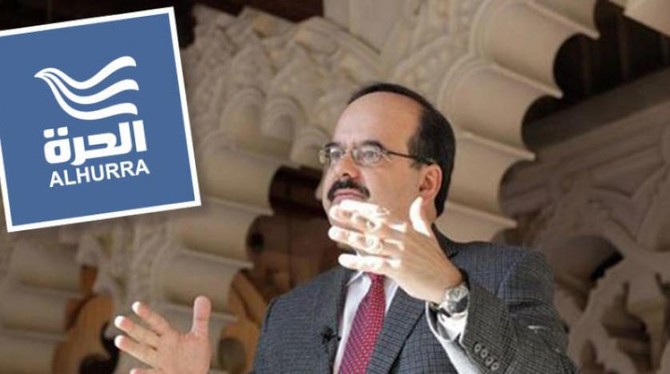
LONDON: He knows the Middle East back to front, having worked across the region for the US Department of State. Now Ambassador Alberto M. Fernandez’s new role sees him take on a fresh challenge — turning around Alhurra Television, making the Arabic-language channel relevant to audiences in countries across the Middle East and North Africa (MENA).
Fernandez, the new president of Middle East Broadcasting Networks (MBN) — a US government-funded broadcaster that beams Alhurra Televsion, Alhurra-Iraq and Radio Sawa to the MENA region — arrives into the job from a long career in diplomacy.
But what will his experience mean for viewers, and can he make MBN’s channels of interest to an audience with a choice of hundreds of satellite channels, with diverse needs and political leanings? Fernandez explained his plans in an interview with Asharq Al-Awsat.
Q: You’ve had a long career in the diplomatic service — which post was the most interesting?
A: For me the most interesting enriching post was Damascus. The years I was in Damascus were really interesting because there was an ugly, terrible, stupid regime, but wonderful people, wonderful writers, artists.
Q: Will running a news channel like Alhurra be more challenging than government diplomacy?
A: Yes, because in diplomacy there’s a lot that you yourself can do as an individual. You can make changes by the specific actions that you take, by who you meet and what you say. To change a network, to influence a network, or an organization with 800 people, it’s like moving a ship you want to turn around, and it’s very slow and cumbersome.
Q: Will you be revamping the Alhurra channel while maintaining its traditions?
A: I have to! Obviously you can’t shut it down, make changes and then come back on, so as we say in the US, “you build the plane while you’re flying the plane,” which is not easy to do — and in this case, it’s “rebuild the plane while you’re flying the plane.”
Q: What will be the main challenges in your new role at MBN?
A: I think it’s not much connected to Alhurra, it’s connected to the environment we’re living in in the region. I think there’s a dead end in much media today, where sectarianism is king, where political polarization is everywhere … There are always red lines in the Arab media — red lines have become greater rather than less. So there’s an opportunity here that can be filled … We can’t be all things to all people, but we can be a choice, not an echo, of what everyone else says.
Q: When Alhurra was launched soon after 9/11 there were few broadcasters competing against it, but the scene is now saturated, so is your plan to be a liberal alternative?
A: We want to offer viewers a choice, something different. The idea of Alhurra back in the day was to offer an alternative, but it’s stood still for many years … You need to have your own voice, your own image, you own identity, so that’s why I focus on a Iiberal world view and, by the way, a world view that flows from the American experience.
Q: What are your priorities in terms of coverage?
A: My immediate priorities are, one, to make sure that news is fair and objective … two, we need to have the ability to do investigative reporting that isn’t done by any of the others … three, we need liberal content … to highlight issues that people should know about. I definitely want to have a liberal agenda, and I don’t mean liberal in a political sense, but in universal liberal values, freedom of expression.
Q: When it comes to investigative reporting, Alhurra journalists have faced many threats, so how will you ensure the safety of your staff, while also ensuring you get those stories from the field?
A: Well, how does Western media get those stories? You have things you have to do; but you’re right, the margin of freedom, of safety, varies from place to place. It’s a sensitive issue, but it’s the same issue faced with Western media, every day, which is why Western journalists have been kidnapped and killed — in Lebanon many years ago, and in Syria more recently. And in Iraq terrible things have happened to local journalists. This is a threat, but journalism is a profession for the brave, for people who believe in the truth.
Q: Do you agree that investigative journalism is lacking in today’s world?
A: What’s happened in the Middle East is that media have become more crushed, because of regimes, because of politics, so it’s become more difficult. In the West … the economic crisis (has) affected Western media. One thing we’ve got is that although we’re independent we’re funded by the US government, so we don’t have to worry about selling advertising, or if people are cancelling their subscriptions. The traditional model of newspapers in the West has been upset. Social media has filled the gap, bloggers and websites, but some of it is good, some of it is junk.
Q: On the topic of social media: Your competitors in the Middle East have done much more on social media, with huge followings, so will you be working on social media with Alhurra as well?
A: Yes, but there’s a problem here. A lot of what (media) puts out is the wrong stuff. One thing that interests consumers is premium content, as in content you can only get at that one place. Digital properties are putting out stuff that everyone else has — that’s not very interesting. That’s not going to attract followers. You have to have voices, commentary that people find interesting.
Q: The channel currently focuses on a lot of US news, so will that continue under your leadership?
A: It will, but I’m interested in US news that highlights issues that would be of interest to a Middle Eastern audience.
Q: The US government supports the Kurds in Syria, so will you have any chance to cover their issues?
A: Often when you see TV news coverage it’s of military action against Daesh, which is fine, but I would like to see more coverage on civil affairs, the challenges of governance, and to do it in a respectful but open way. There are some freedoms in the Kurdish-controlled areas of Syria that are good, but you also have challenges.
You also have ethnic tensions, political tensions. I think you need a more rounded picture of Syrian Kurds, but also of everybody. You need ways to talk about Syria — you need ways to have nuanced discussion, nuanced coverage of the regime and the propaganda of the … jihadists.
• Originally published in Asharq Al-Awsat


![]()
New Alhurra boss pledges fresh start, liberal voice for Mideast viewers
New Alhurra boss pledges fresh start, liberal voice for Mideast viewers
Latest updates


© 2026 SAUDI RESEARCH & PUBLISHING COMPANY, All Rights Reserved And subject to Terms of Use Agreement.