Tokyo to begin seeking names for star giant panda cub

1 / 2
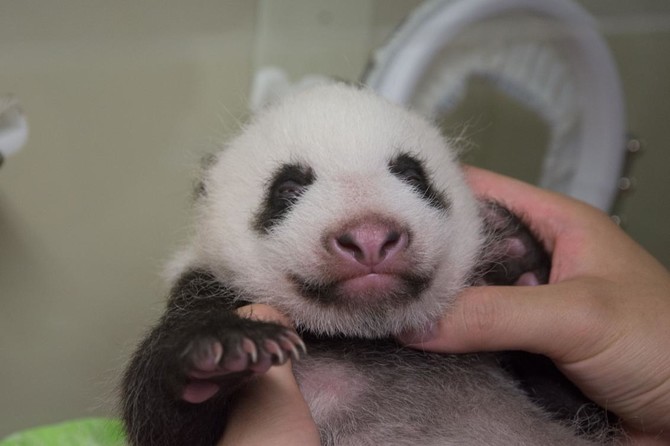
This July 22, 2017 picture released from the Tokyo Zoological Park Society on July 23, 2017 shows the 40-day-old female baby giant panda at Tokyo's Ueno Zoo. At 40 days, she tipped the scales at 1,656.5 grammes and measured 34.1 centimetres in length. (AFP)
2 / 2
This July 22, 2017 picture released from the Tokyo Zoological Park Society on July 23, 2017 shows the 40-day-old female baby giant panda at Tokyo's Ueno Zoo. At 40 days, she tipped the scales at 1,656.5 grammes and measured 34.1 centimetres in length. (AFP)
Updated 25 July 2017
Follow

Tokyo to begin seeking names for star giant panda cub

TOKYO: Tokyo is preparing to start collecting ideas later this week for naming a new giant panda cub born at its Ueno zoo.
The zoo, Japan’s oldest, has not shown the cub directly to the public. But it released a video of the cub born on June 12 showing the squeaky baby snuggling with its mother ShinShin. The roly-poly female cub already has the characteristic black and white giant panda pattern in its fur and its eyes have opened.
ShinShin’s last cub was born in 2012 and survived only six days. The newcomer appears to be thriving, and is sure to draw huge crowds once it goes on display.
About 420 giant pandas live in captivity, mostly in their native China, while about 1,860 live in the wild.


59-kilogram monster fish catches eyes at Nigerian fishing festival

Updated 58 min 52 sec ago
Follow

59-kilogram monster fish catches eyes at Nigerian fishing festival

  • Over the decades, the festival grew into one of Nigeria’s biggest cultural events, drawing international visitors, before insecurity and funding shortages reduced it to an occasional celebration

ARGUNGU: Local fisherman Abubakar Usman’s 59-kilogram monster catch was the major highlight of the UNESCO-listed Argungu fishing festival, which returned after a six-year hiatus because of the insecurity in northwestern Nigeria’s Kebbi state.
Thousands of people, including a handful of women and children, defied the blistering 39-degree heat to take part. Fishermen from Nigeria’s West African neighbors Niger, Chad, and Togo also came to compete.
The fishing festival was first staged in 1934 by the then traditional ruler of Argungu, Mohammed Sama. It was held to mark an end to a century-old history of hostility and distrust between his people and the region’s most powerful ruler, the Sultan of Sokoto, then Hassan Dan-Mu’azu.

FASTFACT

The festival has grown into one of Nigeria’s biggest cultural events, drawing international visitors, before insecurity and funding shortages reduced it to an occasional celebration.

Over the decades, the festival grew into one of Nigeria’s biggest cultural events, drawing international visitors, before insecurity and funding shortages reduced it to an occasional celebration. The last full edition was held six years ago, say organizers.
On Saturday, fishermen floated on brown, round gourds as they hunted for the biggest catch in Matan Fada river, using only their hands and nets in the river’s murky waters.
Thousands of spectators lined the riverbank cheering loudly.
For the Emir of Argungu, Al-Hajji Samaila Mohammed Mera, hosting the festival this year was a victory of some sort.
Parts of Kebbi state have seen sporadic militant attacks in recent years, with analysts blaming the Lakurawa terror group for the deadly violence.
“I came back to have a fuller experience,” said Adeniyi Olugbemii, 56, who is attending the festival a second time from neighboring Sokoto state.
Outside the arena that sits on the edge of the Matan Fada, chants, drumbeats, and cultural displays added to the atmosphere, highlighting the heritage that has turned Argungu into a global tourism draw.
Rukaya Ismaila, 23, said she had traveled from Kogi state, some 850 kilometers away, to attend the festival for the first time.
“The famous Argungu that we’ve been told about since primary school,” she said.
“It is worth all the excitement,” she added, praising the way the competing fishermen helped each other out.
Days of activities preceded the fishing competition, including a motor rally from Nigeria’s capital city, Abuja, a Durbar procession, and a variety of cultural events.
Abubakar Usman’s hefty catch earned him two new saloon cars and 1-million-naira cash prize (about $739).
Hundreds of much smaller catches ended up at a makeshift market set up on the adjoining streets to the arena.
The event was overshadowed by a prominent political campaign for the re-election of President Tinubu and Kebbi Gov. Mohammed Nasir Idris.
Billboards and posters of both men lined the streets leading to the river arena.
Supporters in blue t-shirts emblazoned with their images drummed and danced, drawing crowds of their own, while songs eulogising the visiting president blared through speakers inside the main arena.
Earlier in the day, a false start around midday had forced the already anxious contestants to plunge into the river. They had defied the scorching sun to wait for the arrival of President Bola Tinubu.
The president arrived more than two hours later, after which the contest was restarted.