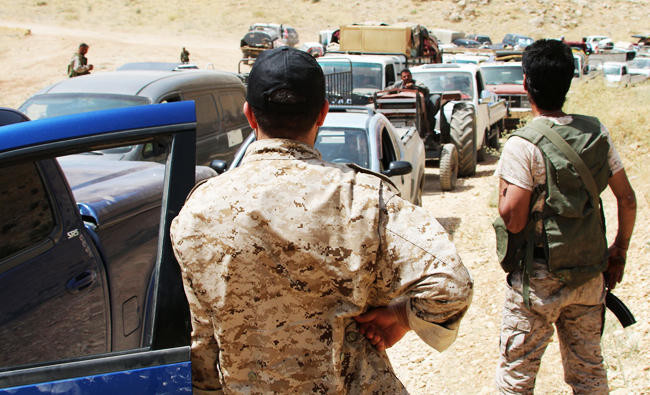
BEIRUT: Hezbollah’s attacks on Jabhat Fateh Al-Sham (JFS) militants have continued in Arsal on the Syrian-Lebanese border for a fifth day, with leading Lebanese parties refusing to provide it with political cover.
The Future Movement, led by Prime Minister Saad Al-Hariri, confirmed in a statement his party’s “commitment to the Lebanese army, which is the legitimate security force and the only one that is entrusted with defending Lebanon and the Lebanese people and protecting the country’s borders.”
The statement said: “If Hezbollah’s approach of incitement and treason during the ongoing battles in the eastern mountain ranges is aimed at legitimizing its participation in the Syrian war, and other ongoing wars in Lebanon and abroad, we will not be party to this national sin, regardless of the threats… against those opposing the policies of Hezbollah.”
Al-Hariri’s party said terrorism is a threat to Lebanon and the Arab and Islamic worlds, and “must be uprooted.”
But it added that fighting terrorism should not be used as a pretext “to trample upon the state and its constitutional institutions to participate in Arab civil wars, interfere in the internal affairs of Arab states or organize cells that threaten their peace and security.”
The Lebanese Forces party, in a statement by Social Affairs Minister Pierre Bou Assi, also rejected Hezbollah’s actions in Arsal, saying: “We only care about decisions taken by the Lebanese government and implemented by the legitimate security institutions.”
The Kataeb Party affirmed “the role of the Lebanese army in combatting terrorism and preserving Lebanon’s sovereignty, security, stability and in protecting its borders.”
President Michel Aoun was briefed by army commander Gen. Joseph Aoun and top security officials on security developments in Arsal.
In a statement, the president praised the “preparedness of the army to repel any attack on Lebanese territories and protect the residents and the displaced people.”
Hezbollah said it is making progress in areas controlled by JFS, while areas controlled by Daesh have not yet witnessed clashes.
Hezbollah said it is in “full control” of Wadi Al-Khail, which it described as “the bastion” JFS. Hezbollah reported “a state of collapse and chaos” among JFS ranks.
Hezbollah urged all militants in Arsal “to hand themselves over with a guarantee of their safety and protection, as the battle appears to be on the verge of ending.”


![]()
Lebanese PM declares Hezbollah battles in Arsal illegitimate
Lebanese PM declares Hezbollah battles in Arsal illegitimate

Latest updates


© 2026 SAUDI RESEARCH & PUBLISHING COMPANY, All Rights Reserved And subject to Terms of Use Agreement.