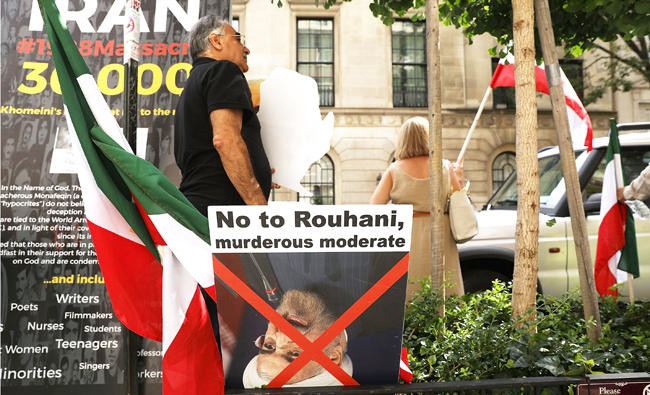
WASHINGTON: Iran continues to be the world’s leading state sponsor of terrorism, the Trump administration said on Wednesday.
In its annual Country Reports on Terrorism, the State Department said Iran was the world’s “foremost” state sponsor of terrorism in 2016, a dubious distinction the country has held for many years.
It said Tehran was firm in its backing of proxies that have destabilized Iraq, Syria and Yemen. It added that Iran continued to recruit in Afghanistan and Pakistan for Shiite militia members to fight in Syria and Iraq. It said Iranian support for Lebanon’s Hezbollah movement was unchanged.
Iran has been designated a “state sponsor of terrorism” by the State Department and subjected to various US sanctions since 1984.
Many of the activities outlined in the new report are identical to those detailed in previous ones. But this year’s finding comes as the Trump administration moves to toughen its stance against Tehran. The administration is expected to complete a full review of its policy next month.
President Donald Trump has been particularly critical of the nuclear deal negotiated by the Obama administration, and only reluctantly certified this week that Iran remained entitled to some sanctions relief under its provisions.
“Iran remained the foremost state sponsor of terrorism in 2016 as groups supported by Iran maintained their capability to threaten US interests and allies,” said the report, the Trump administration’s first, which was released a day after it slapped new sanctions on Iran for ballistic missile activity.
Some of those sanctions were imposed on people and companies affiliated with Iran’s Revolutionary Guard Corps (IRGC), which the report said continues to play “a destabilizing role in military conflicts in Iraq, Syria and Yemen.”
Tehran used a unit of the IRGC, the Quds Force, “to implement foreign policy goals, provide cover for intelligence operations and create instability in the Middle East,” the report said. It added that Iran has publicly acknowledged its involvement in Syria and Iraq.
Hezbollah worked closely with Iran to support the Syrian regime, said the report, adding that with Iranian backing, the Lebanese movement continued to develop “long-term attack capabilities and infrastructure around the world.”
The report also accused Iran of supplying weapons, money and training to militant Shiite groups in Bahrain, maintaining a “robust” cyberterrorism program, and refusing to identify or prosecute senior Al-Qaeda members whom it has detained.
Harvard scholar and Iranian affairs expert Majid Rafizadeh welcomed the report’s categorization of Iran as the “foremost” state sponsor of terrorism.
“Iran’s modus operandi is using asymmetrical warfare, through terror groups and militias, to export its revolutionary ideology and achieve its regional hegemonic ambitions,” he told Arab News on Wednesday.
“Based on my research at Harvard, I concluded that the Iranian government, mainly through the IRGC, supports roughly 40 percent of world-designated terrorist groups. In the region, the statistic is higher.”
Rafizadeh urged the international community to hold Iran accountable as it is “the essence of regional instability.”
Tehran’s activities are “destabilizing the Middle East and posing a threat to the security of other countries,” he said.
“The Trump administration is currently going through a review of Iran policy. I think the policy should closely examine how to counter the IRGC, whether the ultimate mission should be to change the Iranian regime or contain it, and take into consideration that Iranian leaders haven’t altered or moderated the core pillars of their foreign policy… for almost four decades.” As time has passed, Tehran “has become more emboldened and empowered.”
— With input from AP


![]()
US: Iran still top state sponsor of terror
US: Iran still top state sponsor of terror

Latest updates



Recommended


© 2026 SAUDI RESEARCH & PUBLISHING COMPANY, All Rights Reserved And subject to Terms of Use Agreement.