

Erdogan to visit KSA for talks on Qatar crisis

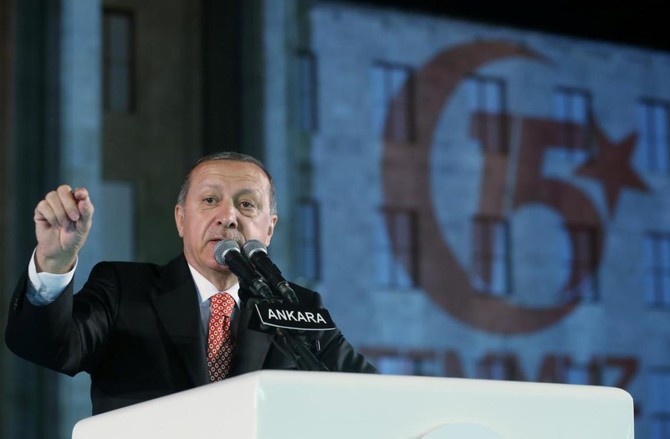
Turkish President Tayyip Erdogan makes a speech during a ceremony marking the first anniversary of the attempted coup at the Parliament in Ankara, Turkey July 16, 2017. (REUTERS)
Updated 19 July 2017
Follow

Erdogan to visit KSA for talks on Qatar crisis

RIYADH: Turkish President Recep Tayyip Erdogan will arrive in Saudi Arabia on July 23 to discuss key issues including the ongoing Qatar crisis.

The Anti-Terror Quartet (ATQ) — comprising Saudi Arabia, the UAE, Egypt and Bahrain — last month cut diplomatic ties with Qatar over allegations it funds extremist groups and is allying with Iran, which has played a destabilizing role in the region.

Erdogan will also visit Qatar and Kuwait during his two-day trip, according to the Turkish Embassy in Riyadh. Kuwait has been leading mediation efforts between Qatar and the ATQ.

Turkish Foreign Minister Mevlut Cavusoglu told reporters in Ankara that Erdogan wants to visit the Gulf region with efforts focused on a solution that suits the laws of brotherly relations.

Turkish Prime Minister Binali Yildirim said Ankara would continue to play a “constructive and active” role to help solve the crisis.

The ATQ has issued 13 demands to restore ties including cutting funding for terrorism and shunning extremist ideology, as well as closing a Turkish military base set up after the crisis in Qatar began, which Doha has refuted.

US Secretary of State Rex Tillerson was in the Gulf last week, after a stop in Istanbul for talks aimed at defusing the crisis.

Anwar Gargash, the UAE’s state minister for foreign affairs, on Monday repeated claims that Qatar funds extremists.

“You cannot be both our friend and a friend of Al-Qaeda,” he said.

Speaking at the Chatham House international affairs think tank in London, he warned Qatar that it could not belong to the Gulf Cooperation Council (GCC) if it undermined regional security, calling for a “change of behavior” but not “regime change.”

“This is our message: You cannot be part of a regional organization dedicated to strengthening mutual security and furthering mutual interest and at the same time undermine that security,” he said.


Secrecy, mines and Israeli strikes complicate removal of Assad-era chemical weapons, says Syrian envoy

Updated 08 January 2026
Follow

Secrecy, mines and Israeli strikes complicate removal of Assad-era chemical weapons, says Syrian envoy

  • Nevertheless, new authorities made significant progress in their work with Organization for the Prohibition of Chemical Weapons, he tells UN Security Council
  • Syrian authorities grant OPCW experts unrestricted access to 23 sites and since October have been hosting the organization’s longest continuous presence in the country

NEW YORK CITY: Syria’s envoy to the UN said on Thursday that secrecy surrounding the nation’s former chemical weapons program, security risks from land mines and other unexploded ordnance, and Israel’s targeting of suspected weapons sites continue to complicate his government’s efforts to eliminate Assad-era chemical weapons.
Speaking at a UN Security Council meeting about Syria’s chemical weapons, Ambassador Ibrahim Olabi said the nation’s new authorities had nevertheless made significant progress over the past year in their work with the Organization for the Prohibition of Chemical Weapons.
Despite what he described as “major challenges,” Syria had moved the issue “from a stage of suspicion and manipulation to one of partnership with the OPCW,” he said, adding: “Syria has achieved a qualitative leap in its cooperation with the OPCW.”
This shift is reflected in recent decisions by the watchdog’s executive council and changing positions among its member states, Olabi noted.
Syria’s chemical weapons program has been under international scrutiny since the early years of the country’s civil war, when repeated chemical attacks killed or injured large numbers of civilians. The deadliest incident occurred in 2013 in the Damascus suburb of Eastern Ghouta, when a sarin attack killed hundreds and triggered international efforts to dismantle the country’s chemical arsenal.
Olabi said the authorities that took over after President Bashar Assad and his regime were toppled in December 2024 were confronting what he called the “heavy legacy of the Assad era,” during which chemical weapons were widely used against civilians. He described the program as an inherited burden rather than a policy of the new government.
“The chemical file is a prime example of these inherited issues, issues of which we were victims,” he added.
Syrian authorities have granted OPCW experts unrestricted access during eight deployments that included visits to 23 sites, he said, and since October have been hosting what he described as the organization’s longest continuous presence in the country.
“This marks the beginning of a sustained presence of the OPCW in Syria,” Olabi added.
Adedeji Ebo, the UN’s deputy high representative for disarmament affairs, said OPCW teams visited 19 locations in Syria last year, four of them previously declared chemical weapons sites and 15 suspected locations, where they conducted interviews and collected samples in their attempts to determine the full scope of undeclared chemical weapons activity.
Some other sites are in dangerous areas, he added, which poses significant risks to both Syrian and international personnel.
“On-site destruction may be required where conditions prevent safe removal,” Ebo said, noting that a recent OPCW decision authorizing expedited on-site destruction of weapons marked a positive step forward.
He also highlighted the reestablishment of Syria’s National Authority for the OPCW and the watchdog’s current, continuous presence in Damascus.
Olabi said Syrian national teams had identified two sites containing empty cylinders previously used to store toxic chemicals and had immediately reported them to the OPCW. Syrian authorities also handed over about 6,000 documents relating to the former regime’s chemical weapons program, he added, and helped arrange interviews with 14 witnesses, including individuals who were involved with the program.
Syrian authorities were also cooperating with international investigators examining chemical attacks by Assad’s government, he said, and accountability and justice for the victims are priorities for the new authorities.
“Syria reiterates its determination to continue the efforts to close this chapter,” Olabi said, adding that there was “no place for chemical weapons in today’s world.”