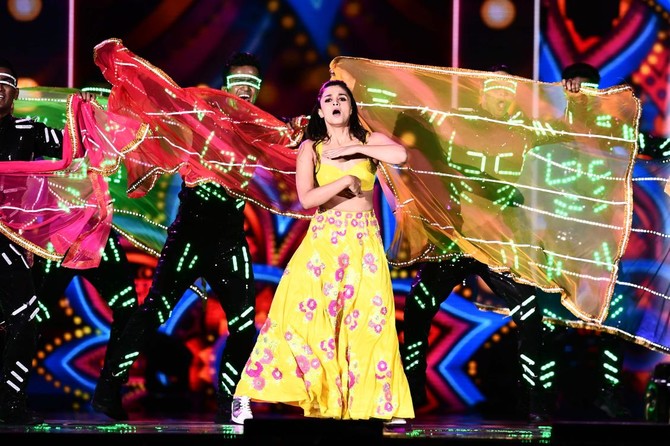
UNITED STATES: India’s biggest Bollywood stars led a triumphant celebration of dance, music and fashion at the International Indian Film Academy awards Saturday, cheered by thousands of ecstatic fans just outside New York.
The five-hour show at an American football stadium in New Jersey, where the glittering Manhattan skyline was visible from the parking lot, was a riot of color, glitz and stunning dance routines.
Best picture went to “Neerja,” a thriller based on the true story of a purser who helped save the lives of more than 350 passengers when Libyan-backed hijackers stormed Pan Am Flight 73 in Karachi in 1986.
The hijackers killed the purser and she posthumously became the youngest person to receive India’s highest civilian award for bravery.
“Udta Punjab,” a gritty crime drama spotlighting the huge problem of drug abuse among young people in Punjab, scooped Shahid Kapoor best actor and Alia Bhatt best actress in a leading role.
The movie angered politicians in the state and the filmmakers took India’s censor board to court over a number of cuts it tried to make.
The trio of serious-minded films winning major awards was rounded out by Aniruddha Roy Chowdhury taking home the award for best director for “Pink,” about sexual violence against women.
The culmination of a three-day celebration of Indian cinema, the 18th edition of the awards ceremony was held just outside New York at the American football MetLife Stadium in East Rutherford, New Jersey.
The awards, which some have likened to the Oscars of Bollywood, is India’s biggest media event and one of the world’s most-watched annual entertainment shows, with an audience of nearly 800 million people.
Held in a different city overseas each year to showcase what is the most prolific film industry in the world and the soft power of India, the 2017 event comes with Indian film on the up in North America.
From a Donald Trump impersonator named Ronald Grump, to a closing song and dance routine from Bollywood bad boy Salman Khan, which had love-struck women screaming in delight, and signature Bollywood formation numbers with eye-popping costumes galore, it was a festive night.
Thousands of delighted fans, dressed to the nines in evening gowns, cocktail dresses, saris and jewel-encrusted shalwar kameez, shrieked with delight, declared love for stars and laughed at the jokes of funny men hosts, actor Saif Ali Khan and producer-director Karan Johar.
There was glamor from winner Alia Bhatt in a crystal-studded strapless ballgown and Katrina Kaif who shimmered in a lime-green bra top, spray-on black pants and silver tassels through an upbeat dance.
Actress Shilpa Shetty, who won fame for being subjected to alleged racist taunts and winning Britain’s “Celebrity Big Brother” in 2007, looked statuesque in shimmering one-shoulder peach lashed to the thigh.
The ceremony honored double-Oscar winner movie composer A.R. Rahman and treated the audience to a snippet of Hollywood production “The Black Prince” about Queen Victoria and the Last King of Punjab, Maharajah Duleep Singh, which goes on release in the US next week.
Indian film is growing in North America, thanks to a thriving Indian economy, an increasing and affluent South Asian diaspora, and growing popularity among Afghans, Arabs, Russians and Caribbean immigrants.
But if there were few non-South Asians in sight Saturday, Bollywood heroes walking the green carpet welcomed the ceremony as a chance to further the industry internationally.
“Many others get exposed to this, that way we will seduce more hearts for Indian films,” said Bollywood actor Gulshan Grover.
Sonu Sood, who stars in action-adventure flick “Kung Fu Yoga” with Jackie Chan, said “all the actors are coming to Bollywood to do Indian movies and all the Indian Bollywood actors are going international.”
“So I think it’s a huge change and hopefully one day we’ll have one single industry,” Sood added.
IIFA selected gender equality as its cause of the year, despite a film industry often criticized for depicting women as meek and subjecting characters to aggressive methods of wooing by dominant male leads.
“Pink” not only won the best director award but also saw actress Taapsee Pannu, win the IIFA woman of the year award.
“The entire world should watch this film,” said director Chowdhury.
India’s treatment of women shot to the international spotlight in late 2012 when the fatal gang rape of a young student in the capital New Delhi sparked outrage over sexual abuse and gender inequality.

Bollywood superstars dazzle at India film awards
As an uncertain 2026 begins, virtual journeys back to 2016 become a trend
- Over the past few weeks, millions have been sharing throwback photos to that time on social media, kicking off one of the first viral trends of the year
LONDON: The year is 2016. Somehow it feels carefree, driven by Internet culture. Everyone is wearing over-the-top makeup.
At least, that’s how Maren Nævdal, 27, remembers it — and has seen it on her social feeds in recent days.
For Njeri Allen, also 27, the year was defined by the artists topping the charts that year, from Beyonce to Drake to Rihanna’s last music releases. She also remembers the Snapchat stories and an unforgettable summer with her loved ones. “Everything felt new, different, interesting and fun,” Allen says.
Many people, particularly those in their 20s and 30s, are thinking about 2016 these days. Over the past few weeks, millions have been sharing throwback photos to that time on social media, kicking off one of the first viral trends of the year — the year 2026, that is.
With it have come the memes about how various factors — the sepia hues over Instagram photos, the dog filters on Snapchat and the music — made even 2016’s worst day feel like the best of times.
Part of the look-back trend’s popularity has come from the realization that 2016 was already a decade ago – a time when Nævdal says she felt like people were doing “fun, unserious things” before having to grow up.
But experts point to 2016 as a year when the world was on the edge of the social, political and technological developments that make up our lives today. Those same advances — such as developments under US President Donald Trump and the rise of AI — have increased a yearning for even the recent past, and made it easier to get there.
2016 marked a year of transition
Nostalgia is often driven by a generation coming of age — and its members realizing they miss what childhood and adolescence felt like. That’s certainly true here. But some of those indulging in the online journeys through time say something more is at play as well.
It has to do with the state of the world — then and now.
By the end of 2016, people would be looking ahead to moments like Trump’s first presidential term and repercussions of the United Kingdom leaving the EU after the Brexit referendum. A few years after that, the COVID-19 pandemic would send most of the world into lockdown and upend life for nearly two years.
Janelle Wilson, a professor of sociology at the University of Minnesota-Duluth, says the world was “on the cusp of things, but not fully thrown into the dark days that were to come.”
“The nostalgia being expressed now, for 2016, is due in large part to what has transpired since then,” she says, also referencing the rise of populism and increased polarization. “For there to be nostalgia for 2016 in the present,” she added, “I still think those kinds of transitions are significant.”
For Nævdal, 2016 “was before a lot of the things we’re dealing with now.” She loved seeing “how embarrassing everyone was, not just me,” in the photos people have shared.
“It felt more authentic in some ways,” she says. Today, Nævdal says, “the world is going downhill.”
Nina van Volkinburg, a professor of strategic fashion marketing at University of the Arts, London, says 2016 marked the beginning of “a new world order” and of “fractured trust in institutions and the establishment.” She says it also represented a time of possibility — and, on social media, “the maximalism of it all.”
This was represented in the bohemian fashion popularized in Coachella that year, the “cut crease” makeup Nævdal loved and the dance music Allen remembers.
“People were new to platforms and online trends, so were having fun with their identity,” van Volkinburg says. “There was authenticity around that.”
And 2016 was also the year of the “boss babe” and the popularity of millennial pink, van Volkinburg says, indications of young people coming into adulthood in a year that felt hopeful.
Allen remembers that as the summer she and her friends came of age as high school graduates. She says they all knew then that they would remember 2016 forever.
Ten years on, having moved again to Taiwan, she said “unprecedented things are happening” in the world. “Both of my homes are not safe,” she said of the US and Taiwan, “it’s easier to go back to a time that’s more comfortable and that you felt safe in.”
Feelings of nostalgia are speeding up
In the last few days, Nævdal decided to hide the social media apps on her phone. AI was a big part of that decision. “It freaks me out that you can’t tell what’s real anymore,” she said.
“When I’ve come off of social media, I feel that at least now I know the things I’m seeing are real,” she added, “which is quite terrifying.”
The revival of vinyl record collections, letter writing and a fresh focus on the aesthetics of yesterday point to nostalgia continuing to dominate trends and culture. Wilson says the feeling has increased as technology makes nostalgia more accessible.
“We can so readily access the past or, at least, versions of it,” she said. “We’re to the point where we can say, ‘Remember last week when we were doing XYZ? That was such a good time!’”
Both Nævdal and Allen described themselves as nostalgic people. Nævdal said she enjoys looking back to old photos – especially when they show up as “On This Day” updates on her phone, She sends them to friends and family when their photos come up.
Allen wished that she documented more of her 2016 and younger years overall, to reflect on how much she has evolved and experienced since.
“I didn’t know what life could be,” she said of that time. “I would love to be able to capture my thought process and my feelings, just to know how much I have grown.”