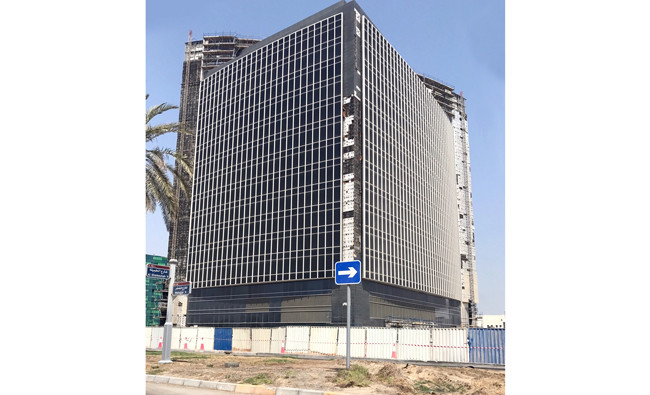
LONDON: A big bank in Abu Dhabi has stripped the cladding from its new headquarters building in the UAE capital amid growing scrutiny of tower facades worldwide.
Abu Dhabi Islamic Bank (ADIB) is replacing the recently installed exterior cladding panels on its new headquarters building as companies across the country assess the materials used on the outside of their offices.
It is not known why the bank decided to replace the facade, but it confirmed that new panels were being mounted on the building.
The bank aims to complete the building located on Abu Dhabi’s Airport Road, by early 2018.
“As part of the process of finalizing the building, (the) new cladding is being mounted that meets the highest local and international standards and requirements,” said Sagheer Mufti, chief operations officer at ADIB, in a statement.
“The new building will house ADIB’s flagship retail branch, our digital studio and training facilities, and will also serve as the bank’s head office.
“ADIB has already completed construction of a mosque in the area, which is now in operation.”
Thousands of building owners are conducting tests on their facades after a spate of blazes involving buildings covered with aluminum composite panels that are sometimes filled with highly flammable plastic material.
A massive fire in London last month, which claimed at least 80 lives, has refocused attention on the safety of towers covered with such panels.
Contractors had started to strip the exterior wall panels of the new Abu Dhabi building before the Grenfell Tower blaze last month.

Abu Dhabi bank strips cladding from new building
Oil prices rise sharply after attacks in Middle East disrupt global energy supply
- Traders were betting the supply of oil from Iran and elsewhere in the Middle East would slow or grind to a halt.
- Attacks throughout the region have restricted countries’ ability to export oil to the rest of the world
NEW YORK: Oil prices rose sharply Monday as US and Israeli attacks on Iran and retaliatory strikes against Israel and US military installations around the Gulf sent disruptions through the global energy supply chain.
Traders were betting the supply of oil from Iran and elsewhere in the Middle East would slow or grind to a halt. Attacks throughout the region, including on two vessels traveling through the Strait of Hormuz, the narrow mouth of the Arabian Gulf, have restricted countries’ ability to export oil to the rest of the world. Prolonged attacks would likely result in higher prices for crude oil and gasoline, according to energy experts.
West Texas Intermediate, the light, sweet crude oil produced in the United States, was selling for about $72 a barrel early Monday, up around 7.3 percent from its trading price of about $67 on Friday, according to data from CME group.
A barrel of Brent crude, the international standard, was trading at $78.55 per barrel early Monday, according to FactSet, up 7.8 percent from its trading price of $72.87 on Friday, which had been a seven-month high at the time.
Higher global energy prices could lead to consumers paying more for gasoline at the pump and shelling out more for groceries and other goods, at a time when many are already feeling the impacts of elevated inflation.
Roughly 15 million barrels of crude oil per day — about 20 percent of the world’s oil — are shipped through the Strait of Hormuz, making it the world’s most critical oil chokepoint, according to Rystad Energy. Tankers traveling through the strait, which is bordered in the north by Iran, carry oil and gas from Saudi Arabia, Kuwait, Iraq, Qatar, Bahrain, the UAE and Iran.
Iran had temporarily shut down parts of the strait in mid-February for what it said was a military drill, which led oil prices to jump about 6 percent higher in the days that followed.
Against that backdrop, eight countries that are part of the OPEC+ oil cartel announced they would boost production of crude Sunday. The Organization of Petroleum Exporting Countries, in a meeting planned before the war began, said it would increase production by 206,000 barrels per day in April, which was more than analysts had been expecting. The countries boosting output include Saudi Arabia, Russia, Iraq, the United Arab Emirates, Kuwait, Kazakhstan, Algeria and Oman.
“Roughly one-fifth of global oil supply passes through the Strait of Hormuz, a vital artery for world trade, meaning markets are more concerned with whether barrels can move than with spare capacity on paper,” said Jorge León, Rystad’s senior vice president and head of geopolitical analysis, in an email. “If flows through the Gulf are constrained, additional production will provide limited immediate relief, making access to export routes far more important than headline output targets.”
Iran exports roughly 1.6 million barrels of oil a day, mostly to China, which may need to look elsewhere for supply if Iran’s exports are disrupted, another factor that could increase energy prices.