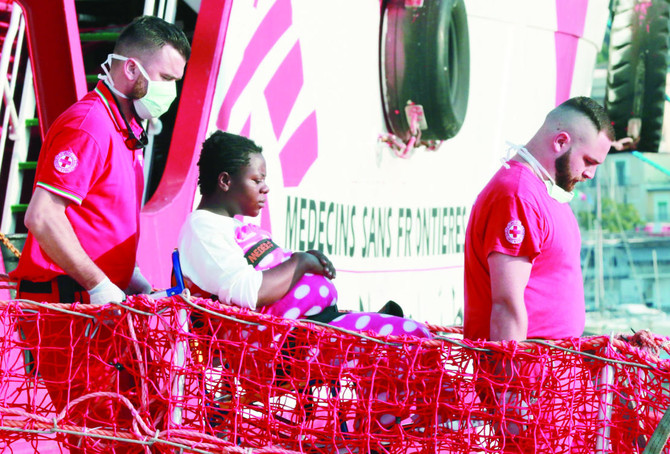
CATANIA, Italy: More than 1,400 migrants disembarked in Italy on Friday, the first of more than 4,400 who are expected to come ashore during the day after being picked up by rescue boats this week in the southern Mediterranean.
Their arrival comes as the Italian government, looking to stem the flow of migrants into the country, has drawn up a draft code of conduct for non-governmental organizations (NGOs) operating in the Mediterranean.
The Interior Ministry said that up until July 13, some 86,123 migrants had come to Italy so far this year, up 10 percent on the same period in 2016.
While NGOs have criticized plans for a code of conduct, saying it will make it more difficult to help migrants fleeing poverty and war, a UN spokeswoman said Italy needed more help dealing with the crisis.
“Basically, in Italy we need more solidarity from the rest of the European Union. In Libya we need more stability, but we also need across all of Africa better investment in order to help people (there),” said Carlotta Sami, spokeswoman for UN High Commissioner for Refugees (UNHCR).
Besides 1,428 newcomers who disembarked from an Italian coast guard vessel in the Sicilian port of Catania, a further 935 were due in the southern Italian port of Salerno, 860 were due to arrive in Brindisi and 1,200 in Crotone.

Over 4,400 migrants arrive in Italian ports
Turkiye’s Erdogan says Israel’s recognition of Somaliland benefits nobody
- Recep Tayyip Erdogan: 'I would like to emphasize that Israel’s recognition of Somaliland does not benefit Somaliland or the Horn of Africa'
- NATO member Turkiye has increased its influence in Africa in recent years, including the training of Somalia’s security forces
ANKARA: Turkish President Recep Tayyip Erdogan said on Tuesday that Israel’s recognition of the breakaway Republic of Somaliland would not benefit Somaliland or the region.
In December, Erdogan had said Israel’s decision to formally recognize Somaliland, a northern region that declared itself independent in 1991, was illegal and unacceptable, and he accused Israel of trying to destabilize the Horn of Africa.
“I would like to especially underline our stance of valuing the sovereignty and territorial integrity of states in the area where Ethiopia is located,” Erdogan told a press conference during a visit to Addis Ababa, adding Turkiye did not want to see new conflicts in the region.
“We believe regional countries need to find solutions to the problems of the region and for the Horn of Africa not to become a competition field for foreign forces. In that regard, I would like to emphasize that Israel’s recognition of Somaliland does not benefit Somaliland or the Horn of Africa,” he added.
NATO member Turkiye has increased its influence in Africa in recent years, training Somalia’s security forces and supplying development assistance in return for a foothold on a key global shipping route. Ankara has also developed close ties with other regional countries, including Ethiopia.
Turkiye has been one of the most vocal critics of Israel and its assault on Gaza, calling it a genocide. It has cut all trade with Israel and called for international measures against its leaders.
In December, Erdogan had said Israel’s decision to formally recognize Somaliland, a northern region that declared itself independent in 1991, was illegal and unacceptable, and he accused Israel of trying to destabilize the Horn of Africa.
“I would like to especially underline our stance of valuing the sovereignty and territorial integrity of states in the area where Ethiopia is located,” Erdogan told a press conference during a visit to Addis Ababa, adding Turkiye did not want to see new conflicts in the region.
“We believe regional countries need to find solutions to the problems of the region and for the Horn of Africa not to become a competition field for foreign forces. In that regard, I would like to emphasize that Israel’s recognition of Somaliland does not benefit Somaliland or the Horn of Africa,” he added.
NATO member Turkiye has increased its influence in Africa in recent years, training Somalia’s security forces and supplying development assistance in return for a foothold on a key global shipping route. Ankara has also developed close ties with other regional countries, including Ethiopia.
Turkiye has been one of the most vocal critics of Israel and its assault on Gaza, calling it a genocide. It has cut all trade with Israel and called for international measures against its leaders.
© 2026 SAUDI RESEARCH & PUBLISHING COMPANY, All Rights Reserved And subject to Terms of Use Agreement.