World’s ‘oldest’ hippo dies at Philippine zoo

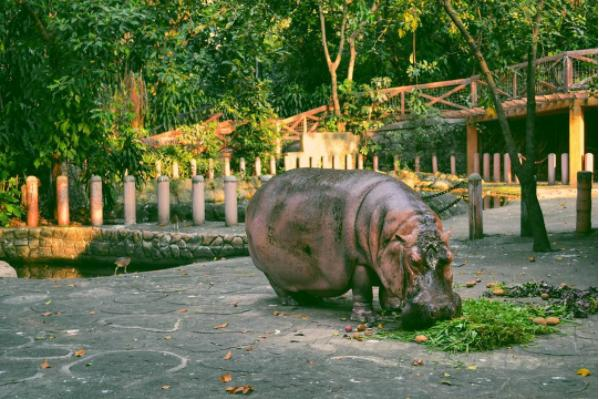
Bertha, the world's oldest hippo, has died at the age of 61 in Manila Zoo, her home since its opening in July 1959. (Photo courtesy: Instagram)
Updated 10 July 2017
Follow

World’s ‘oldest’ hippo dies at Philippine zoo

MANILA: Bertha, believed to be the world’s oldest hippopotamus, has died aged 65, the Manila zoo said Monday, having beaten the typical lifespan for the mostly herbivorous mammals by decades.
The 2.5-ton female was found dead Friday in her enclosure, with a post mortem examination concluding that Bertha, the zoo’s oldest resident, had died from multiple organ failure, zoo director James Dichaves said.
“Bertha was among the pioneer animals here. Her mate died sometime in the 1980s and the couple failed to produce any offspring,” he told AFP.
A seven-year-old Bertha arrived at the zoo in the Philippines’ capital the year it opened in 1959. The zoo has lost the records of where she came from, Dichaves said.
Fed a diet of grass, fruit, and bread, Bertha lived far beyond the 40 to 50 year lifespans which are typical for the species in the wild and in captivity respectively, Dichaves said.
Zoo officials believed Bertha was the oldest living hippo in captivity at the time of her death.
Donna, who died in 2012 at the age of 62 at the US Mesker Park Zoo and Botanic Garden in Evansville, Indiana, was previously said to be the world’s oldest hippo, according to media reports at the time.
Two years ago, an adult male hippo named Bertie was euthanized at the Denver Zoo in Colorado at the age of 58, the reports said.
The common hippopotamus of sub-Saharan Africa faces a “high risk of extinction in the wild” from habitat loss and illegal hunting for meat and ivory from its teeth, according to the Swiss-based International Union for Conservation of Nature.
Bertha’s death leaves Mali, a 43-year-old Asian elephant, as the oldest remaining animal among the some 500 residents at the Manila Zoo, Dichaves said.
Animal rights groups around the world have called for Mali, an adult female elephant, to be retired from the zoo and sent to a Thai sanctuary in a seven-year campaign, alleging it suffered from cruelty and loneliness.
However, the country’s environment department eventually allowed the zoo to keep the elephant after experts ruled it was healthy and said it was uncertain how Mali would react to the other elephants at the Thai sanctuary, Dichaves said.


English museum shines light on Mary Shelley and her Gothic classic ‘Frankenstein’  

Updated 16 February 2026
Follow

English museum shines light on Mary Shelley and her Gothic classic ‘Frankenstein’  

  • Museum in English city of Bath celebrates work of Mary Shelley

BATH: On a window of a Bath townhouse, one of the southwestern ​English city’s most famous residents looks out at passersby. Inside is Mary Shelley’s House of Frankenstein, a museum dedicated to the writer and her Gothic novel, published in 1818, which has inspired numerous screen adaptations, with the latest being Mexican filmmaker Guillermo del Toro’s Oscar contender.
“‘Frankenstein’ is regarded as one of the most important books in English literature ... It’s the world’s first science fiction novel,” said Chris Harris, co-founder and director of the immersive attraction.
“It’s a very modern story ... he’s trying to fit in, but he’s abandoned ... and rejected and ‌has prejudice thrown ‌toward him. And you think, well, from prejudice comes violence, ​which is ‌happening ⁠nowadays.”
‘FEAR ABOUT ​CHANGE’

Born ⁠Mary Wollstonecraft Godwin, Shelley came up with the idea for “Frankenstein; or, the Modern Prometheus” at 18 years old. She and her future husband, poet Percy Bysshe Shelley, were staying by Lake Geneva in 1816 with Lord Byron when the latter challenged their group to write a ghost story. She found inspiration there.
Back in England, she moved to Bath, where she penned key chapters before finishing the book — about the scientist Victor Frankenstein, who brings to life a creature ⁠assembled from body parts — in the town of Marlow.
“It plays on ‌people’s fears about change,” Harris said. “Now Frankenstein is a ‌metaphor for anything we’re scared of.”
The first “Frankenstein” adaptation was ​a musical, he said.
“The Creature in her ‌book is sensitive, he talks ... but in the play, he was rendered into a ‌monster. He didn’t talk, he was mute. He just went around killing people,” Harris said.
“So, right from the off, he’s been sort of invented in a slightly different way. And that’s happened all the way through the evolution of film and theater ... So it’s interesting to see del Toro’s ‌film; they’re exploring a different side of him.”
OSCAR AND BAFTA NOMINATIONS
That film, with nine Oscar nominations including best picture, shows actor ⁠Jacob Elordi’s Creature as ⁠gentle and hungry for knowledge but facing resentment. Elordi received Best Supporting Actor nods at the Oscars and Sunday’s BAFTA Film Awards, Britain’s top movie honors, where “Frankenstein” has eight nominations.
While del Toro’s movie differs from the book in several ways, including omitting the Creature’s murders, Harris said physically it was “a similar recreation” of Shelley’s description.
The museum has its own animatronic, standing in Victor Frankenstein’s recreated laboratory. Elsewhere, visitors learn about Shelley’s life, tragedies she faced and her interest in science.
Nearby, by Bath Abbey, is a 2018 plaque marking where Shelley lived in 1816-1817 and worked on the book. Bath is also associated with another female novelist, Jane Austen, who is celebrated annually with a festival. Harris, who opened his museum in 2021, says ​Shelley deserves more recognition.
“We just want ​people to understand that this is an extraordinary young woman who came up with one of the most enduring books ever written, that will never go out of fashion.”