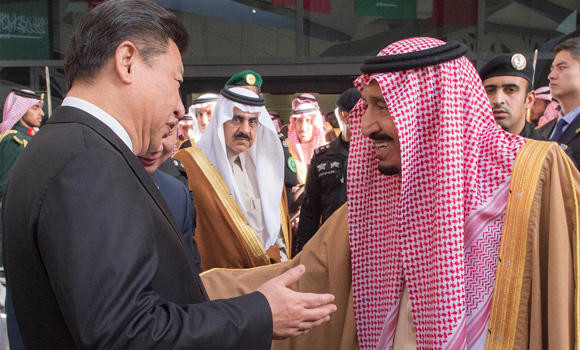
LONDON: Events in the Gulf have accelerated dramatically over the past month, bringing with it global attention given the region’s strategic position in terms of energy and financial resources. One country that has a big stake in the Gulf is China, which is watching developments very closely.
According to some Chinese experts, the Gulf crisis may have taken Beijing by surprise. China has called for a peaceful resolution of the crisis through dialogue, but has kept a low profile and made until now a few cautious comments and moves.
Beijing cannot ignore what is happening. The Gulf is China’s largest supplier of oil and second-largest provider of natural gas. The region is also the eighth-largest export market for China. The Gulf Cooperation Council (GCC) markets account for 46 percent of China’s total exports to the Middle East, according to official Chinese data.
Saudi Arabia is China’s top trade partner in the Middle East, while the UAE is the largest market in the region for Chinese goods. China is Saudi Arabia’s third-largest oil customer after Japan and the US, while Qatar is China’s second-largest supplier of liquefied natural gas (LNG) after Australia.
Song Niu, associate professor of the Middle East Studies Institute at the Shanghai International Studies University (SISU), told Arab News: “The current Qatar crisis has seriously affected the overall stability of the Gulf. The GCC countries are one of the top priorities for China’s Middle East diplomacy, since they’re significant partners in the Belt and Road Initiative.”
Beijing has not yet sided with any party in the crisis, but Song said: “Saudi Arabia is the largest and most powerful actor in the GCC, and has close contacts with China in political, economic, military and religious areas. Qatar is a small country, and its status in China’s Middle East diplomacy is hard to compare with Saudi Arabia.”
Qian Xuming, a research fellow at the Middle East Studies Institute at SISU, told Arab News: “The Gulf crisis will have no substantive impact on China as Beijing has good relations with all sides.” But Beijing “should communicate with both sides, help find a peaceful solution to the crisis and reduce the negative impact on the Belt and Road Initiative.”
Energy is at the heart of Gulf-China relations. Degang Sun of SISU’s Middle East Studies Institute told Arab News that Beijing “has been quite surprised by the Gulf crisis. Since 50 percent of its imported oil comes from the region, China is a major stakeholder.
“Besides, China wants a stable and peaceful Gulf so it can implement its Belt and Road Initiative. With substantial investment in infrastructure in the area, Beijing strongly advocates that the dispute should be settled by peaceful means as soon as possible.”
Chinese analysts expect that energy imports from the Gulf will not be affected, but Qian said: “Some contracted construction projects will be affected, including a new port, a medical services area, a section of railway and eight venues. The price of some materials will rise due to closure of the land crossings.”
Importantly, a former Chinese ambassador who previously worked in a GCC country told Arab News that the crisis has negatively affected the Gulf’s image among China’s political decision-makers. “After the region was seen as an oasis of stability in the troubled Middle East, the rapid deterioration of the situation took the Chinese leadership by surprise,” he said, adding that Beijing may seek to diversify its energy imports.

China and the Gulf crisis — the stakes are high
Refugees, migrants in Lebanon find rare sanctuary from Israeli strikes in Beirut church
- Beirut church offers safe haven for displaced migrants, refugees
- Many refugees lived through 2024 war, but are now more vulnerable
BEIRUT: When Israeli strikes began pummelling Beirut’s southern suburbs early on Monday, Sudanese refugee Ridina Muhammad and her family had no choice but to flee home on foot, eventually reaching the only shelter that would accept them: a church.
Eight months pregnant, Muhammad, 32, walked with her husband and three children for hours in the dark streets until they found a car to take them to the St. Joseph Tabaris Parish, which has opened its doors to refugees and migrants.
They are among 300,000 people displaced across Lebanon this week by heavy Israeli strikes, launched in response to a rocket and drone attackinto Israel by the Lebanese armed group Hezbollah.
Just 100,000 of the displaced are in government shelters. Others are staying with relatives or sleeping in the streets. But migrants and refugees say government shelters were never an option for them, saying they were turned away during the last war between Hezbollah and Israel.
Muhammad’s oldest daughter, now seven, stopped speaking after the 2024 war.
This time, they are even more vulnerable: their home was destroyed in this week’s strikes and Muhammad is due to give birth at the end of the month.
“I don’t know if there’s a doctor or not, but I’m really scared about it because I haven’t prepared any clothes for the baby, nor arranged a hospital, and I don’t know where to go,” she told Reuters as her younger daughter leaned against her pregnant belly.
Muhammad said she was registered with the United Nations’ refugee agency (UNHCR) but had not received support.
“Us, as refugees, why did we register with the UN, if they are not helping us in the most difficult times?” she said.
Dalal Harb, a spokesperson for UNHCR Lebanon, said the agency had mobilized but reaching everyone immediately was extremely challenging given the scale and speed of displacement. The UNHCR operation in Lebanon is currently only around 14 percent funded, she said.
The Jesuit Refugee Service (JRS), which helped the church host displaced in 2024, is doing so again.
Michael Petro, JRS’ Emergency Shelter Director, said the church was full within the first day of strikes, with 140 people from South Sudan, Ethiopia, Bangladesh, and other countries sheltering there.
“There are many, many more people coming than there were in 2024, and we have fewer and fewer places to put them,” he said.
Petro said he was told weeks ago that government shelters would be open to migrants if war erupted.
But when the strikes began and even Lebanese struggled to find shelter, the policy seemed to change, he said.
“We’re hearing from hotlines up to government officials and ministries that migrants are not welcome,” Petro said.
Lebanon’s Minister for Social Affairs Haneen Sayyed did not respond to a request for comment. On Thursday, Sayyed said Beirut shelters were full.
When Israeli strikes began, Othman Yahyeh Dawood, a 41-year-old Sudanese man, put his two young sons on his motorcycle.
They drove 75 kilometers (46 miles) from the southern Lebanese town of Nabatieh to St. Joseph’s, where they had sheltered in 2024.
“I know the area is safe and there are people who will welcome us,” he said.
“We don’t know where to go; there’s war there (in the south), war here (in Beirut), war in Sudan, and nowhere else to go,” he said.
Eight months pregnant, Muhammad, 32, walked with her husband and three children for hours in the dark streets until they found a car to take them to the St. Joseph Tabaris Parish, which has opened its doors to refugees and migrants.
They are among 300,000 people displaced across Lebanon this week by heavy Israeli strikes, launched in response to a rocket and drone attackinto Israel by the Lebanese armed group Hezbollah.
Just 100,000 of the displaced are in government shelters. Others are staying with relatives or sleeping in the streets. But migrants and refugees say government shelters were never an option for them, saying they were turned away during the last war between Hezbollah and Israel.
Muhammad’s oldest daughter, now seven, stopped speaking after the 2024 war.
This time, they are even more vulnerable: their home was destroyed in this week’s strikes and Muhammad is due to give birth at the end of the month.
“I don’t know if there’s a doctor or not, but I’m really scared about it because I haven’t prepared any clothes for the baby, nor arranged a hospital, and I don’t know where to go,” she told Reuters as her younger daughter leaned against her pregnant belly.
Muhammad said she was registered with the United Nations’ refugee agency (UNHCR) but had not received support.
“Us, as refugees, why did we register with the UN, if they are not helping us in the most difficult times?” she said.
Dalal Harb, a spokesperson for UNHCR Lebanon, said the agency had mobilized but reaching everyone immediately was extremely challenging given the scale and speed of displacement. The UNHCR operation in Lebanon is currently only around 14 percent funded, she said.
The Jesuit Refugee Service (JRS), which helped the church host displaced in 2024, is doing so again.
Michael Petro, JRS’ Emergency Shelter Director, said the church was full within the first day of strikes, with 140 people from South Sudan, Ethiopia, Bangladesh, and other countries sheltering there.
“There are many, many more people coming than there were in 2024, and we have fewer and fewer places to put them,” he said.
Petro said he was told weeks ago that government shelters would be open to migrants if war erupted.
But when the strikes began and even Lebanese struggled to find shelter, the policy seemed to change, he said.
“We’re hearing from hotlines up to government officials and ministries that migrants are not welcome,” Petro said.
Lebanon’s Minister for Social Affairs Haneen Sayyed did not respond to a request for comment. On Thursday, Sayyed said Beirut shelters were full.
When Israeli strikes began, Othman Yahyeh Dawood, a 41-year-old Sudanese man, put his two young sons on his motorcycle.
They drove 75 kilometers (46 miles) from the southern Lebanese town of Nabatieh to St. Joseph’s, where they had sheltered in 2024.
“I know the area is safe and there are people who will welcome us,” he said.
“We don’t know where to go; there’s war there (in the south), war here (in Beirut), war in Sudan, and nowhere else to go,” he said.
© 2026 SAUDI RESEARCH & PUBLISHING COMPANY, All Rights Reserved And subject to Terms of Use Agreement.