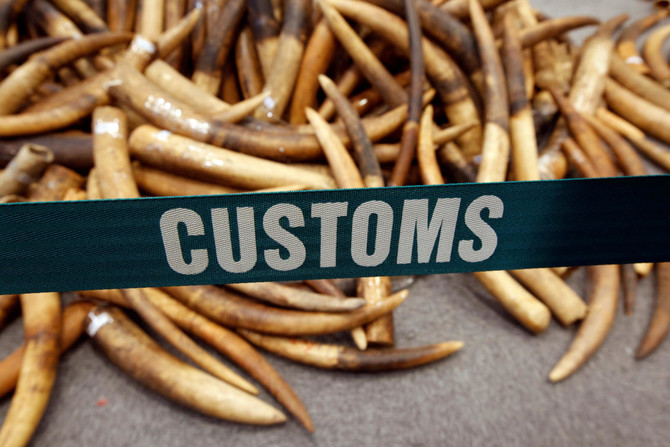
HONG KONG: More than seven tons of ivory worth over $9 million was seized in Hong Kong, officials said Thursday, the largest bust of its kind in the city in three decades.
The 7,200 kilogramme (16,000 pound) haul was hidden underneath frozen fish and raised suspicions because of the high transportation fees listed on the bill of import.
Customs officials in the southern Chinese city said the cargo had come from Malaysia and was believed to have been the work of a major smuggling ring.
Three people — one man and two women — have been arrested in connection with the find, customs official Wan Hing-chuen said, warning there could be more detentions.
Hong Kong is a major hub for ivory import and processing, but launched a landmark bill last month to phase out the trade by 2021.
Critics say the city’s authorities are lagging behind mainland China, where officials have pledged to completely ban ivory trading by the end of 2017.
The global trade in elephant ivory, with rare exceptions, has been outlawed since 1989 after populations of the African giants dropped from millions in the mid-20th century to around 600,000 by the end of the 1980s.
There are now believed to be some 415,000, with 30,000 illegally killed each year.
Ivory is highly sought-after in China, where elephant tusks are used in traditional medicine or to make ornaments. Prices for a kilogramme (2.2 pounds) reach as high as $1,100.

Hong Kong seizes 7.2 tons of ivory
26 Doctors without Borders workers remain unaccounted for in South Sudan a month after attacks
- A hospital in the town of Lankien was bombed by government forces, MSF said
- “We have lost contact with them amid ongoing insecurity”
NAIROBI: More than two dozen Doctors Without Borders workers remain unaccounted for a month after attacks in South Sudan, the medical charity said.
Two facilities belonging to the group, known by French acronym MSF, were attacked on Feb. 3 in Jonglei State, northeast of the capital, Juba, where violence has displaced an estimated 280,000 people since December.
A hospital in the town of Lankien was bombed by government forces, MSF said, while another medical facility in the town of Pieri was raided by “unknown assailants.” Both were located in opposition-held areas.
Staff working at the two facilities fled alongside much of the local population into deeply rural areas where armed clashes and aerial bombardments were ongoing.
MSF said in a statement on Monday that “26 of 291 of our colleagues working in Lankien and Pieri remain unaccounted for.
“We have lost contact with them amid ongoing insecurity,” it said.
The lack of communication with its staff could be linked to the limited network connectivity in much of the state. Staff members who had been contacted described “destruction, violence and extreme hardships.”
Fighting escalated sharply in December, when opposition forces captured a string of government outposts in north central Jonglei. In January, the government responded with a counteroffensive that recaptured most of the area it had lost.
Displaced people in Akobo, an opposition-held town near the Ethiopian border, described horrific violence by government fighters. Many described not being able to find food or water as they walked for days to reach safety.
The attacks on MSF facilities in Lankien and Pieri are part of an uptick in violence on humanitarian staff, supplies and infrastructure, aid groups say. MSF facilities have been attacked 10 times in the last 12 months.
“This violence has taken an unbearable toll not only on health care services, but on the very people who kept them running,” said Yashovardhan, MSF head of mission in South Sudan, who only uses one name.
“Medical workers must never be targets,” he said. “We are deeply concerned about what has happened to our colleagues and the communities we serve.”