

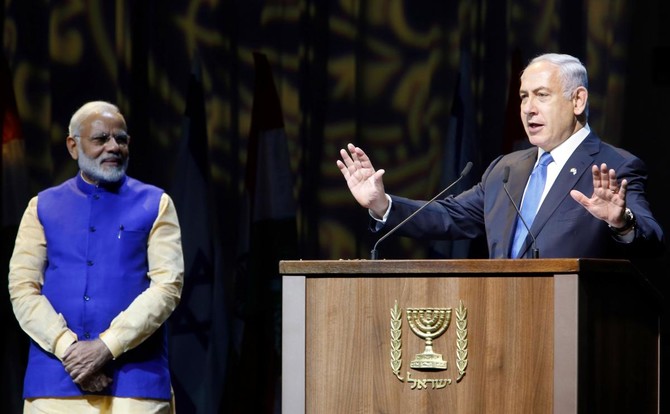
TEL AVIV: In the months leading up to Indian Prime Minister Narendra Modi’s historic visit to Israel, India signed two arms deals, spending $2.6 billion on Israeli missile defense systems.
Yet since Modi arrived on Tuesday, military ties — for decades the secretive bedrock of India-Israel relations — have taken a back seat. The governments have instead spent time discussing companies that sell medical devices, hi-tech and water systems.
Rather than making the visit, the first by a sitting Indian prime minister, all about the value of deals signed, Israel’s Prime Minister Benjamin Netanyahu and Modi appear intent on playing up shared culture and values, in the hope this will give commercial ties deeper roots.
Under Arab pressure, India kept its distance from Israel for decades but is now seeing advantages in a complementary relationship with Israel. There is interest on both sides in building a broad economic base, rather than merely a contractual exchange based around defense.
The timing reflects a diplomatic shift toward Israel being more accepted in the region. Modi, who is acutely conscious of the need to adopt innovation and new technology to update India’s infrastructure has always had a personal affinity for Israel and came to learn more about the country before he became premier.
“India and Israel are walking hand in hand into the future as partners,” Modi and Netanyahu wrote in a joint editorial this week. “From start-ups to space, communications to cybernetics, Israel’s technological capabilities are merging with India’s.”
The two men are spending 48 hours together with Modi, accompanied by Indian business leaders, getting a political and business tour that covers Israeli history, culture and innovation, as well as the signing of economic agreements.
HOPES FOR MORE DEALS
“What’s it going to take to get Israeli money to take India seriously? Just open their eyes,” Jon Medved, CEO of Israeli equity crowdfunding group OurCrowd said. “The problem is their eyes are ... blinded by the China opportunity,” he added.
There have only been a handful of Indian investments in Israel over the past decade, as opposed to the $16.5 billion received from China in 2016 alone.
OurCrowd just closed three deals with India, joining with Reliance Industries for a hi-tech incubator that helps to grow young companies in Jerusalem, bringing Israeli technology to India with Reliance Capital, and collaborating with India’s Lets Venture to invest in start-ups.
During Modi’s visit, Zebra Medical Vision, a company from a kibbutz near Tel Aviv, and Bangalore-based Teleradiology Solutions will sign a partnership to use analytics in 150 health-care centers.
Looking to reorient Israel’s economy toward Asia, Netanyahu hopes more deals will follow, setting a goal of increasing exports to India by 25 percent in the next four years. But it may take a while before the Modi-Netanyahu relationship sparks a serious expansion in investment and trade, both of which remain relatively negligible.
In many respects export-dependent Israel and India, which is focused on supplying its huge population, are complementary.
Israel is a global leader in water and food systems, two critical fields India needs to upgrade. India wants to strengthen its manufacturing base and is looking to do so with technologies coming from Israel. Both countries host major diamond trading and polishing hubs.
DIAMOND TRADE SPARKLES
Israeli exports to India last year totalled $1.15 billion, excluding diamonds, just 2.5 percent of total exports. Bilateral trade was less than $2 billion, which jumped to $4.13 billion including diamonds. Israel’s foreign direct investment in India totals only $100 million.
“It’s nothing, it’s a blip. Why hasn’t the relationship grown to the level it should have?” said A. Didar Singh, secretary general of the Federation of Indian Chambers of Commerce.
Singh said more needed to be done to ease regulations, lower non-tariff barriers and solve licensing problems.
Incentives and lifting of red tape could help overcome what diplomats, lobbyists and business owners say is a cultural divide between the breakneck pace of Israel’s start-up scene and India’s more gradual approach.
It can take time to cement negotiations in India, where building trust and a relationship is paramount, said Elias Ghosalkar, a former investment banker from Mumbai who is director of corporate development for OurCrowd after moving to Israel last year.
“Israelis on the other hand are quite direct and lack patience in their business approach,” he told Reuters.
Israel’s ambassador to India, Daniel Carmon, said it is becoming easier to do business between the two countries, even if there may remain some differences in practice.
“It could be that the Israeli businessman arrives on a Monday flight and wants to return on Thursday with a deal in hand. I say to him ‘forget it’. It’s not going to happen. There are processes, the processes take time, not four days,” he said.


