DUBAI: The London property scene has always been an attraction for Middle East investors, and one of the sights of the summer in wealthier parts of the city is groups of Arab visitors studying the postings in the city’s upmarket real estate office windows.
But recently, since the Brexit vote and other problems the capital has faced, there have been some concerns that houses and apartments in the traditional areas might not be as desirable, nor such a sound investment.
A recent UK-wide survey found that the value of upmarket London real estate was growing at the weakest rate in five years, and less than the rest of the country.
Mayfair, the “village” in London’s swanky West End, has been a traditional draw for the wealthy Gulf visitor. Great restaurants, hotels, upmarket shopping and the open green spaces of nearby Hyde Park all combine to give it an edge over other parts of the British capital.
It is said the area only really comes alive in the months of July and August, when visitors from the Gulf take up residence in the fabulously expensive properties they own, but which are shuttered for several months of the year.
“Arabs have always loved Mayfair, but now I sense they are looking for a new kind of property there, which developers are beginning to provide for them,” said Charles Lloyd, head of office for the upmarket real estate agent Savills in Mayfair and nearby St. James’s.
Three-story townhouses in one of the sophisticated streets between Park Lane and Regent Street, Mayfair’s borders, have been traditionally popular among Gulf Arab property investors. These properties — often pinned with “blue plaques,” which honor famous former residents — were like gold dust for many years and could command prices well above $20 million.
But tastes change, said estate agent Lloyd. Not only are Gulf buyers looking again at the Mayfair region, after a flirtation with the attractions of Knightsbridge and Kensington, but they are looking at properties perhaps more reminiscent of home — medium-rise luxury accommodation that can provide the full London experience while offering the top services and facilities.
Several of these kinds of developments are being planned in Mayfair, especially in what Lloyd calls the “jewel in the crown” — Grosvenor Square — where the US Embassy building is to be developed into a luxury hotel.
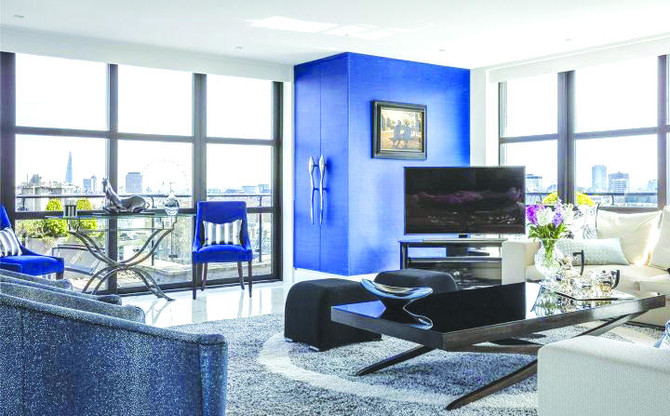
There is one property on the books of Savills at the moment that adds up to the “perfect penthouse,” Lloyd said: A four-bedroom apartment over two floors on the sixth and seventh floors of a block in Curzon Street, in the heart of the “village.”
Apartments are rather better value than town houses, so for the Curzon Street property any buyer would get some change — but not very much — out of £12 million ($15.5 million). The two underground parking places are a valuable part of the package.
But will it be a sound investment? A report from mortgage company Nationwide showed that property prices in the capital experienced only modest growth this spring, at just 1.2 percent between April and June. That seems to confirm a trend that has been evident for some time in the West End.
“There is still life in the market, but we can see now that it peaked at the end of 2014,” said Lloyd.
That was when the government introduced a new “stamp duty” tax on high-end properties. The effect of the Brexit vote a year ago also led to wobbles in the market, but was mostly offset by the fall in the value of sterling since then, Lloyd said.
He estimated properties in his high-end “village” were some 10 percent cheaper than they were two years ago.
“But Arabs still love London. I would estimate buyers from the Middle East form about 25 percent of our total foreign customers, which is the biggest part of the business. The Indian market is also booming for us, about the same proportion as from the Gulf.”
As regard to the problems of Brexit and security that have affected the city in recent weeks, Lloyd said: “London has always been a long-term attractive investment for foreign buyers, who see the city as a ‘safe haven’ and I don’t think that will change anytime soon.”

Arab property investors still appreciate UK capital’s classy ‘village’
AI will never replace human creativity, says SRMG CEO
- Speaking to Maya Hojeij, senior business anchor at Asharq with Bloomberg, Jomana R. Alrashid expressed pride in SRMG platforms that had absorbed and adopted AI
RIYADH: Jomana R. Alrashid, CEO of Saudi Research and Media Group, highlighted how AI cannot replace human creativity during a session at The Family Office’s “Investing Is a Sea” summit at Shura Island on Friday.
“You can never replace human creativity. Journalism at the end of the day, and content creation, is all about storytelling, and that’s a creative role that AI does not have the power to do just yet,” Alrashid told the investment summit.
“We will never eliminate that human role which comes in to actually tell that story, do the actual investigative reporting around it, make sure to be able to also tell you what’s news or what’s factual from what’s wrong ... what’s a misinformation from bias, and that’s the bigger role that the editorial player does in the newsroom.”
Speaking on the topic of AI, moderated by Maya Hojeij, senior business anchor at Asharq with Bloomberg, the CEO expressed her pride in SRMG platforms that had absorbed and adopted AI in a way that was “transformative.”
“We are now translating all of our content leveraging AI. We are also now being able to create documentaries leveraging AI. We now have AI-facilitated fact-checking, AI facilities clipping, transcribing. This is what we believe is the future.”
Alrashid was asked what the journalist of the future would look like. “He’s a journalist and an engineer. He’s someone who needs to understand data. And I think this is another topic that is extremely important, understanding the data that you’re working with,” she said.
“This is something that AI has facilitated as well. I must say that over the past 20 years in the region, especially when it comes to media companies, we did not understand the importance of data.”
The CEO highlighted that previously, media would rely on polling, surveys or viewership numbers, but now more detailed information about what viewers wanted was available.
During the fireside session, Alrashid was asked how the international community viewed the Middle Eastern media. Alrashid said that over the past decades it had played a critical role in informing wider audiences about issues that were extremely complex — politically, culturally and economically — and continued to play that role.
“Right now it has a bigger role to play, given the role again of social media, citizen journalists, content creators. But I also do believe that it has been facilitated by the power that AI has. Now immediately, you can ensure that that kind of content that is being created by credible, tier-A journalists, world-class journalists, can travel beyond its borders, can travel instantly to target different geographies, different people, different countries, in different languages, in different formats.”
She said that there was a big opportunity for Arab media not to be limited to simply Arab consumption, but to finally transcend borders and be available in different languages and to cater to their audiences.
The CEO expressed optimism about the future, emphasizing the importance of having a clear vision, a strong strategy, and full team alignment.
Traditional advertising models, once centered on television and print, were rapidly changing, with social media platforms now dominating advertising revenue.
“It’s drastically changing. Ultimately in the past, we used to compete with one another over viewership. But now we’re also competing with the likes of social media platforms; 80 percent of the advertising revenue in the Middle East goes to the social media platforms, but that means that there’s 80 percent interest opportunities.”
She said that the challenge was to create the right content on these platforms that engaged the target audiences and enabled commercial partnerships. “I don’t think this is a secret, but brands do not like to advertise with news channels. Ultimately, it’s always related with either conflict or war, which is a deterrent to advertisers.
“And that’s why we’ve entered new verticals such as sports. And that’s why we also double down on our lifestyle vertical. Ultimately, we have the largest market share when it comes to lifestyle ... And we’ve launched new platforms such as Billboard Arabia that gives us an entry into music.”
Alrashid said this was why the group was in a strong position to counter the decline in advertising revenues across different platforms, and by introducing new products.
“Another very important IP that we’ve created is events attached to the brands that have been operating in the region for 30-plus years. Any IP or any title right now that doesn’t have an event attached to it is missing out on a very big commercial opportunity that allows us to sit in a room, exchange ideas, talk to one another, get to know one another behind the screen.”
The CEO said that disruption was now constant and often self-driving, adding that the future of the industry was often in storytelling and the ability to innovate by creating persuasive content that connected directly with the audience.
“But the next disruption is going to continue to come from AI. And how quickly this tool and this very powerful technology evolves. And whether we are in a position to cope with it, adapt to it, and absorb it fully or not.”