Preparations finalized for much-awaited Souq Okaz festival in Taif

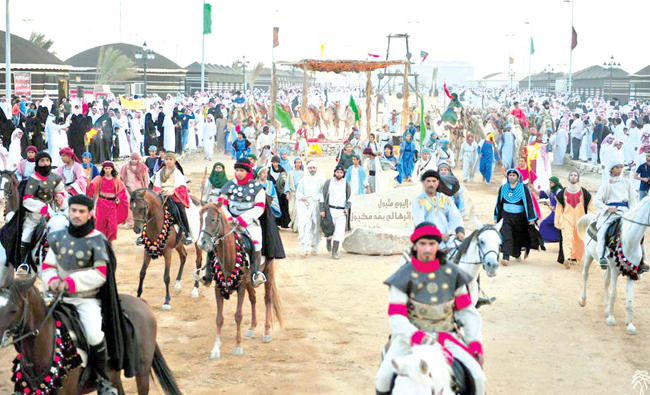
A file photo of last year’s Souq Okaz festival in Taif. (SPA)
Updated 03 July 2017
Follow

Preparations finalized for much-awaited Souq Okaz festival in Taif

RIYADH: The Saudi Commission of Tourism and National Heritage (SCTH) has finalized preparations for the 11th edition of Souq Okaz, scheduled to kick off on July 12 under the patronage of King Salman.
Located on the outskirts of the resort city of Taif, the Souq is held every year during the summer break.
Prince Sultan bin Salman, president of the SCTH and head of the supervisory committee of Souq Okaz, said the festival this year will witness more than 100 events, in addition to contests and tourist experiences.
The events will include a number of historical and cultural functions including Arabic and early Islamic poetry recitations, theater performances, market presentations, language challenges, sports shows, horse and camel shows, handicrafts, and light and sound presentations, he said.
Souq Okaz will also witness five nights of Arabic classical poetry, 10 cultural workshops, an Arabic calligraphy show, a fine art corner, the Okaz library, an ancient and Islamic inscription show, and a tent for storytellers under the supervision of the King Abdul Aziz Foundation for Research and Archives (Darah).
Prince Sultan said the SCTH has organized a series of preparatory workshops with its partners in Taif province including investors, the media, officials of government agencies, universities and citizens.


Carved by time: Saudi Arabia's hidden geotourism gem of Razan

Updated 4 sec ago
Follow

Carved by time: Saudi Arabia's hidden geotourism gem of Razan

  • Long before modern engineering, the geology of Razan functioned as effective natural infrastructure, sustaining life in an arid environment
  • This utility made Razan a strategic landmark, playing a vital role in the ancient Yemeni Hajj Road

AL-LITH: Sixty kilometers north of Al-Lith governorate in the Kingdom's west, rising above the shifting sands and valleys of the Makkah region, lies a place where the earth itself tells a story. This is Razan, a geological wonder where history is not written in ink, but etched into the stone by the patient hands of wind, water, and time.

Perched atop a high rocky mass and flanked by valleys to the northwest and southeast, Razan stands in natural isolation. This geographic solitude has acted as a guardian, preserving a landscape that feels almost otherworldly — a pristine stage set by nature over millennia.

The place is defined by its striking rock formations: dense clusters of stone, stepped ridges that resemble ancient staircases, and natural ceilings sculpted by the relentless flow of seasonal torrents.

The visual impact is one of dramatic contrast — the heaviness of solid rock balanced against open, airy spaces carved by erosion. Fine channels and intricate flow patterns mark the stone, serving as fossilized evidence of the water that once rushed through these corridors, shaping the land into a rugged work of art.
 

In the quiet majesty of Razan, the past is preserved. (SPA)

Nature’s infrastructure 

But Razan is more than just a scenic marvel; for centuries, it served as a lifeline. The same forces that sculpted the cliffs also hollowed out natural rock basins. These geological depressions acted as seasonal reservoirs, catching rainwater and supplementing nearby wells. Long before modern engineering, the geology of Razan functioned as effective natural infrastructure, sustaining life in an arid environment.

This utility made Razan a strategic landmark, playing a vital role in the ancient Yemeni Hajj Road. The sturdy, elevated terrain provided a natural pathway for pilgrims, offering stability and protection on their spiritual journey toward Makkah.

Today, Razan stands at the intersection of heritage and opportunity. No longer just a passage for pilgrims, it is emerging as a valuable asset for geotourism. Its unique topography offers a visual feast for travelers and a treasure trove for scientists studying geological history.

As Saudi Arabia moves toward the goals of Vision 2030, sites like Razan are finding new purpose. By transforming this geological narrative into a tourism destination, the region aims to preserve its natural heritage while breathing new life into the local economy.