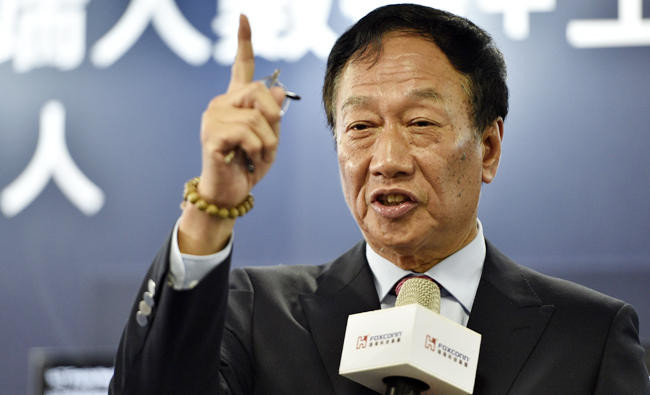
NEW TAIPEI CITY: The head of Taiwan’s tech giant Foxconn said Thursday its pursuit of Toshiba “is not yet over,” a day after the Japanese firm announced it preferred another group of bidders to acquire its prized chip business.
Foxconn, also known as Hon Hai, is controlled by billionaire Terry Gou and reportedly had Apple as a financial backer in its multi-billion-dollar bid for Toshiba’s memory chip unit, seen as crucial for the cash-strapped Japanese firm to turn itself around.
Toshiba said Wednesday it would hold exclusive talks with a consortium of US, South Korean and state-backed Japanese investors, dashing Gou’s ambitions.
Gou blasted the decision as a “scam” after an annual shareholders meeting in New Taipei City Thursday, accusing Japan’s Ministry of Economy, Trade, and Industry (METI) of interfering with the sale and engaging in “bureaucratic politics.”
The ministry declined to comment on Gou’s remarks when approached by AFP.
Foxconn chairman Gou vowed to keep pursuing the acquisition, telling reporters the Taiwanese firm still had a “more than 50 percent chance.”
“The Toshiba case is not yet over. It is very similar to the Sharp deal,” Gou had told shareholders earlier Thursday.
He was referring to his takeover last year of the Japanese electronics firm for $3.7 billion, a move he described as “really worth it.”
Gou is known for his aggressive dealmaking prowess, shown by his dogged determination to acquire Sharp despite concerns over the Japanese firm’s mounting losses.
The inclusion of Japanese investors in the selected bidding group by Toshiba will ease reported government concerns about losing a sensitive technology to foreign owners.
But a Foxconn official criticized Japanese authorities for taking a protectionist approach.
“There’s no end to their corporate crisis if they are not able to open up,” said Tai Jeng-wu, who took over as president of Sharp after Foxconn’s buyout.
Gou said the deal had been “directed from the very beginning.”
“It’s a big scam of the high-tech sector,” he told reporters.
The Taiwanese firm is the world’s largest contract electronics maker and is best known for assembling products for international brands such as Apple and Sony.
Gou said earlier this year he was mulling a $7 billion investment to make flat panels in the US in a joint project with Japan’s Softbank.
Foxconn plans to spend more than $10 billion over five years investing in the US, a plan codenamed “Flying Eagle,” Gou told reporters Thursday.
He is in talks with six states, including Wisconsin and Ohio to build plants, which will create tens of thousands of jobs, he said.
“The US has land, talent, resources. There is also protection in its legal and investment climate,” he said.
Gou has also said Foxconn aims to increase investment in China this year to try to boost Sharp’s market share in the country.


Taiwan’s Foxconn says Toshiba deal ‘not over’
Taiwan’s Foxconn says Toshiba deal ‘not over’

Free trade negotiations between GCC, India mark new phase of partnership, says sec-gen
RIYADH: The Gulf Cooperation Council’s secretary-general affirmed that the negotiations for a free trade agreement between the GCC and India, and the signing of the joint statement, represents a new phase of strategic partnership.
Jasem Mohamed Al-Budaiwi said that this contributes to enhancing close cooperation and strengthening economic and trade ties, according to the Saudi Press Agency.
This came during the signing ceremony of the joint statement on launching the free trade agreement negotiations between the Al-Budaiwi and India’s Minister of Commerce and Industry, Piyush Goyal, which took place in New Delhi, on Tuesday.
During the signing ceremony, Al-Budaiwi said that the Terms of Reference, signed on Feb. 5, provide a comprehensive and clear framework for these negotiations. The two nations agreed to discuss enhancing cooperation in vital strategic areas, including trade in goods, customs procedures, and services.
Additionally, the framework covers Sanitary and Phytosanitary measures, intellectual property rights, cooperation on Micro, Small, and Medium Enterprises, along with other topics of mutual interest. This reflects the comprehensive nature of the agreement and its ability to keep pace with the future economy.
Al-Budaiwi expressed hope that these negotiations would lead to a comprehensive and ambitious free trade agreement that works to remove customs and non-customs barriers, enhance the flow of quality investments in both directions, and achieve further liberalization in trade and investment cooperation between the GCC and India for mutual benefit.
This would provide a stimulating economic environment and an investment climate that opens broad horizons for the business sector, supports supply chains, and accelerates the pace of economic growth in line with the ambitious developmental visions of the GCC states.
The top official affirmed the full readiness of the General Secretariat to host the first round of negotiations at its headquarters in Riyadh during the second half of this year.
The two sides held a meeting during which they reviewed the existing cooperation relations between the GCC and India and discussed ways to develop and elevate them to broader horizons, serving mutual interests and enhancing opportunities for strategic partnership between the two sides, particularly in the economic, investment, and trade fields.
They praised the role undertaken by the negotiating teams from both sides, appreciating the efforts contributing to reaching a comprehensive agreement that enhances economic integration and supports the smooth flow of trade between the two nations.


