LONDON: Parts of the UK media have come under fire for alleged “bias” in covering the terror attack on a mosque in Finsbury Park, north London, on Monday.
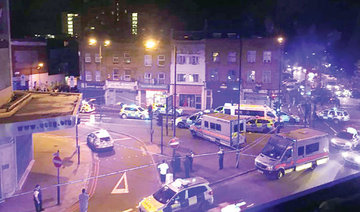
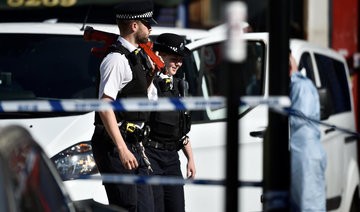
Nine people were taken to hospital after a man drove into worshippers near the mosque, with suspect Darren Osborne, 47, taken into custody.
Some of the resulting media coverage has been slammed for how it portrayed the alleged attacker, who is white, and the victims, who were Muslims worshipping at a nearby mosque.
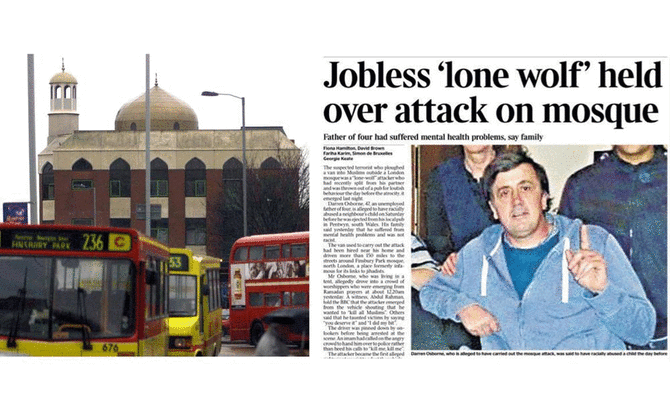
One Daily Mail headline in particular caused uproar after making reference to the Finsbury Park Mosque’s history, given that a notorious cleric used to preach there. The mosque has long been under a different management.
“White van driver injures at least 10 people after plowing into a crowd outside London’s Finsbury Park mosque where hate cleric Abu Hamza once preached as Muslims finish their evening prayers,” the Daily Mail headline read.
Although it was later changed, taking out the reference to Abu Hamza, and adding the words “terror attack,” Twitter was already alight with consternation.
“What a disgusting way to further add hatred on to an already horrific event, they should be ashamed of themselves,” wrote Mathew James Norman, who tweets @norman_mathew.
“Even then the way they put terror attack in quote marks like that is a disgrace, all the quote marks do is intentionally demean the words,” wrote Andy Stanley, who tweets @AStan1006.
An article in The Times on Tuesday morning was described as “atrociously bad” by Miqdaad Versi, the assistant secretary general of the Muslim Council of Britain.
The newspaper’s headline called the alleged Finsbury Park Mosque attacker a “lone wolf” with “mental health problems.”
Versi, speaking to Arab News, explained: “I think some newspapers reported on (the Finsbury Park Mosque attack) very well, such as Metro, The Sun, The Guardian… However, (it was) outrageous for The Times to say that this individual was a ‘lone wolf’; it always appears that there’s an attempt to normalize the individual, and while I understand where that’s coming from, why is that same opportunity not afforded to a far right extremist who happens to be Muslim?”
A spokeswoman for The Times declined to comment, but someone connected with the newspaper pointed out that the article text, if not the headline, made reference to the “suspected terrorist.”
The debate as to how terror attacks should be reported has now itself become the subject of international news, with The Indian Express reporting on the reaction to The Times of London’s story. The Indian outlet wrote: “Many people have expressed their shock at the newspaper for not treating (Darren) Osborne as a white Christian terrorist suspect.”
Many readers of a story in The New York Times pointed out that the incident in north London had not been described as “terrorism” in one report. The American paper later posted an article titled, “London Attack Near Mosque Investigated as Terrorism,” which has drawn hundreds of comments on the debate as what should be called terrorism.
Back in the UK, many news organizations initially reported the Finsbury Park attack as an accident, but most reports were later updated as information became clearer. JK Rowling, author of the Harry Potter books, was incensed that the suspected attacker was described as a “white van driver” instead of a suspected “terrorist,” although she later deleted her tweet when many newspapers updated their headlines.
The Muslim Council of Britain’s Versi explained what he sees as the root of the problem in UK journalism: “Many mainstream newspapers are providing platforms for individuals to spread hate about Muslims; that is totally and utterly reprehensible, yet it appears on a regular basis… There are articles that are not only explicitly hate-filled, but also articles that are scare-mongering and which Cambridge University has said create an atmosphere of hostility against Muslims.”
Gill Wood, senior lecturer at London Metropolitan University, pointed to some of the more controversial commentators in the UK.
“Obviously some newspapers give platforms to hate-mongers such as Katie Hopkins. This is compounded by the fact that some columnists, such as Hopkins and Richard Littlejohn, will seemingly say anything for a buck,” Wood told Arab News.
“The system can be changed only if people want to change it. There are strong vested interests in the profits that can be made from such biased journalism, and also fake news.”
Versi adds to this: “You are allowed to portray individuals however you see fit. We live in a free society. There’s a big difference between reporting facts and inciting hatred, causing scare-mongering, and articles spreading hate against Muslims.”
But the main question is how to change the status quo. More regulation is the key, according to Wendy Sloane, senior lecturer in journalism at London Metropolitan University. She explains: “Self-regulation doesn’t work, as we have seen with the recent deplorable incident of the Grenfell Tower fire, where the Daily Mail blamed the non-white resident of the tower for a faulty fridge that led to the subsequent tragedy.”
Whether increased regulation would have changed the wording of how some outlets reported the Finsbury Park attack is unclear, but organizations on both sides of the aisle confirmed that the incident should be termed as “terrorism.”
The Henry Jackson Society’s spokesperson Ross Cypher-Burley told Arab News: “It is clear that the incident at Finsbury Park Mosque was a terrorist attack, perpetrated by a far-right extremist. Editorializing those facts plays into the hands of the extremists who are attempting to divide our society.”