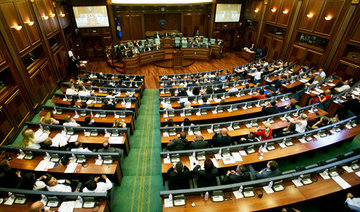
PRISTINA: Kosovo began voting Sunday for a new Parliament that will have to navigate tense relations with Serbia, endemic corruption and possible war crimes indictments for some of its leaders.
The early general election is only the third since Kosovo unilaterally declared independence in 2008. But it “might be the hardest to predict,” according to Florian Bieber, professor of Southeast European Studies at the University of Graz in Austria.
A month after the last government lost a confidence vote, the battle for a new prime minister pitches an ex-guerrilla commander against a former student protest leader and an economist likened to French President Emmanuel Macron.
Polls opened at 0500 GMT across the country of about 1.8 million people, most of whom are ethnic Albanian.
“This election has to open a new chapter,” said 66-year-old Ekrem Haziri, one of dozens of pensioners queueing in the early morning rain in the capital Pristina.
“It is time to end the huge abuse of tax-payers’ money. We need a government that will take care of its own people.”
Officials said 8.45 percent of the electorate had voted four hours after polls opened, down on the last election in 2014.
Overshadowing the vote is a new special court set up to try war crimes allegedly committed by members of the pro-independence Kosovo Liberation Army (KLA), which fought Serbian forces in the late 1990s.
Among those some speculate could be on the list of indictees — which may be announced later this year — are President Hashim Thaci and outgoing speaker Kadri Veseli, who both hail from the powerful Democratic Party of Kosovo (PDK).
The European Center for Minority Issues, a Germany-based research institute, said the court’s arrest warrants “compounded with the political agenda, may severely hamper or even bring about the fall of the future government.”
The new court was largely absent from the debate during the short election campaign.
But the threat it poses could explain why the PDK decided to end its ruling coalition with the Democratic League of Kosovo (LDK), said political scientist Loic Tregoures, a Balkans specialist.
The party may have pushed for a snap election to consolidate its position before the court begins work, he said.
The PDK’s new alliance is the favorite to win and has been dubbed the “war wing” coalition owing to the prominence of former KLA fighters.
The coalition’s candidate for prime minister is Ramush Haradinaj, known as “Rambo,” whom Serbia wants to try for war crimes.
Haradinaj has criticized EU-brokered talks between Belgrade and Pristina aimed at “normalizing” relations. He says they should only move forward if Serbia recognizes Kosovo — an unlikely prospect.
Another coalition has emerged around the center-right LDK party, closer to civil society groups.
Its candidate for premier is outgoing finance minister Avdullah Hoti. He has pushed a strongly pro-European platform and earned the nickname “Kosovo’s Macron,” promising to take on corruption.
Nearly 20 years after the war, political elites in Kosovo are “characterised by crime, corruption and nepotism,” according to an assessment by the Slovenia-based International Institute for Middle-East and Balkan Studies.
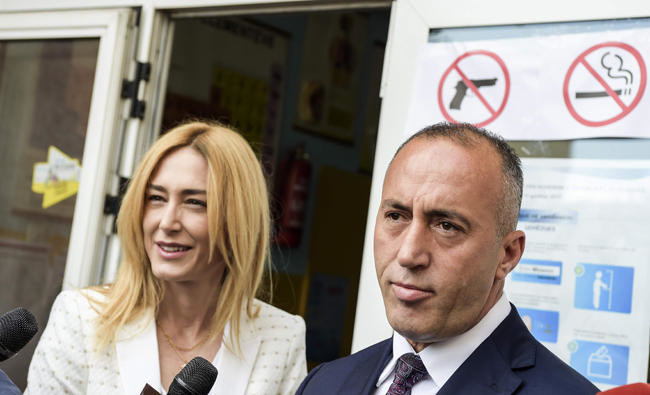
After voting with his wife, Hoti called on voters to decide “the future of their families.”
In a country where half of the population is aged under 30, the unemployment rate is officially at 27.5 percent and young people are leaving in droves in search of a better life elsewhere.
To deny the “war wing” alliance power, Hoti would have to turn to the Vetevendosje (Self-Determination) party of former student leader Albin Kurti, which has adopted radical methods.
Kurti and fellow party members repeatedly threw tear gas in Parliament to prevent a law passing on a border demarcation deal with Montenegro.
The EU has made the deal a prerequisite to liberalising Kosovo’s visa regime, but its opponents say it deprives Kosovo of land.
The protesters are also opposed to an association — agreed on in the talks with Belgrade — that would grant Kosovo’s Serb minority greater autonomy.
Progress on this issue has stalled and tensions remain palpable in the ethnically divided northern city of Mitrovica.
For although Kosovo’s independence has been recognized by more than 110 countries, Serbia still refuses to acknowledge it.
Kosovo’s Serbs, who number between 100,000 and 150,000, will on Sunday elect 10 of the 120 deputies in Parliament.
The embassies of Germany, Italy, Britain and the United States recently issued a joint statement denouncing “deeply concerning reports” of “threats and intimidation” — particularly targeting Serbs — during the campaign.
An EU mission is monitoring the polls, which close at 1700 GMT, and the first results are expected later Sunday.


![]()
Kosovo votes with war crimes court, corruption in mind
Kosovo votes with war crimes court, corruption in mind

Latest updates




© 2026 SAUDI RESEARCH & PUBLISHING COMPANY, All Rights Reserved And subject to Terms of Use Agreement.