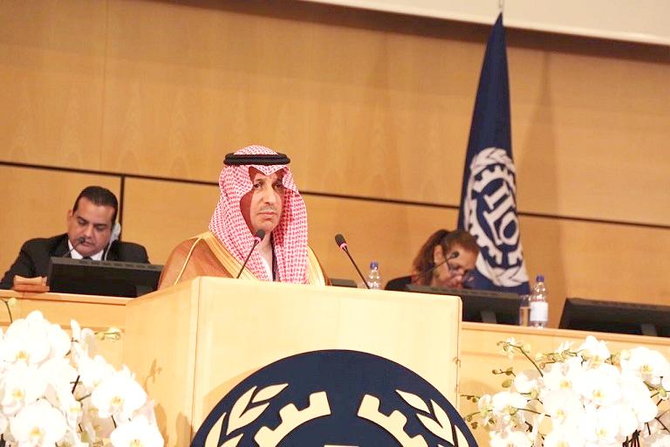
JEDDAH: Minister of Labor and Social Development Ali bin Nasser Al-Ghafis on Wednesday said Vision 2030 and its objectives go hand in hand with the agenda of the International Labor Conference (ILC) currently taking place in Geneva.
These aims include aligning education outcomes with the needs of the labor market, preparing youths to enter the market, increasing women’s participation, and involving people with disabilities and developing their skills, Al-Ghafis added.
Addressing the plenary at the 106th session of the ILC, he said the Kingdom allows Syrians and Yemenis to obtain temporary work permits, integrate into the labor market and have access to services until they return to their countries safely.
The Kingdom pursues a policy of resolving the situation of expats who violate residency and labor regulations by following humane values that stem from Islam and international labor standards, Al-Ghafis added.
“The Kingdom has given undivided attention to social protection of expat workers by launching a nationwide campaign to correct the status of violators of labor and residency regulations without inflicting any negative effects on them,” he said.
“They do not incur any fees or fines, and they are not denied returning to work.
This has permitted a huge number of expat workers to stay and work in the Kingdom after they corrected their situations and became legal workers and residents.”
As climate change determines the fate of the planet, Al-Ghafis said the Kingdom seeks to “achieve environmental sustainability and protect natural resources, including oil wealth and ground water.”
The Kingdom has laid out a plan to develop the renewable energy sector because it believes in the importance of transitioning to a green economy, he added.

Vision 2030 aligns education outcomes with labor market needs: Labor minister
Saudi Arabia’s Sharaan and Wadi Nakhlah nature reserves win Dark Sky recognition
- The two reserves in AlUla join more than 250 locations worldwide that are protected from light pollution
- AlUla Manara and AlGharameel Nature Reserve, also both in AlUla, received Dark Sky Park designations last year
ALULA: Two more nature reserves in Saudi Arabia’s AlUla have won recognition as Dark Sky Places, joining more than 250 locations worldwide that are protected from light pollution.
The official accreditation of Sharaan National Park and Wadi Nakhlah reserves from the DarkSky International builds on AlUla’s 2024 achievement, when AlUla Manara and AlGharameel Nature Reserve became the first sites in the Kingdom and the Gulf region to receive Dark Sky Park designations.
The latest recognition further strengthens AlUla’s position as a leading global destination for night sky protection and astronomical tourism, said the Royal Commission for AlUla (RCU) in a statement carried by the Saudi Press Agency (SPA).
Dark Sky International also announced the recognition in an earlier report, noting that the Sharaan and Wadi Nakhlah’s combined area of 6,146 square kilometers reflects the “expanded scope of environmental protection efforts aimed at preserving AlUla’s pristine night skies and reducing light pollution across a vast geographical area.”
DarkSky International works to reduce light pollution in both urban and rural areas and to raise global awareness of the importance of protecting the night sky.
AlUla’s protected areas are located in the heart of northwest Arabia, near the ancient oasis city of AlUla in Madinah Province.
“Towering sandstone cliffs, labyrinthine canyons, tranquil basins, and volcanic formations create a dramatic setting where geological diversity, cultural heritage, and thriving biodiversity converge beneath exceptionally dark, open skies,” Dark Sky said.
Scientists have noted that AlUla’s natural isolation from urban light sources, combined with ideal atmospheric conditions, makes it a world-class destination for stargazing, astronomy education, and immersive dark-sky experiences.
With the phased development of its reserves, AlUla is now ranked 3rd globally in the Dark Sky Park category, solidifying its status as one of the world’s premier destinations for astronomical discovery.
The RCU reaffirmed its commitment to protecting the natural environment, preserving the night sky, and promoting sustainable tourism, further positioning AlUla as a leading global destination for astronomy, scientific research, and advanced environmental experiences, in line with AlUla Vision and the Kingdom’s Vision 2030.