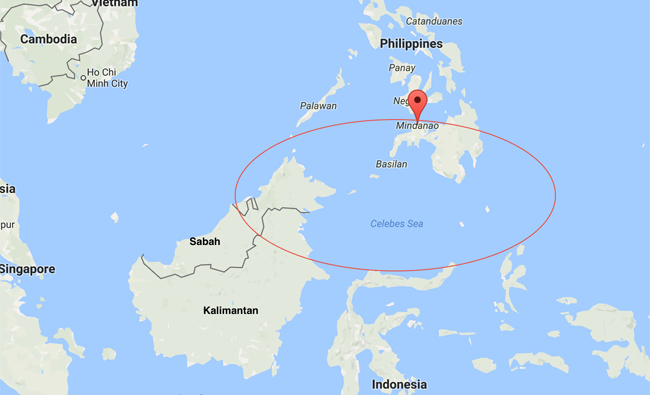
SINGAPORE: Malaysia, the Philippines and Indonesia will launch joint patrols in waters off the Mindanao region this month to counter threats from Daesh, Malaysia’s Defense Minister Hishammuddin Hussein said.
The minister made the comments at a security conference in Singapore as Philippine troops continued to battle militants who attacked the city of Marawi on Mindanao island nearly two weeks ago.
Hishammuddin said joint sea patrols in the waters bordering the three nations would kick off on June 19, with air patrols starting at a later date.
Philippine President Rodrigo Duterte has declared martial law in Mindanao in response to the crisis, describing the attack on Marawi as the start of a major campaign by Daesh to establish a foothold in the Philippines.
Security analysts say Daesh is planning to establish a “province” in the southern island of Mindanao as part of its efforts to set up a caliphate in Southeast Asia.
“If you talk about Sulu Straits (it) ... would involve Malaysia, Indonesia and the Philippines,” Hishammuddin told delegates to Shangri-La Dialogue, an annual security summit.
“So within ASEAN (Association of Southeast Asian Nations), we decided at least these three countries, to avoid being accused of doing nothing, the three of us took the initiative to have the joint patrol... initiatives in the Sulu Straits,” he added.
Hishammuddin said Malaysia, Indonesia and Singapore have carried out successful joint patrols in the Malacca Strait bordering their countries to fight maritime piracy.
Singapore Defense Minister Ng Eng Hen said the city-state stood ready to help Manila deal with the jihadist threat.
“There was clear realization... that if the situation in Marawi in Southern Philippines was allowed to escalate or entrench, it would pose decades of problems for ASEAN,” he said.
“We are fully on board on this threat.”
Analysts have said the porous maritime borders between the three countries make it hard to detect the movement of militants.
Mindanao is “the primary area in the region where Islamist militant groups are still able to operate with some freedom of operation, run training camps, and conduct frequent attacks,” said Otso Iho, senior analyst at IHS Jane’s Terrorism and Insurgency Center (JTIC).
“This level of lawlessness and the fact that the space is difficult for government forces and institutions to effectively govern makes it the most likely place for a declaration,” he said.
“It’s also the location where the vast majority of Southeast Asian groups that have pledged allegiance to Daesh are based.”
Hishammuddin and other defense ministers who spoke at the conference warned of the threat posed by returning Southeast Asian militants who are fighting with Daesh in Iraq and Syria where the group is losing territory.
“This however then gives rise to the disturbing prospect that the Asia-Pacific is now in Daesh’s crosshairs,” he said.
The threat is “real and multidimensional, whether from returning fighters, regional franchises or more disturbingly, from self-radicalized lone wolves,” he added.
US Defense Secretary Jim Mattis said Washington stood by the Philippines, its defense treaty ally in fighting terrorism, but did not refer to moves by Duterte to shift his country’s foreign policy away from the US and closer to China and Russia.
“During this challenging fight against terrorists, we will stand by the people of the Philippines and we will continue to uphold our commitments to the Philippines under the mutual defense treaty,” Mattis told the conference.
The Combating Terrorism Center, a West Point, New York-based think tank, said in a recent report that Daesh is leveraging militant groups in Southeast Asia to solidify and expand its presence in the region. The key will be how well it manages relations with the region’s jihadi old guard, CTC said.
Officials in Indonesia worry that even if the Filipinos successfully take back Marawi in coming days, the threat will still remain high.
“We worry they will come over here,” said one Indonesian counter-terrorism official, noting that Mindanao was not very far from the Indonesian island of Sulawesi.


Joint patrols in waters off Mindanao to fight militants
Joint patrols in waters off Mindanao to fight militants

France’s Le Pen insists party acted in ‘good faith’ at EU fraud appeal
- Le Pen said on her second day of questioning that even if her party broke the law, it was unintentional
- She also argued that the passage of time made it “extremely difficult” for her to prove her innocence
PARIS: French far-right leader Marine Le Pen told an appeals trial on Wednesday that her party acted in “good faith,” denying an effort to embezzle European Parliament funds as she fights to keep her 2027 presidential bid alive.
A French court last year barred Le Pen, a three-time presidential candidate from the far-right National Rally (RN), from running for office for five years over a fake jobs scam at the European institution.
It found her, along with 24 former European Parliament lawmakers, assistants and accountants as well as the party itself, guilty of operating a “system” from 2004 to 2016 using European Parliament funds to employ party staff in France.
Le Pen — who on Tuesday rejected the idea of an organized scheme — said on her second day of questioning that even if her party broke the law, it was unintentional.
“We were acting in complete good faith,” she said in the dock on Wednesday.
“We can undoubtedly be criticized,” the 57-year-old said, shifting instead the blame to the legislature’s alleged lack of information and oversight.
“The European Parliament’s administration was much more lenient than it is today,” she said.
Le Pen also argued that the passage of time made it “extremely difficult” for her to prove her innocence.
“I don’t know how to prove to you what I can’t prove to you, what I have to prove to you,” she told the court.
Eleven others and the party are also appealing in a trial to last until mid-February, with a decision expected this summer.
- Rules were ‘clear’ -
Le Pen was also handed a four-year prison sentence, with two years suspended, and fined 100,000 euros ($116,000) in the initial trial.
She now again risks the maximum sentence of 10 years in prison and a one-million-euro ($1.16 million) fine if the appeal fails.
Le Pen is hoping to be acquitted — or at least for a shorter election ban and no time under house arrest.
On Tuesday, Le Pen pushed back against the argument that there was an organized operation to funnel EU funds to the far-right party.
“The term ‘system’ bothers me because it gives the impression of manipulation,” she said.
EU Parliament official Didier Klethi last week said the legislature’s rules were “clear.”
EU lawmakers could employ assistants, who were allowed to engage in political activism, but this was forbidden “during working hours,” he said.
If the court upholds the first ruling, Le Pen will be prevented from running in the 2027 election, widely seen as her best chance to win the country’s top job.
She made it to the second round in the 2017 and 2022 presidential polls, before losing to Emmanuel Macron. But he cannot run this time after two consecutive terms in office.


