Minutes from Federal Reserve weigh on dollar, euro resumes climb

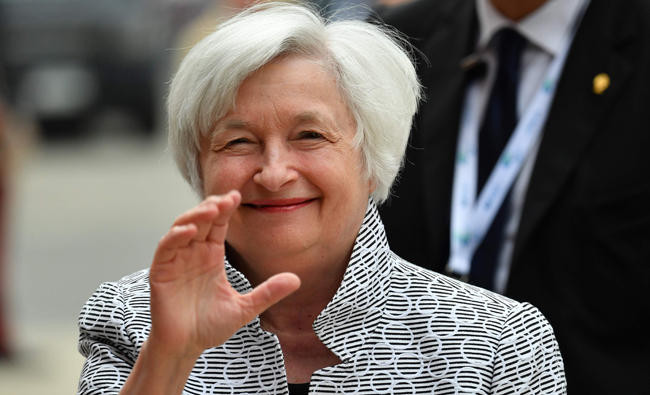
US Federal Reserve Chairperson Janet Yellen
Updated 25 May 2017
Follow

Minutes from Federal Reserve weigh on dollar, euro resumes climb

LONDON: The dollar was on the defensive on Thursday, with investors low on incentives to buy the greenback after the Federal Reserve dialled down some expectations that it would hike interest rates soon, while the euro began to climb back toward a 6-1/2-month high.
Fed policymakers agreed they should hold off on raising interest rates until they see evidence that a recent economic slowdown was transitory, the minutes from their last policy meeting showed on Wednesday.
The minutes were seen to indicate heightened Fed caution toward interest rate hikes and took the wind out of an earlier bounce by the dollar, which had been plagued recently by US political concerns centered on President Donald Trump.
The dollar index against a basket of major currencies . was down 0.3 percent at 96.972.
“The minutes, while leaving the door open for another rate hike weren’t as hawkish as some investors had been expecting — there had been speculation ahead of time that hawkish tones could be quite supportive for the dollar,” said Alexandra Russell-Oliver, currency analyst at Caxton FX in London.
“I think some of those expectations were a bit disappointed following the minutes and we’ve seen the dollar ease off since. That’s also because it’s been quite vulnerable recently.”
The dollar rose 0.3 percent to 111.830 yen, pushed away from Tuesday’s one-week high of 112.130 yen.
The euro, which went as low as $1.1168 overnight, was 0.2 percent higher at $1.1240, making its way back toward the 6-1/2-month peak of $1.1268 touched on Tuesday.
The common currency has enjoyed a bull run this month on factors including an ebb in French political concerns and upbeat euro zone data.
“The euro is resuming its advance with the dollar sagging on the Fed’s minutes. It has the momentum to surpass the $1.1300 mark and we could see the rise continue toward $1.1500,” said Daisuke Karakama, market economist at Mizuho Bank in Tokyo.
“That said, the market is low on incentives after the Fed minutes’ release. We have to wait until the US non-farm payrolls report for the next big event, with dealers keeping an eye on any irregular Trump-related news headlines in the meantime.”
The Canadian dollar was at C$1.3405 per dollar after touching C$1.3389, its strongest since April 19, after the Bank of Canada gave a more upbeat assessment of the economy than some investors expected.
Stronger crude oil prices, which have bounced sharply from multi-month lows seen earlier in the month amid hopes that an OPEC-led production cut would be extended, have also supported the loonie this week.
Other oil-linked currencies also gained.
The Norwegian crown stood at 9.3326 per euro for a gain of about 0.2 percent on the week. The currency has managed to put some distance between a nine-month low of 9.577 plumbed three weeks ago when oil prices fell to their lowest levels since November.
The Australian dollar was 0.2 percent higher at $0.7485 after Wednesday’s fall to $0.7443 following rating agency Moody’s downgrade of China.
The Australian dollar is often used as a liquid proxy for China-related trades.


Saudi investment pipeline active as reforms advance, says Pakistan minister

Updated 08 February 2026
Follow

Saudi investment pipeline active as reforms advance, says Pakistan minister

ALULA: Pakistan’s Finance Minister Mohammed Aurangzeb described Saudi Arabia as a “longstanding partner” and emphasized the importance of sustainable, mutually beneficial cooperation, particularly in key economic sectors.

Speaking to Arab News on the sidelines of the AlUla Conference for Emerging Market Economies, Aurangzeb said the relationship between Pakistan and Saudi Arabia remains resilient despite global geopolitical tensions.

“The Kingdom has been a longstanding partner of Pakistan for the longest time, and we are very grateful for how we have been supported through thick and thin, through rough patches and, even now that we have achieved macroeconomic stability, I think we are now well positioned for growth.”

Aurangzeb said the partnership has facilitated investment across several sectors, including minerals and mining, information technology, agriculture, and tourism. He cited an active pipeline of Saudi investments, including Wafi’s entry into Pakistan’s downstream oil and gas sector.

“The Kingdom has been very public about their appetite for the country, and the sectors are minerals and mining, IT, agriculture, tourism; and there are already investments which have come in. For example, Wafi came in (in terms of downstream oil and gas stations). There’s a very active pipeline.”

He said private sector activity is driving growth in these areas, while government-to-government cooperation is focused mainly on infrastructure development.

Acknowledging longstanding investor concerns related to bureaucracy and delays, Aurangzeb said Pakistan has made progress over the past two years through structural reforms and fiscal discipline, alongside efforts to improve the business environment.

“The last two years we have worked very hard in terms of structural reforms, in terms of what I call getting the basic hygiene right, in terms of the fiscal situation, the current economic situation (…) in terms of all those areas of getting the basic hygiene in a good place.”

Aurangzeb highlighted mining and refining as key areas of engagement, including discussions around the Reko Diq project, while stressing that talks with Saudi investors extend beyond individual ventures.

“From my perspective, it’s not just about one mine, the discussions will continue with the Saudi investors on a number of these areas.”

He also pointed to growing cooperation in the IT sector, particularly in artificial intelligence, noting that several Pakistani tech firms are already in discussions with Saudi counterparts or have established offices in the Kingdom.

Referring to recent talks with Saudi Minister of Economy and Planning Faisal Alibrahim, Aurangzeb said Pakistan’s large freelance workforce presents opportunities for deeper collaboration, provided skills development keeps pace with demand.

“I was just with (Saudi) minister of economy and planning, and he was specifically referring to the Pakistani tech talent, and he is absolutely right. We have the third-largest freelancer population in the world, and what we need to do is to ensure that we upscale, rescale, upgrade them.”

Aurangzeb also cited opportunities to benefit from Saudi Arabia’s experience in the energy sector and noted continued cooperation in defense production.

Looking ahead, he said Pakistan aims to recalibrate its relationship with Saudi Arabia toward trade and investment rather than reliance on aid.

“Our prime minister has been very clear that we want to move this entire discussion as we go forward from aid and support to trade and investment.”