


RIYADH: The US on Saturday said it hoped Hassan Rouhani, Iran’s newly re-elected president, will halt his country’s support for “destabilizing forces,” end ballistic missile tests and carry out democratic reforms during his second term.
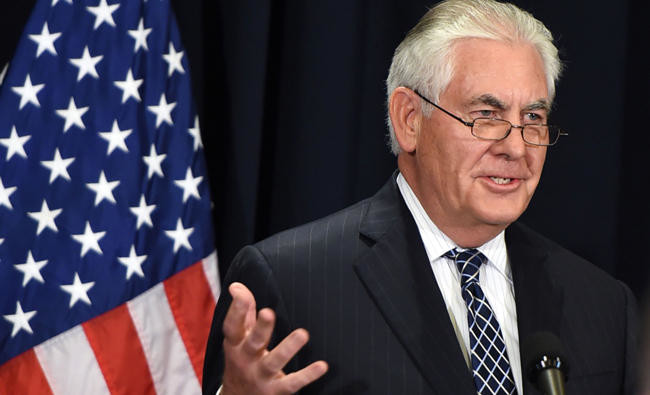
“We hope that if Rouhani wanted to change Iran’s relationship with the rest of the world, those are the things he could do,” US Secretary of State Rex Tillerson said during a joint press conference with Saudi Foreign Minister Adel Al-Jubeir.
Al-Jubeir said US President Donald Trump’s visit to Saudi Arabia marks “the beginning of a turning point” in bilateral relations.
This will contribute to enhancing cooperation between the two countries, as well as with the Arab and Islamic world, he added.
Al-Jubeir said that the strategic partnership agreement by King Salman and Trump would develop into a strong strategic partnership.
The strategy will formulate different ways to counter extremism and terrorism, increase the Kingdom’s defense capabilities and design joint defense cooperation. The visit, he said, is historic and opens the door to cooperation between the two countries in the fields of trade, investment and education.
“The two countries have signed a series of agreements, both by private, commercial, entities and inter-governmental, including on investment and infrastructure,” said Al-Jubeir.
“The value of the deals exceeds $380 billion; they will be executed over the next 10 years and will provide many opportunities both for the Kingdom and for the United States.” Al-Jubeir added that technical cooperation between the two countries will ensure economic growth and greater American investment in the Kingdom.
The focus of talks between the two leaders was the threat posed by terrorism, the sources that finance terrorists and action on Iran’s involvement in the affairs of Arab countries.
“The two sides agreed on the need to stop Iran from financing terrorist activities and the ballistic missiles it supplies to the terrorists, and address the ongoing violations of human rights in Iran, in addition to countering its interference in regional affairs,” Al-Jubeir said.
Al-Jubeir said that King Salman, in his talks with Trump, emphasized the need to find a solution to the Syrian crisis, as well as to arrive at a lasting peace between Palestinians and Israelis, as well as the situation in Yemen and private investments.
Meanwhile, Tillerson praised the new scope of partnership between the two sides, describing it as a turning point in the ties between Saudi Arabia and the US. He said by working together, the two sides will be able to promote peace and economic development, to benefit the people of the region.
Tillerson also stressed that it is important to show solidarity to move forward and consolidate the security interests of both countries, to confront extremist terrorism and eradicate it, and to drain the terrorists’ sources of funding, and register progress in joint defense cooperation. He added that Saturday’s discussions focused on the long-standing security relations.
The US secretary of state said that over 20 licenses were issued to large US companies helping direct investment between the two countries, which will result in the creation of thousands of jobs for Americans, increase the purchase of US goods, equipment and technologies, and also benefit Saudi Arabia.
“These business deals are a clear indication of the confidence the Kingdom has in US investment. Investors in the United States enjoy a positive image and have a positive impact. President Trump seeks to promote these investment opportunities and create new jobs, and build trust between the two countries. The strong economic relationship is the basis of a strong security relationship.”
Regarding defense, Tillerson said the two sides signed agreements on border security, combating terrorism, missile defense, and on receiving updates in the field of communication and training.
The agreements will enhance the US’ and Saudi Arabia’s security while supporting the Kingdom’s plans to enhance its military capabilities to counter the Iranian influence and threats spilling across the Kingdom’s borders.
Tillerson said the US seeks to strengthen the Kingdom’s ability to contribute to the fight against terrorism in the Middle East, and improve its capability to face the against regional threats, which is one of the US national security priorities.
Iran's Network of terrorism
While Khamenei gave Rouhani some leeway to negotiate the nuclear deal, other reforms he sought at home, especially greater political freedoms for Iranians, were stymied by Khamenei and the powerful Islamic Revolutionary Guard Corps.
Trump, a Republican, has harshly criticized the nuclear accord struck under predecessor President Barack Obama, a Democrat, but he has kept it alive while signaling a desire to confront Iran more directly.
Washington says Tehran’s support for Syrian President Bashar Assad in Syria’s civil war, Houthi rebels in Yemen, and the Hezbollah political party and militia in Lebanon contribute to instability in the Middle East. (With Reuters)


