BERLIN: The scandal surrounding an attack plot hatched by two far-right soldiers has again forced Germany to confront its dark past — specifically, the role of the Wehrmacht in the Third Reich.
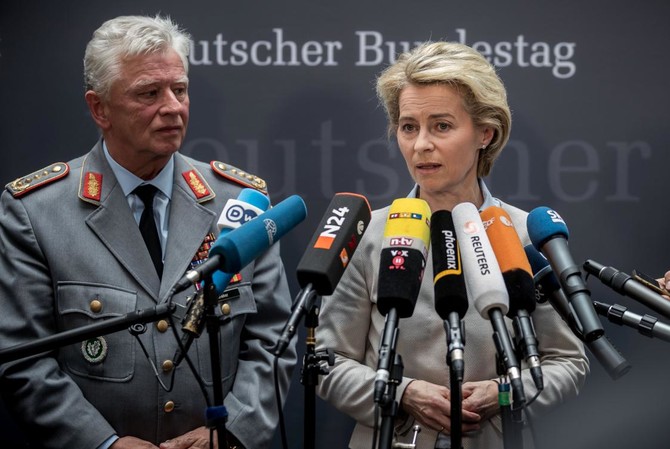
Defense Minister Ursula von der Leyen has ordered the Bundeswehr to cleanse itself of all links to the Nazi-era army that set the world aflame under Adolf Hitler over 70 years ago.
What seems like an obvious and belated step to many, given documented Wehrmacht atrocities in World War II especially on the eastern front, has also sparked criticism of a “witch hunt” and an unjust blanket condemnation of the conscript army.
Parliament was set to debate the sensitive historical question, brought to the fore by the arrests since last month of lieutenant Franco Albrecht, 28, and two alleged co-conspirators including another soldier.
In the bizarre case, far-right extremist Albrecht allegedly created the fake identity of a Syrian refugee who was granted asylum status, a bed in a shelter and welfare payments.
Prosecutors say Albrecht then planned to shoot a pro-refugee politician, possibly former President Joachim Gauck, and blame the murder on his fictious Syrian alter ego to stoke public fears about militant terror.
After Albrecht’s arrest, von der Leyen was incensed to learn that steel helmets and other memorabilia of the World War II army were openly on display at the Franco-German barracks where the army suspects were stationed.
Angry that earlier evidence of Albrecht’s far-right worldview had been ignored by superiors out of “a misunderstood esprit de corps,” she has ordered the Bundeswehr to sweep all barracks for Wehrmacht items and images.
“The Wehrmacht is not part of the tradition of the Bundeswehr,” said the minister who is often seen as a possible successor to Chancellor Angela Merkel.
She ordered a review of the army’s 1982 “decree on traditions” which allows displaying Wehrmacht items within their “historical context.”
She also said new names would have to be found for barracks still named after World War II figures, including field marshall Erwin Rommel, dubbed the “Desert Fox” for his North Africa campaign.
While there is mainstream condemnation for the Nazis, Gestapo and SS troops, the role of the millions-strong conscript army is more ambiguous in the minds of many Germans.
Hans-Peter Uhl of the conservative Christian Social Union (CSU) criticized von der Leyen’s “blanket condemnation” of all German soldiers of the era, urging some “respect for our fathers and grandfathers.”
The party’s parliamentary vice president, Johannes Singhammer, said they were “drafted under the reign of terror of the Nazis.”
Criticism also came from former defense minister Rudolf Scharping of the Social Democrats (SPD), who deplored the “witch hunt.”
He was angered by a decision of the Bundeswehr University in Hamburg to take a down a picture that showed former SPD chancellor Helmut Schmidt as a young Wehrmacht officer.
“That is cheap, it is outrageous,” Scharping wrote in a newspaper commentary, charging that “iconoclastic action does not make up a failure to deal with right-wing extremists in the ranks of the Bundeswehr.”
Theo Sommer, a former senior defense bureaucrat, labelled the sweep “an overreaction, which casts suspicion of Wehrmacht nostalgia over the entire armed forces.”
He added: “I won’t hide the photo of my father as a Wehrmacht soldier in a drawer.
“He served in Rommel’s Africa Corps and came back from the war with a belly shot — a brave, upright man who was abused by an ominous, criminal system. I see no reason to be ashamed of him.”
Von der Leyen has been undeterred, a position welcomed by many lawmakers and voters.
In the mid-1990s, traveling exhibitions extensively documented Wehrmacht war crimes against Jews, civilians and prisoners of war in eastern Europe and Russia.
More than one million people saw the exhibitions, which were frequently targeted by right-wing protests.
The minister has argued that the Bundeswehr should look at its own 60-year tradition in defense of a liberal democracy as a source of pride and meaning.
The Bundeswehr was founded as a purely defense military, but this has since the 1990s been interpreted to cover peacekeeping and conflict prevention abroad.
The now 180,000-strong armed forces have joined multinational missions from Kosovo to Afghanistan and Mali which must be mandated by parliament.
German troops — all volunteers since male conscription ended in 2011 — make their pledge at the Berlin Bendlerblock site that was the headquarters of the unsuccessful military resistance against Hitler.


![]()

German far-right plot rekindles debate on Nazi-era Wehrmacht
German far-right plot rekindles debate on Nazi-era Wehrmacht
Ex-Philippine leader Duterte to face ICC hearing Feb 23
THE HAGUE: Former Philippines president Rodrigo Duterte will face a hearing at the International Criminal Court next month, judges ruled on Monday, rejecting arguments the 80-year-old was unfit to take part.
Duterte will face a so-called “confirmation of charges” hearing starting February 23, where judges decide whether the prosecution’s allegations are strong enough to proceed to trial.
“Having regard to the relevant legal principles, the medical assessment of the independent experts... and all of the relevant circumstances of the case, the Chamber was satisfied that Mr.Duterte is able effectively to exercise his procedural rights,” the court said.
Duterte is “therefore fit to take part in the pre-trial proceedings,” the ICC added.
ICC prosecutors have charged Duterte with three counts of crimes against humanity, alleging his involvement in at least 76 murders as part of his “war on drugs.”
The first count concerns his alleged involvement as a co-perpetrator in 19 murders carried out between 2013 and 2016 while Duterte was mayor of Davao City.
The second count relates to 14 murders of so-called “High Value Targets” in 2016 and 2017 when Duterte was president.
And the third charge is about 43 murders committed during “clearance” operations of lower-level alleged drug users or pushers.
These took place across the Philippines between 2016 and 2018, the prosecution alleged.
In October, the court had already rejected a defense plea for early release, arguing he posed a flight risk and could be in a position to influence witnesses if freed.
Duterte was arrested in Manila on March 11, flown to the Netherlands that same night and has been held at the ICC’s detention unit at Scheveningen Prison since.
He followed his initial hearing by video link, appearing dazed and frail and barely speaking.
Duterte will face a so-called “confirmation of charges” hearing starting February 23, where judges decide whether the prosecution’s allegations are strong enough to proceed to trial.
“Having regard to the relevant legal principles, the medical assessment of the independent experts... and all of the relevant circumstances of the case, the Chamber was satisfied that Mr.Duterte is able effectively to exercise his procedural rights,” the court said.
Duterte is “therefore fit to take part in the pre-trial proceedings,” the ICC added.
ICC prosecutors have charged Duterte with three counts of crimes against humanity, alleging his involvement in at least 76 murders as part of his “war on drugs.”
The first count concerns his alleged involvement as a co-perpetrator in 19 murders carried out between 2013 and 2016 while Duterte was mayor of Davao City.
The second count relates to 14 murders of so-called “High Value Targets” in 2016 and 2017 when Duterte was president.
And the third charge is about 43 murders committed during “clearance” operations of lower-level alleged drug users or pushers.
These took place across the Philippines between 2016 and 2018, the prosecution alleged.
In October, the court had already rejected a defense plea for early release, arguing he posed a flight risk and could be in a position to influence witnesses if freed.
Duterte was arrested in Manila on March 11, flown to the Netherlands that same night and has been held at the ICC’s detention unit at Scheveningen Prison since.
He followed his initial hearing by video link, appearing dazed and frail and barely speaking.
Latest updates





© 2026 SAUDI RESEARCH & PUBLISHING COMPANY, All Rights Reserved And subject to Terms of Use Agreement.