JOHANNESBURG: South Africa’s highest court weighed Monday whether lawmakers can cast secret ballots in a no-confidence vote in President Jacob Zuma, who faces growing criticism within the ruling African National Congress (ANC).
Several hundred protesters marched to the Constitutional Court in Johannesburg in the latest demonstrations against Zuma, who has been implicated in a series of corruption scandals.
Opposition parties have lobbied for a secret ballot and called for ANC lawmakers to “vote with their conscience.”
The ANC holds a large majority in Parliament and Zuma has survived similar votes in the past, which have not been secret.
“ANC members of Parliament will have to choose between what is best for themselves and what is best for South Africa,” Mmusi Maimane, leader of the main opposition Democratic Alliance (DA) party, told protesters.
“They did not swear (their oath of office) to be faithful to Jacob Zuma, or to the ANC... They promised to be faithful to South Africa.”
The case united DA protesters with marchers from the radical leftist Economic Freedom Fighters (EFF) party, with the court forecast to give its ruling later in the day.
“If Parliament fails to remove Zuma, then the people in the 2019 election will make sure that the ANC is voted out,” said EFF supporter Daniel Mninele, who traveled from Pretoria to rally outside the court.
The scheduled no-confidence debate has been postponed by parliamentary Speaker Baleka Mbete, who has said she has no powers to agree to a secret ballot.
Zuma’s sacking of respected Finance Minister Pravin Gordhan in March fueled public anger over years of government corruption scandals, record unemployment and slowing economic growth.
The president has recently faced unprecedented criticism from senior ANC figures, including from Deputy President Cyril Ramaphosa.
Zuma, who came to office in 2009, is due to step down as head of the ANC in December, and as national president ahead of the 2019 general election.
He is seen as favoring his ex-wife, former African Union chief Nkosazana Dlamini-Zuma, to succeed him — rather than Ramaphosa.
“Zuma’s time is up,” 22-year-old marcher Tsido Molefe told AFP. “We are going to march until he leaves, and today we are here to support the court case,” she said.
On Monday morning, the Constitutional Court heard legal arguments in favor of the secret ballot.
The court last year found Zuma guilty of violating the constitution after he refused to repay taxpayers’ money used to refurbish his private rural house.
Zuma has been accused of being in the sway of the wealthy Gupta business family, allegedly granting them influence over government appointments, contracts and state-owned businesses.
He is also fighting a court order that could reinstate almost 800 corruption charges against him over a multi-billion dollar arms deal in the 1990s.
The dismissal of Gordhan saw the Fitch ratings agency as well as Standard and Poor’s cut South Africa’s sovereign credit rating to junk status due to fears of political instability and growing corruption.
The ANC — which Nelson Mandela led to power in the 1994 post-apartheid elections — has lost popularity in recent years, taking just 55 percent of the vote in last year’s local elections, its worst ever result.
Zuma retains widespread support from ANC members in some rural areas and has been able to rely on lawmakers to survive previous votes of no confidence.


![]()
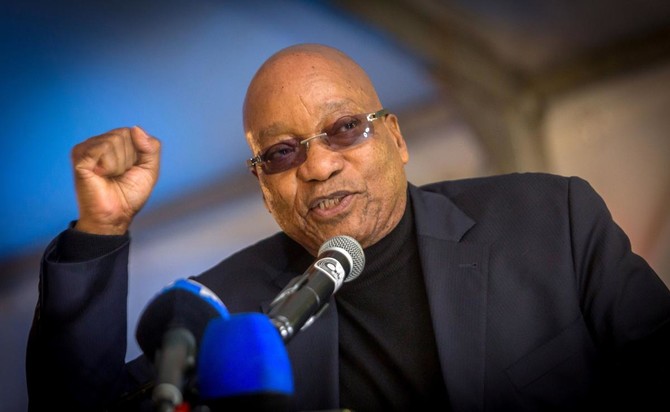
S. Africa court to rule on Zuma confidence vote
S. Africa court to rule on Zuma confidence vote

Latest updates


© 2026 SAUDI RESEARCH & PUBLISHING COMPANY, All Rights Reserved And subject to Terms of Use Agreement.