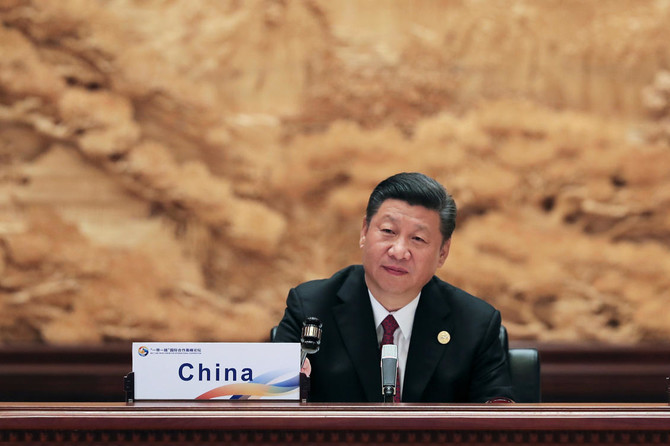
BEIJING: Chinese President Xi Jinping on Monday urged major multilateral institutions to join his new Belt and Road Initiative, stressing the importance of rejecting protectionism in seeking global economic growth.
Addressing other world leaders at a summit on the initiative in Beijing, Xi said it was necessary to coordinate policies with the development goals of institutions including the Asia-Pacific Economic Cooperation (APEC), ASEAN, African Union and the European Union.
Xi pledged $124 billion on Sunday for his new Silk Road which aims to bolster China’s global leadership ambitions by expanding links between Asia, Africa, Europe and beyond, as US President Donald Trump promotes “America First.”
“We need to improve policy coordination and reject beggar-thy-neighbor practices,” Xi said on Monday.
“This is an important lesson that can be drawn from the global financial crisis and is still very relevant to the development of the world economy today,” he said.
“We need to seek win-win results through greater openness and cooperation, avoid fragmentation, refrain from setting inhibitive thresholds for cooperation or pursuing exclusive arrangements and reject protectionism.”
The Belt and Road initiative is seen as part of China’s answer to the Trans-Pacific Partnership (TPP) deal, a regional trade pact involving Pacific Rim countries, but excluding China.
The TPP, touted by the previous US administration of President Barack Obama, has effectively been killed by Trump, who has withdrawn US support.
In contrast, Xi said China’s Belt and Road plan would be inclusive and open to all. He said deep-seated problems in global development had yet to be addressed effectively, with international trade and investment sluggish, and economic globalization encountering headwinds.
“In a world of growing interdependency and challenges, no country can tackle the challenges, also the world’s problems, on its own,” Xi said.
Leaders from 29 countries attended the Belt and Road forum, as well as the heads of the United Nations, International Monetary Fund and World Bank.
But some Western diplomats have expressed unease about both the summit and the plan as a whole, seeing it as an attempt to promote Chinese influence globally. They are also concerned about transparency and access for foreign firms to the scheme.

China’s Xi says Belt and Road needs to reject protectionism
Saudi Arabia leads outcome-based education to prepare future-ready generations: Harvard Business Review
- The Riyadh-based school group developed a strategy that links every classroom activity to measurable student competencies, aiming to graduate learners equipped for the digital economy and real-world contexts
RIYADH: Saudi Arabia’s education system is undergoing a sweeping transformation aligned with Vision 2030, shifting from traditional, input-focused methods to outcome-based education designed to equip students with future-ready skills, Harvard Business Review Arabic reported.
The transformation is being adopted and spearheaded by institutions such as Al-Nobala Private Schools, which introduced the Kingdom’s first national “learning outcomes framework,” aimed at preparing a generation of leaders and innovators for an AI-driven future, the report said.
Al-Nobala has leveraged international expertise to localize advanced learning methodologies.
The Riyadh-based school group developed a strategy that links every classroom activity to measurable student competencies, aiming to graduate learners equipped for the digital economy and real-world contexts. The school’s group approach combines traditional values with 21st-century skills such as critical thinking, communication, innovation and digital fluency.
According to the report, the shift addresses the growing gap between outdated models built for low-tech, resource-constrained environments and today’s dynamic world, where learners must navigate real-time information, virtual platforms, and smart technologies.
“This is not just about teaching content, it’s about creating impact,” the report noted, citing how Al-Nobala’s model prepares students to thrive in an AI-driven world while aligning with national priorities.
The report noted that Saudi Arabia’s Ministry of Education has paved the way for this shift by transitioning from a centralized controller to a strategic enabler, allowing schools such as Al-Nobala to tailor their curriculum to meet evolving market and societal needs. This is part of the long-term goal to place the Kingdom among the top 20 global education systems.
Al-Nobala’s work, the report stated, has succeeded in serving the broader national effort to link education outcomes directly to labor market demands, helping to fulfill the Vision 2030 pillar of building a vibrant society with a thriving economy driven by knowledge and innovation.
Last February, Yousef bin Abdullah Al-Benyan, Saudi Arabia’s minister of education, said that the Kingdom was making “an unprecedented investment in education,” with spending aligned to the needs of growth and development. He said that in 2025, education received the second-largest share of the state budget, totaling $53.5 billion.