RIYADH: Saudi Arabia and China could work together and link Saudi Vision 2030 and China’s “One Belt One Road Initiative” for the benefit of both countries, said Ambassador Li Huaxin following a press conference recently at the Chinese Embassy in Riyadh.
“If we connect them together, it will create very good opportunities for both sides and not just the two sides, even other sides will benefit from this connection,” he said.
“I can tell you that different government bodies and ministries met to discuss it; they already have some specific projects in this field and hope this will come true very soon.”
Saudi Vision 2030 aims to diversify revenue sources and develop a knowledge-based economy while the “One Belt One Road Initiative” aims to create the largest economic corridor in the world.
“We think Vision 2030 is a sustainable development strategy by the Kingdom and offers a good chance for Chinese companies to participate to work together to benefit both sides,” Li said.
At the press conference, the ambassador said the “Belt and Road Forum” for international cooperation will be held next week on May 14 and 15 in Beijing.
The forum aims to build a more open and effective international platform for cooperation and partnership. The envoy said that China has invited leaders of nearly 20 countries to attend the forum to discuss how to take this initiative forward in the future.
He said the Kingdom has also been invited, but since King Salman visited China in March, Khalid Al-Falih, minister of energy, industry and mineral resources is going to attend the forum instead with a delegation including senior officials and businessmen.
He said Al-Falih will be speaking at a session, adding: “I think it is a good opportunity to share his ideas at this important forum, especially how to build this initiative in the future.”
President Xi Jinping will attend the opening ceremony of the forum, he added.
The forum has been designed to identify cooperation directions, push forward the implementation of projects and improve supporting systems.
The Belt and Road comprises the land-based Silk Road economic belt and the 21st-century maritime Silk Road, which were put forward for the first time by President Xi in September and October 2013 in his subsequent state visits to Kazakhstan and Indonesia.


China seeks closer ties with Saudi Arabia on ‘Belt and Road Initiative’

China seeks closer ties with Saudi Arabia on ‘Belt and Road Initiative’

Deals worth $8bn signed at World Defense Show 2026
- Five-day event brought together 1,486 exhibitors from 89 countries and attracted 137,000 visitors
- Andrew Pearcey: We look at the industry and the trends, and see other new features that we can bring to the show
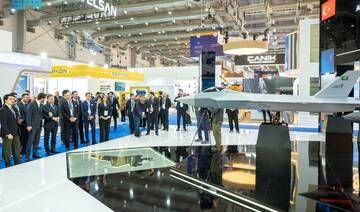
RIYADH: More than 60 military and defense deals worth SR33 billion ($8.8 billion) were signed at the third edition of the World Defense Show, which ended on Thursday in Riyadh.
The flagship defense exhibition is part of Saudi efforts to expand its military industries sector.
Organized by the General Authority for Military Industries, the five-day event brought together 1,486 exhibitors from 89 countries and attracted 137,000 visitors, according to official figures announced at the closing media briefing on Thursday.
Ahmad Al-Ohali, governor of the General Authority for Military Industries, said the event reflects broader efforts to localize defense spending under Vision 2030.
“When we started in 2018, the percentage of military spending from within the Kingdom of Saudi Arabia was 4 percent of total spending; by the end of 2024, it jumped to 25 percent,” he said.
Al-Ohali added that number of national cadres working in the sector increased from 25,000 male and female employees in 2020 to 34,000 — a rise of 40 percent.
Beyond attendance and displays, the exhibition served as a venue for commercial and government agreements.
The number of agreements signed reached 220, including 93 government-to-government agreements and 127 partnership agreements with companies.
Al-Ohali said the deals include technology transfer and local manufacturing projects aimed at strengthening domestic supply chains.
Aerial and static displays included 63 aircraft, alongside more than 700 pieces of military equipment exhibited across indoor and outdoor platforms. Maritime and unmanned systems were also showcased through dedicated demonstration areas.
Andrew Pearcey, CEO of the World Defense Show, said that planning for the next edition had already begun.
“So, what we do is we take stock of our successes, so we’re now starting to see what worked, and we also learned that some things that didn’t work,” Pearcey told Arab News.
“Over time, one of the key things is to try and grow; the demand for this show is huge, so we want to try and accommodate that.
“So, we need to try and build more space. Then we look at ways we brought new features to this show. So, we look at the industry and the trends, and see other new features that we can bring to the show.”
The event also introduced a “Future Talent Program” during its final two days, inviting students aged 16 to university level to explore career opportunities in the defense sector.
“The future talent program is where we invite youngsters, so from 16 up to university level, to come and look at the show, understand what career opportunities there are in the defense industry, sit and do some content programs, and meet the exhibitors that want to demonstrate some of their things,” Pearcey said.
“So, we bring around 4,000 to 5,000 students to the show. So, that’s bringing that next generation through.”