ANKARA/JERUSALEM: Barely a year after reconciling and restoring diplomatic ties, Turkey and Israel were back at each other's throat on Monday.
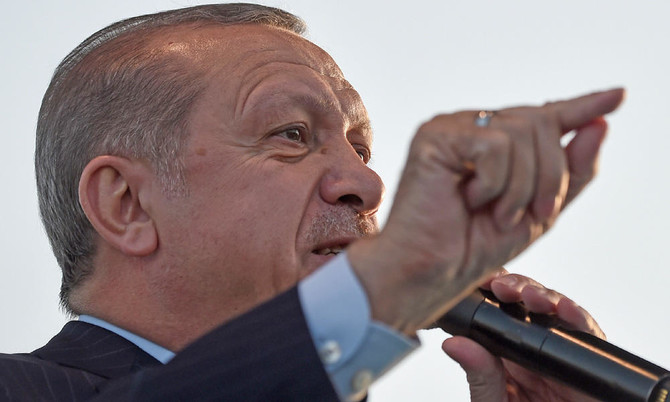
Turkish President Recep Tayyip Erdogan called on Muslims to stand up for the Palestinian cause, saying each day that Jerusalem remains under “occupation” is an insult to them. His words drew strong criticism from Israel, which called him a "serial human rights violator."
Speaking in Istanbul on Monday, Erdogan compared Israeli actions against Palestinians to those of South Africa under Apartheid and said the United States must drop plans to move its embassy from Tel Aviv to Jerusalem.
Erdogan, a fervent supporter of Palestinians, normalized relations with Israel in June last year after bilateral ties deteriorated over the 2010 Israeli raid on a Gaza-bound aid ship that killed 10 Turkish activists.
On Monday, he vowed to prevent a draft bill being advanced in Israel that would prevent the use of speakers mounted on minarets to summon Muslims for prayer overnight.
The bill, which was approved by ministers in February but has yet to be adopted by parliament, would apply to mosques in Israel as well as annexed Arab east Jerusalem, but not to the highly sensitive Al-Aqsa mosque compound, Islam’s third holiest site.
“God willing, we will never allow the silencing of azan (call to prayers) in the skies of Jerusalem,” Erdogan said at the International Jerusalem Foundations Forum in Istanbul.
Erdogan accused Israel of keeping Jerusalem “without the Muslims.”
“What’s the difference of Israel’s current practices from the racist and discriminatory policies implemented toward the blacks in America in the past, and in South Africa more recently?” he asked.
The Turkish president also spoke out against the possibility of moving the US embassy in Israel from Tel Aviv to Jerusalem, warning that even “relocating a stone” in the Holy City could have serious implications.
“The debates over the possibility of US moving its Israel embassy to Jerusalem are extremely wrong and should certainly drop from the agenda,” he said.
‘Serial human rights violator’
The Israeli Foreign Ministry accused Erdogan of “systematically” violating human rights and said he “should not preach morality.”
“Whoever systematically violates human rights in their own country should not preach morality to the only true democracy in the region,” said Israeli foreign ministry spokesman Emmanuel Nahshon.
“Israel consistently protects total freedom of worship for Jews, Muslims and Christians — and will continue to do so despite the baseless smears launched against it,” he said in a statement.
US President Donald Trump had promised during his campaign to move the American embassy to Jerusalem, whose status is one of the thorniest issues of the Israeli-Palestinian conflict.
Israel occupied the West Bank and east Jerusalem in 1967. It later annexed east Jerusalem in a move never recognized by the international community.
Israel supports the US moving its embassy.


![]()
Erdogan slams Israeli crimes against Palestinians, drawing sharp rebuke
Erdogan slams Israeli crimes against Palestinians, drawing sharp rebuke
Latest updates




© 2026 SAUDI RESEARCH & PUBLISHING COMPANY, All Rights Reserved And subject to Terms of Use Agreement.