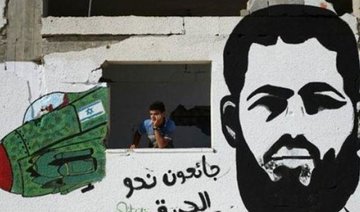
CAIRO: The Arab League called Thursday on the UN to open an international inquiry into “violations” against Palestinian prisoners in Israeli jails as some inmates enter their third week of hunger strikes.
The pan-Arab body “invites the UN and its relevant specialized agencies to send an international commission of inquiry to Israeli prisons,” representatives said in a resolution adopted Thursday.
The commission would “view the violations being committed against the prisoners of war,” and to press international actors to compel Israel to abide by the Geneva convention.
The move came as about 1,000 Palestinian prisoners are fasting in a protest launched on April 17 by jailed leader Marwan Barghouti demanding improved conditions including family visits, better medical care and phone access.
Those taking part are ingesting only water and salt. It is unclear how many have been on strike for the full period as some of the original participants have since pulled out while others appeared to have joined.
The Arab League also demanded all “relevant international institutions and bodies” to “intervene immediately and urgently to compel the Israeli government to apply international humanitarian law,” according to the resolution.
It “condemned the Israeli occupation authorities in their ongoing detention of thousands of Palestinian prisoners... including children, women, and political leaders and elected representatives.”

Arab League urges UN to probe ‘violations’ in Israeli prisons
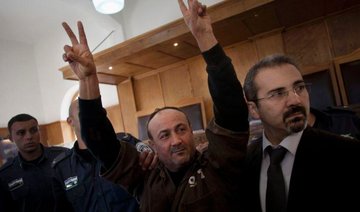
Turkiye’s Kurdish party says Syria deal leaves Ankara ‘no excuses’ on peace process
ANKARA: Turkiye’s pro-Kurdish DEM Party said on Monday that the Turkish government had no more “excuses” to delay a peace process with the Kurdistan Workers Party (PKK) now that a landmark integration deal was achieved in neighboring Syria.
On Sunday in Syria, the Kurdish-led Syrian Democratic Forces (SDF) agreed to come under the control of authorities in Damascus — a move that Ankara had long sought as integral to its own peace effort with the PKK. “For more than a year, the government has presented the SDF’s integration with Damascus as the biggest obstacle to the process,” Tuncer Bakirhan, co-leader of the DEM Party, told Reuters, in some of the party’s first public comments on the deal in Syria.
“The government will no longer have any excuses left. Now it is the government’s turn to take concrete steps.” Bakirhan cautioned President Tayyip Erdogan’s government against concluding that the rolling back Kurdish territorial gains in Syria negated the need for a peace process in Turkiye. “If the government calculates that ‘we have weakened the Kurds in Syria, so there is no longer a need for a process in Turkiye,’ it would be making a historic mistake,” he said in the interview.
Turkish officials said earlier on Monday that the Syrian integration deal, if implemented, could
advance the more than year-long process with the PKK, which is based in northern Iraq. Erdogan urged
swift integration of Kurdish fighters into Syria’s armed forces. Turkiye, the strongest foreign backer of Damascus, has since 2016 repeatedly sent forces into northern Syria to curb the gains of the SDF — which after the 2011–2024 civil war had controlled more than a quarter of Syria while fighting Islamic State with strong US backing.
The United States has built close ties with Damascus over the last year and was closely involved in mediation between it and the SDF toward the deal.
Bakirhan said progress required recognition of Kurdish rights on both sides of the border.
“What needs to be done is clear: Kurdish rights must be recognized in both Turkiye and Syria, democratic regimes must be established, and freedoms must be guaranteed,” he said.
On Sunday in Syria, the Kurdish-led Syrian Democratic Forces (SDF) agreed to come under the control of authorities in Damascus — a move that Ankara had long sought as integral to its own peace effort with the PKK. “For more than a year, the government has presented the SDF’s integration with Damascus as the biggest obstacle to the process,” Tuncer Bakirhan, co-leader of the DEM Party, told Reuters, in some of the party’s first public comments on the deal in Syria.
“The government will no longer have any excuses left. Now it is the government’s turn to take concrete steps.” Bakirhan cautioned President Tayyip Erdogan’s government against concluding that the rolling back Kurdish territorial gains in Syria negated the need for a peace process in Turkiye. “If the government calculates that ‘we have weakened the Kurds in Syria, so there is no longer a need for a process in Turkiye,’ it would be making a historic mistake,” he said in the interview.
Turkish officials said earlier on Monday that the Syrian integration deal, if implemented, could
advance the more than year-long process with the PKK, which is based in northern Iraq. Erdogan urged
swift integration of Kurdish fighters into Syria’s armed forces. Turkiye, the strongest foreign backer of Damascus, has since 2016 repeatedly sent forces into northern Syria to curb the gains of the SDF — which after the 2011–2024 civil war had controlled more than a quarter of Syria while fighting Islamic State with strong US backing.
The United States has built close ties with Damascus over the last year and was closely involved in mediation between it and the SDF toward the deal.
Bakirhan said progress required recognition of Kurdish rights on both sides of the border.
“What needs to be done is clear: Kurdish rights must be recognized in both Turkiye and Syria, democratic regimes must be established, and freedoms must be guaranteed,” he said.
© 2026 SAUDI RESEARCH & PUBLISHING COMPANY, All Rights Reserved And subject to Terms of Use Agreement.