WASHINGTON: An Arab News/YouGov poll that exposed a big “knowledge gap” about the Arab world among Americans, presents both gaps and opportunities in people-to-people relations, US and international experts said.
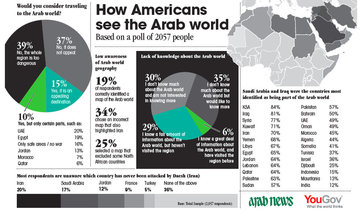
The poll found that 65 percent of the 2,057 American respondents surveyed said that they do not know much about the Arab world. And more than one-fifth identified the fictional “Sultanate of Agrabah” as part of the region, and an even higher proportion — 38 percent — said they would be happy with a US travel ban on citizens of Agrabah should they be proven a threat.
Over three-quarters of the respondents said they would not consider traveling to the Arab world, with 39 percent saying the whole region is too dangerous to visit. And while almost eight in 10 said they follow international news, of those only 24 percent tune into news about the Arab world.
Half of the respondents to the survey said US media do not provide sufficient coverage of the Arab world, with many saying they would like more social and cultural news from the region.
Here three experts react to the findings of the apparent gap in US knowledge about the region:
Merissa Khurma, Non-resident fellow at the New America Foundation’s International Security Program. @MerissaKhurma
The lack of knowledge about the Arab world and limited interest in learning more about it reinforces the notion that there is indeed a disconnect between US foreign policy in the region and the American people.
It is also a disconcerting finding because we tend to fear and mistrust what we do not know. These numbers help explain the rise in hate crimes against Arab and Muslim communities in America, which are often seen as one and the same community.
US involvement in the region has also been defined through the national security prism, particularly post-9/11, and so information about the region is connected to a negative milestone in America’s history. It is, therefore, not surprising that most respondents were able to identify Saudi Arabia, where 15 out of the 19 hijackers came from, and Iraq, where America went to war post-9/11.
Travel: This lack of knowledge also helps explain the lack of interest in better understanding the Arab world or the paucity of travel to the region as the findings also show.
Geography: The inability of most respondents to locate the Arab world on a map also helps explain the root cause of this lack of knowledge or interest about the region. We will have to explore how or if the region is featured in American textbooks. Other studies have shown that American students perform poorly in geography.
While the media has a responsibility to cover the region differently beyond the national security story, Arab Americans and Arabs living in America should also be more engaged in addressing this chasm in understanding. There are other mediums to educate, including film and the arts — as the findings on the “Sultanate of Agrabah” showcase.
Hussein Ibish, Senior resident scholar at the Arab Gulf States Institute. @Ibishblog
This poll almost entirely confirms long-known and well-understood features of lack of understanding about the Middle East, the Arab world and the Middle Eastern affairs by most Americans. It should be remembered that this is hardly unique to the Arab world or the Middle East. Americans are a very parochial people in terms of international relations, rarely practically concerned with overseas events unless engaged in a major war (and even then, usually because of US casualties). American culture and international soft power projection are so enormous that it is very difficult for the cultural influence of even other western, or highly developed economies such as Japan, to have a cultural influence in the US.
And, for the developing and non-western worlds, it is extremely difficult to make a major and accurate impact on American consciousness. On the other hand, both anecdotal and empirical evidence does suggest that Americans remain very fair when dealing with individuals. My own experience is that Europeans, for example, tend to harbor much more serious and less ridiculous stereotypes about non-western cultures, including the Middle East, but to retain, hold and apply prejudices very rigidly. Americans will frequently make an exception for any individual they happen to be dealing with, attributing their stereotypes to “those people over there,” and not with the person in front of them, which is much rarer when it comes to Europeans. So, this is at least one positive quality that Americans have that offsets the generalized ignorance that is often pretty striking.
It is good that people know what they do not know. And at least they know they do not know much about the Middle East. We also have long known that there is an abiding interest in learning more, which the media generally resolutely refuses to provide, about the Middle East, among those Americans who choose to consume international news.
However, we also know that this is a small minority of Americans. The intention to follow international affairs, particularly regarding the Middle East, is much like the intention to go on a crash diet: Many more people wish to do it than will ever follow through. And most people have no intention whatsoever.
The bad news: Americans are generally as ignorant as we feared. Many of them do not care. There is space for the media to educate a potentially more engaged minority, but it is likely that many of those practically speaking either cannot or will not be reached, and that the majority simply is not interested, in practice.
Emma Beals, Investigative journalist focused on Syria and the regional implications of the conflict. @ejbeals
This survey exposes, rather unsurprisingly, a gap in knowledge about the Arab world among residents of the US. Worryingly, this gap in knowledge does not appear to equate with a lack of opinions about issues like banning citizens of fictional cities. The partisan split in attitudes is also notable and reflects broader trends caused by media consumption bubbles, which have been well-documented in the US during and after the recent election. With an increase in the severity of US policy relating to the Arab world, including travel bans and recent military action in Syria, there is a clear need for more robust reporting, on a broader range of issues, from the region.
The US appetite for more society and arts and culture stories presents an opportunity. So often these areas are framed as an exception to the rule, as someone “beating the odds,” or through a counterterrorism or counter violent-extremism lens — comedy against ISIS (Daesh), girl skaters against the Taliban — that they obscure the rich, vibrant and very real cultural life of much of the Arab world. Arab institutions and western media alike could focus on sectors like the Saudi Arabia’s art scene, Jordan’s growing media and film industry, Lebanon’s vibrant food culture and the region’s incredible cartooning community, to name just a few examples, whetting the public’s attitude for cultural news, while increasing their understanding of the region outside of the often-dramatic news cycle.