ISTANBUL: Tensions rose Saturday along the Turkish-Syrian border as both Turkey and the US moved armored vehicles to the region and Turkey’s leader once again demanded that the United States stop supporting the Syrian Kurdish militants there.
The relocation of Turkish troops to an area near the border with Syria comes a day after US troops were seen patrolling the tense border in Syria. Those patrols followed a Turkish airstrike against bases of Syrian Kurdish militia, Washington’s main ally in combating Daesh militants in Syria.
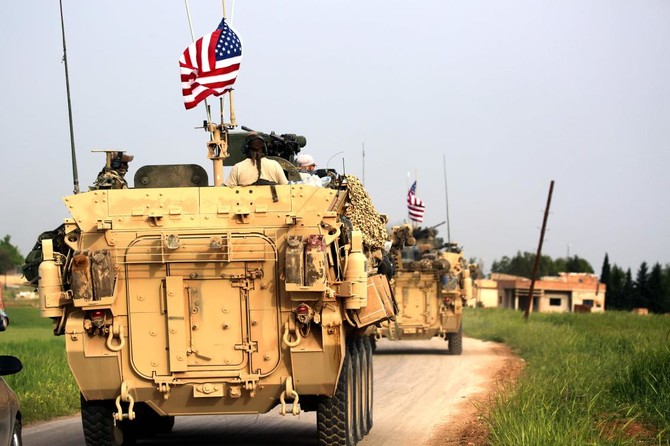
More US troops were seen Saturday in armored vehicles in Syria in Kurdish areas. Kurdish officials describe US troop movement as “buffer” between them and Turkey.
But Turkey views Syria’s Kurdish People’s Protection Units, known as YPG, as a terrorist organization and an extension of the Kurdish militants who have been waging a three-decade-long insurgency against Turkey.
“The YPG, and you know who’s supporting them, is attacking us with mortars. But we will make those places their grave, there is no stopping,” President Recep Tayyip Erdogan said.
Footage shot Friday night showed a long line of Turkish trucks carrying military vehicles driving to the border area. The private Ihlas news agency IHA reported the convoy was heading to southeastern Sanliurfa province from Kilis in the west. The base is 50 kilometers (30 miles) from Syria’s Tal Abyad, a town controlled by the Kurdish militia.
The agency said the relocation comes after Turkish officials announced the completion of a phase of Turkey’s cross-border operation of Euphrates Shield in Syria, adding that the force may be used against Syrian Kurdish militants “if needed.”
Tensions in the border area rose this week when Turkey conducted airstrikes against bases for YPG group in Syria and Iraq on Tuesday. The Turkish military said it killed at least 90 militants and wounded scores. The Kurdish group in Syria said 20 of its fighters and media activists were killed in the strike, which was followed by cross-border clashes.
Erdogan hinted his country is also ready to repeat its attacks in Sinjar, Iraq, to prevent it from turning into a base for the Kurdish militia.
Kurdish officials said the US patrols are monitoring the Turkish-Syrian border to prevent an increase in tensions with Turkey, a NATO member and US ally.
On Saturday, more US troops in armored vehicles arrived in Kurdish areas, passing through Qamishli town, close to the border with Turkey. The town is mostly controlled by Kurdish forces, but Syrian government troops hold pockets of territory there, including the airport.
The convoy was followed by another of YPG militia. Some footage posted online showed Kurdish residents cheering American-flagged vehicles as they drove by.
US officials say the troop movement is part of its operations with the Kurdish forces in northern Syria.
Ankara sent its troops into Syria last August in a military operation triggered in large part by the Kurdish group’s expansion along its borders.
The issue has been a source of tension between Ankara and Washington that threatens to hamper the fight against Daesh militants. Instead of working with the Syrian Kurds, Turkey is pressing the US to let its army join the campaign for Raqqa, the self-proclaimed capital of Daesh.
Erdogan is due in Washington on May 16 for his first meeting with US President Donald Trump.
Claiming that his country is leading the most effective campaign against Daesh, Erdogan said: “Let us, huge America, all these coalition powers and Turkey, let us join hands and turn Raqqa to Daesh’s grave,” using the Arabic acronym for Daesh.
The YPG forms the backbone of the US-backed Syria Democratic Forces (SDF).
Redur Khalil, the spokesman for the YPG in Syria, said Turkey is reinforcing its border posts opposite Tal Abyad as well as other border posts.
“We hope that this military mobilization is not meant to provoke our forces or for another purpose linked to entering Syrian territories. We don’t want any military confrontation between us, since our priority is to fight Daesh in Raqqa and Tabqa,” Khalil told The Associated Press in text messages.
Khalil said his forces were not building up in the area.
___
El Deeb contributed from Beirut.


![]()

Tensions rise between Turkey, US along Syrian border
Tensions rise between Turkey, US along Syrian border
Israel to terminate MSF work in Gaza for failing to provide Palestinian staff list
JERUSALEM: Israel announced Sunday it was terminating Doctors Without Borders’ humanitarian operations in Gaza after the charity failed to provide a list of Palestinian staff, a move MSF said was a “pretext” to obstruct aid to the war-devastated territory.
In December, Israel announced it would prevent 37 aid organizations, including MSF, from working in Gaza from March 1 for failing to submit detailed information about their Palestinian employees, drawing widespread condemnation from NGOs and the United Nations.
“The Ministry of Diaspora Affairs and Combating Antisemitism is moving to terminate the activities of Medecins Sans Frontieres (MSF) in the Gaza Strip,” the ministry said on Sunday.
The decision follows “MSF’s failure to submit lists of local employees, a requirement applicable to all humanitarian organizations operating in the region,” it added.
The ministry had earlier alleged that two MSF employees had links with Palestinian militant groups Hamas and Islamic Jihad, which the charity has vehemently denied.
On Sunday, the ministry said MSF had committed in early January to sharing the staff list, but ultimately refrained.
“Subsequently, MSF announced it does not intend to proceed with the registration process at all, contradicting its previous statements and the binding protocol,” the ministry added, saying “MSF will cease its operations and depart the Gaza Strip by February 28.”
- No assurances -
MSF said it had tried for months to engage with Israeli authorities over the issue, but its attempts were unsuccessful.
MSF charged that the ministry’s move was a “pretext to obstruct humanitarian assistance” to Gaza.
“Israeli authorities are forcing humanitarian organizations into an impossible choice between exposing staff to risk or interrupting critical medical care for people in desperate need,” it said in a statement issued on Sunday.
“MSF did not hand over staff names because Israeli authorities failed to provide the concrete assurances required to guarantee our staff’s safety, protect their personal data, and uphold the independence of our medical operation,” it said.
Such demands by Israel will force aid organizations to pull out when “needs are overwhelming and health services are collapsing” in Gaza, it said.
“At a moment when more humanitarian assistance is urgently needed, it is being restricted rather than facilitated,” the charity said, adding that it remained open for dialogue with Israeli authorities to maintain its services in Gaza and the occupied West Bank.
MSF says 15 of its employees have been killed over the course of the Gaza war.
Minister of Diaspora Affairs and Combating Antisemitism Amichai Chikli said the organization had “abruptly changed” its position.
“It appears the organization’s employees do not meet the established criteria,” Chikli said.
- Care at risk -
MSF has long been a key provider of medical and humanitarian aid in Gaza, particularly since the war broke out in October 2023 after Hamas’s attack on Israel.
The charity says it currently provides at least 20 percent of hospital beds in the territory and operates around 20 health centers.
In 2025 alone, it carried out more than 800,000 medical consultations and more than 10,000 infant deliveries, and it also provides drinking water.
Aid groups warn that without international support provided by organizations such as MSF, critical services such as emergency care, maternal health and paediatric treatment could collapse entirely in Gaza, leaving hundreds of thousands of residents without basic medical care.
As they did with MSF, the Israeli authorities have repeatedly accused the UN agency for Palestinian refugees, UNRWA, of providing cover for Hamas militants, claiming that some of its employees even took part in the October 7, 2023 attack.
A series of investigations, including one led by France’s former foreign minister Catherine Colonna, found some “neutrality-related issues” at UNRWA but stressed Israel had not provided conclusive evidence for its headline allegation.
Last month, Israeli authorities began demolishing buildings at UNRWA’s headquarters in east Jerusalem, which the organization described as an “unprecedented attack.”
UNRWA has now been banned from operating in east Jerusalem, but it continues to operate in Gaza and the Israeli-occupied West Bank.
In December, Israel announced it would prevent 37 aid organizations, including MSF, from working in Gaza from March 1 for failing to submit detailed information about their Palestinian employees, drawing widespread condemnation from NGOs and the United Nations.
“The Ministry of Diaspora Affairs and Combating Antisemitism is moving to terminate the activities of Medecins Sans Frontieres (MSF) in the Gaza Strip,” the ministry said on Sunday.
The decision follows “MSF’s failure to submit lists of local employees, a requirement applicable to all humanitarian organizations operating in the region,” it added.
The ministry had earlier alleged that two MSF employees had links with Palestinian militant groups Hamas and Islamic Jihad, which the charity has vehemently denied.
On Sunday, the ministry said MSF had committed in early January to sharing the staff list, but ultimately refrained.
“Subsequently, MSF announced it does not intend to proceed with the registration process at all, contradicting its previous statements and the binding protocol,” the ministry added, saying “MSF will cease its operations and depart the Gaza Strip by February 28.”
- No assurances -
MSF said it had tried for months to engage with Israeli authorities over the issue, but its attempts were unsuccessful.
MSF charged that the ministry’s move was a “pretext to obstruct humanitarian assistance” to Gaza.
“Israeli authorities are forcing humanitarian organizations into an impossible choice between exposing staff to risk or interrupting critical medical care for people in desperate need,” it said in a statement issued on Sunday.
“MSF did not hand over staff names because Israeli authorities failed to provide the concrete assurances required to guarantee our staff’s safety, protect their personal data, and uphold the independence of our medical operation,” it said.
Such demands by Israel will force aid organizations to pull out when “needs are overwhelming and health services are collapsing” in Gaza, it said.
“At a moment when more humanitarian assistance is urgently needed, it is being restricted rather than facilitated,” the charity said, adding that it remained open for dialogue with Israeli authorities to maintain its services in Gaza and the occupied West Bank.
MSF says 15 of its employees have been killed over the course of the Gaza war.
Minister of Diaspora Affairs and Combating Antisemitism Amichai Chikli said the organization had “abruptly changed” its position.
“It appears the organization’s employees do not meet the established criteria,” Chikli said.
- Care at risk -
MSF has long been a key provider of medical and humanitarian aid in Gaza, particularly since the war broke out in October 2023 after Hamas’s attack on Israel.
The charity says it currently provides at least 20 percent of hospital beds in the territory and operates around 20 health centers.
In 2025 alone, it carried out more than 800,000 medical consultations and more than 10,000 infant deliveries, and it also provides drinking water.
Aid groups warn that without international support provided by organizations such as MSF, critical services such as emergency care, maternal health and paediatric treatment could collapse entirely in Gaza, leaving hundreds of thousands of residents without basic medical care.
As they did with MSF, the Israeli authorities have repeatedly accused the UN agency for Palestinian refugees, UNRWA, of providing cover for Hamas militants, claiming that some of its employees even took part in the October 7, 2023 attack.
A series of investigations, including one led by France’s former foreign minister Catherine Colonna, found some “neutrality-related issues” at UNRWA but stressed Israel had not provided conclusive evidence for its headline allegation.
Last month, Israeli authorities began demolishing buildings at UNRWA’s headquarters in east Jerusalem, which the organization described as an “unprecedented attack.”
UNRWA has now been banned from operating in east Jerusalem, but it continues to operate in Gaza and the Israeli-occupied West Bank.
Latest updates


Recommended


© 2026 SAUDI RESEARCH & PUBLISHING COMPANY, All Rights Reserved And subject to Terms of Use Agreement.