BRASILIA: Fed up with endless encroachment on their ancestral lands, leaders of Brazil’s many indigenous tribes went to the capital Brasilia to speak out this week. But they had trouble finding anyone to listen.
More than 3,000 tribal members massed on the esplanade outside the government complex in Brasilia for the 14th annual “Free lands” event.
But their freedom had limits: when they tried to approach Congress on Tuesday, they were pushed back in clouds of tear gas.
“They’re prejudiced,” said Alvaro Tucano, one of the tribal members taking part in a week-long camp outside the government complex. “I have never seen such a conservative Congress as the one there is today.”
The clash provided surreal scenes of men in traditional headdresses with bows and arrows facing off against black-clad riot police.
Those who were there say the contrast reflected the permanent disconnect between Brazil’s state and the descendants of the country’s original inhabitants.
Nearly 900,000 indigenous tribe members currently live in Brazil, or 0.4 percent of the entire population, divided into 305 ethnic groups.
The statistic that matters most, however, is the 12 percent of Brazil their recognized lands cover, much of it in the Amazon.
Although most of the world sees the region as one of the planet’s greatest natural wonders, the powerful Brazilian agricultural industry values the sparsely populated lands mainly for logging and converting to farmland for soy and cattle.
The government is committed to protecting those lands — in theory. But the fact that many of the borders are not officially demarcated effectively deprives the tribal members of legal rights.
The result is constant pressure on the indigenous peoples and frequent clashes.
At least 137 tribal people were murdered in 2015, according to the Indigenous Missionary Council, run by the Catholic Church. The number of those killed since 2003 reaches above 890.
To their chagrin, the official ultimately responsible for protecting vulnerable indigenous groups in the country’s conservative government, Justice Minister Osmar Serraglio, belongs to Brasilia’s influential pro-agriculture political wing.
He recently outraged indigenous activists by saying that land is not the main issue in dispute.
“Land doesn’t fill anyone’s stomach,” he said. “We’re going to give them good living conditions, but we’re going to stop this talking about land.”
Adriana Ramos of the civil society group Social Environmental Institute says his words betray ignorance of indigenous people’s true value to Brazil as well as their longing to inhabit their own lands.
“The presence of these communities and the traditional management practices contribute to the enrichment of the forest and conservation,” he said.
Alessandra Korap, from the Munduruku ethnic group — which is resisting hydroelectric and other infrastructure developments in its Amazon homeland — says the minister just doesn’t understand the country’s native peoples.
“I would like to tell him that the land does fill our stomach,” he said.
“It’s on the land and for the land that we live,” he added. “It sustains us, gives us fish, pigs, fruits and the artisanal techniques that we use.”
“It won’t be cement that fills our stomach.”


![]()
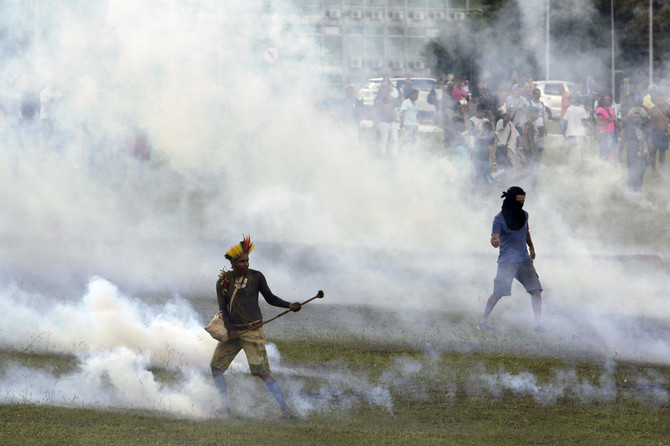
Brazil’s indigenous tribes protest against land theft
Brazil’s indigenous tribes protest against land theft
Latest updates


© 2026 SAUDI RESEARCH & PUBLISHING COMPANY, All Rights Reserved And subject to Terms of Use Agreement.