

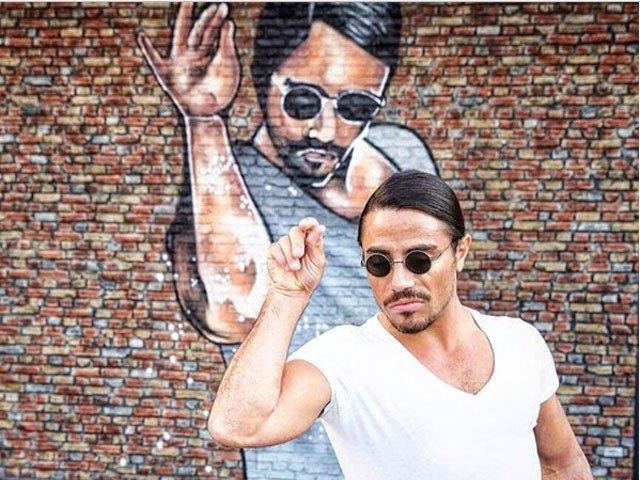
Lifting the veal off Salt Bae’s not so organic rise to fame

Nusret Gökçe. (Instagram: @nusr_et)
Updated 28 April 2017
Follow

Lifting the veal off Salt Bae’s not so organic rise to fame

JEDDAH: Nusret Gökçe, Turkish butcher and chef best known for his uniquely famous salt-sprinkling move, apparently did not gain his fame genuinely through his unmatched skills.
Dubbed ‘Salt Bae’ online, Nusret had reportedly signed a deal with an American public relations agency to further promote his now widely-recognized signature, where he paid a total sum of $2 million.
The acclaimed “meatatarian,” who took the Internet by storm, paid a substantial amount to arrange a visit by Oscar-winning actor Leonardo DiCaprio to his Dubai-based restaurant.


2017 Oscar adayi sensin dedi#saltbae #saltlife #salt @leonardodicaprio

A post shared by Nusr_et#Saltbae (@nusr_et) on

Additionally, the chef also paid for his cameo role in the “Narcos” TV series.
According to Uçankuş, a big number of celebrities were paid as well to make an appearance in Nusret’s Turkish “Nurs-Et” Steakhouse and showcase his trademark salting signature.


Senin havan başka dedi

A post shared by Nusr_et#Saltbae (@nusr_et) on

Italian football player Marco Borriello, famous singer Bruno Mars, the Golden State Warriors basketball team, FC Galatasaray forward Lukas Podolski, Brazilian footballer Matheus Doria, and many others had a share in the $2 million paid by the chef.

In January 2017, Nusret became an Internet sensation after he shared a short clip named “Ottoman steak” of his flamboyant knife-work and trademark overarm salt-sprinkle, which got 14.3 million views so far.


Birimiz hepimiz hepimiz birimiz icin dedik

A post shared by Nusr_et#Saltbae (@nusr_et) on

Nurset’s fame has made it to James Corden’s “The Late Late Show,” and even Ben Affleck and Rihanna’s T-shirts!
The chef did not respond to what has been circulating social media about his, somewhat, PR “scandal” and only shared a picture of him enjoying his stay in the French capital of Paris.


Benden cok takipcin var dedi @antoniobanderasoficial

A post shared by Nusr_et#Saltbae (@nusr_et) on

His Instagram followers reached 6.5 million followers in a matter of months.
Will this newly exposed news damage the chef’s popularity around the globe?



Where We Are Going Today: Nakhat Marga

Photo/Supplied
Updated 21 February 2026
Follow

Where We Are Going Today: Nakhat Marga

  • For the main course, the menu offers a variety of meat and chicken dishes, but the must-try is madhgout laham, a flavorful one-pot meal of spiced meat slow-cooked with rice and served hot

Nakhat Marga, with locations in Al-Naeem and Al-Waha in Jeddah, is a restaurant that focuses on traditional Saudi meat and broth dishes, making it a fitting choice to celebrate Saudi Founding Day. 

The menu is structured around classic dishes, offering a wide selection of meats, chicken, and accompanying sides that reflect the culinary heritage of the Kingdom.

We began with jareesh, a creamy, savory porridge, and marqa, a slow-cooked stew of tender meat, onions, garlic, and different spices, simmered to create a rich broth. 

For the main course, the menu offers a variety of meat and chicken dishes, but the must-try is madhgout laham, a flavorful one-pot meal of spiced meat slow-cooked with rice and served hot.

If you are looking for other rice options, red meat madhbi is cooked in a traditional style, with muqlaqil and maknoom offering familiar tastes that many in Jeddah would recognize from home-cooked meals. 

Among the chicken dishes, kabli stands out for its balanced flavor, but the must try is the maqluba which is served in a generous portion, layering rice and chicken in the classic inverted style. The taste is so good that you may end up eating more than you expected.

Side dishes such as liver and moussaka were consistent with their descriptions and went well with the mains, not too heavy or filling. I also tried the yogurt cucumber salad, which offered a simple, cooling contrast to the heavier meat dishes.

Desserts such as basbousa are served with a dipping sauce, while marsa, made from semolina, sugar, butter, and flavored with cardamom, is similar in texture to basbousa but may vary slightly in ingredients and taste different.

Aseedah is a must-try when visiting, delivering a comforting taste of Saudi cuisine with its soft, traditional porridge served with butter, honey, or date syrup.

The restaurant’s atmosphere leans more toward functional but traditional dining rather than an elaborate experience, which keeps the focus on the food itself.