Indian Kashmir blocks social media after clashes

1 / 3
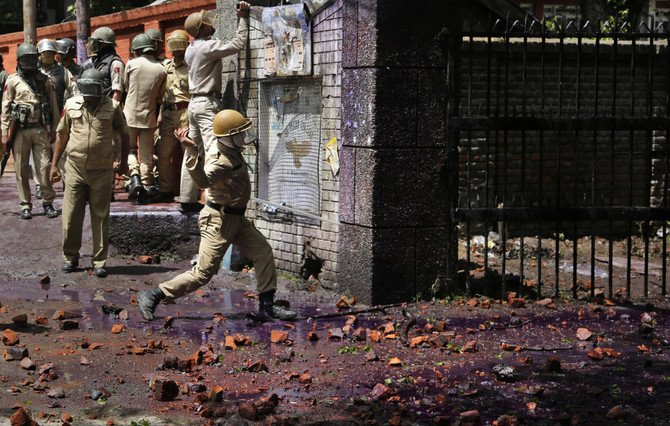
An Indian police man throws stones at Kashmiri student protesters as they clash in Srinagar, Indian controlled Kashmir, Monday, April 24, 2017. (AP)
2 / 3
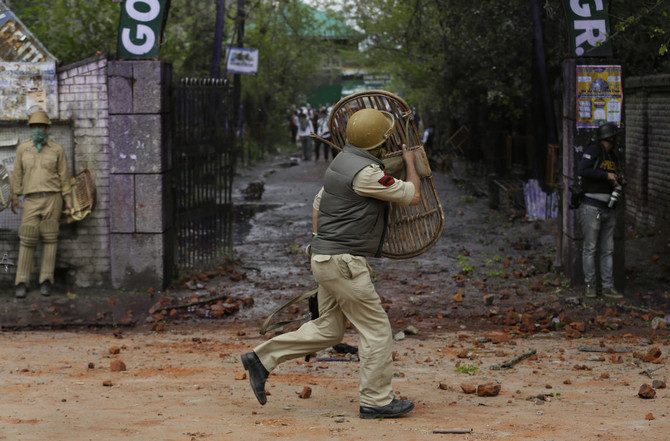
An Indian police man covers himself with a bamboo shield to protect himself from stones thrown by student protestors as they clash in Srinagar, Indian controlled Kashmir, Monday, April 24, 2017. (AP)
3 / 3
Members of the youth wing of Kashmir's main opposition National Conference party shout anti-government slogans during a protest against police violence involving students in central Srinagar on April 18, 2017. (AFP)
Updated 26 April 2017
Follow

Indian Kashmir blocks social media after clashes

SRINAGAR: Authorities in Indian-administered Kashmir on Wednesday ordered Internet service providers to block popular social media services including Facebook, Twitter and WhatsApp after an upsurge in violence in the region.
In a statement, the local government said the services were “being misused by anti-national and anti-social elements” and should be blocked for one month or until further notice “in the interest of maintenance of public order.”
It is the first time the government has taken such a step, although it regularly blocks the mobile Internet signal in the volatile Kashmir valley.
Indian-administered Kashmir has been tense since April 9, when eight people were killed by police and paramilitaries during by-election violence.
Anti-India sentiment runs deep in the valley, where most people favor independence or a merger with mainly Muslim Pakistan.
Clashes between rebels and government forces have become more frequent since the killing of a popular rebel leader by security forces last July sparked widespread unrest.
Authorities say militants are using social media sites to rally support.
Earlier this week the leader of Jammu and Kashmir, the northern state that administers the area, held talks with Indian Prime Minister Narendra Modi on the developing crisis.
Hundreds of student protesters have taken to the streets in recent weeks, many chanting anti-India slogans and throwing rocks at police.
The students were angered by a raid earlier this month on a college in the southern district of Pulwama in which police tried to detain the alleged ringleaders of earlier protests.


At UN, Pakistan condemns attacks against Gulf states, calls for immediate de-escalation

Updated 5 sec ago
Follow

At UN, Pakistan condemns attacks against Gulf states, calls for immediate de-escalation

  • Iran targeted American military bases in Gulf states on Saturday after initial Israel, US strikes
  • Pakistan’s envoy says safety of millions of Pakistanis in Gulf region Islamabad’s top priority 

ISLAMABAD: Pakistan’s envoy at the United Nations this week condemned attacks against Saudi Arabia and other Gulf states amid rising tensions in the Middle East after Israeli and US strikes on Iran triggered retaliatory attacks, calling on all sides to immediately halt escalation. 

Tensions surged across the Middle East on Saturday after Israel said it launched a “pre-emptive” attack against Iran, dimming hopes for a diplomatic solution to Tehran’s long-running nuclear dispute with the West. US President Donald Trump later confirmed in a video statement that the US had also taken part in the strikes. 

Iran subsequently targeted American military bases in Gulf states, including the United Arab Emirates, Bahrain, Qatar, Kuwait and Jordan, prompting regional governments to issue condemnations. Saudi Arabia also confirmed Iran launched attacks in Riyadh and the Eastern Province, saying they were successfully intercepted. 

During a UN Security Council briefing on Saturday, Pakistan’s Permanent Representative to the UN Asim Iftikhar Ahmad condemned the “initiation of unwarranted attacks” against Iran, describing them as a violation of international law. 

“Pakistan also condemns the attacks against the Kingdom of Saudi Arabia, Bahrain, Jordan, Kuwait, Qatar and the United Arab Emirates, and stands in solidarity with all these brotherly countries and underscores the need to exercise maximum restraint,” Ahmad said. 

Ahmad said the attack was unfortunate, noting that several Arab countries were supporting Iran’s dialogue with the US on its nuclear program. 

The Pakistani envoy also condemned the death of a Pakistani national in the UAE caused by Iran’s attack on Saturday. 

He said Islamabad is “deeply alarmed” at surging regional tensions, adding that the safety and well-being of millions of Pakistani nationals in the Gulf region was also Islamabad’s “top priority.”

“Diplomacy and dialogue should be the guiding principles for achieving negotiated settlement of all contentious issues in accordance with the rights, obligations, and responsibilities of the parties concerned,” he said.

“Pakistan calls on all sides to immediately halt escalation, and urgently resume diplomacy with a view to achieving a peaceful, negotiated resolution to the crisis.”

Iranian state media confirmed early Sunday that Supreme Leader Ayatollah Ali Khamenei was killed in a major attack by Israel and the US, further raising regional tensions. 

State media reported that the 86-year-old was killed in an airstrike targeting his compound in downtown Tehran. Satellite photos from Airbus showed the site heavily bombed.

Iran’s ‌Ali ​Shamkhani, ‌top ‌adviser ​to ‌the ⁠supreme ​leader, ⁠and ⁠Revolutionary Guards ‌commander ​Mohammed ‌Pakpour ‌have ‌also been ⁠killed, IRNA reported.

The Iranian Revolutionary Guard also warned of “a severe, decisive and regret-inducing punishment” coming over Khamenei’s killing.