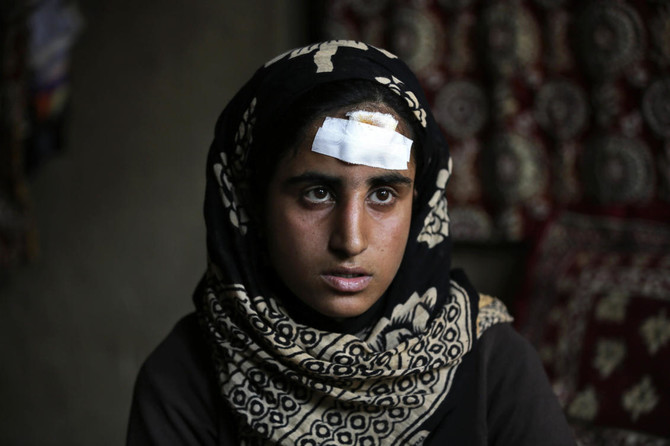
SRINAGAR: He was documenting a protest by dozens of Kashmiri students confronting armed Indian government forces wearing riot gear. But when an 18-year-old was hit in the head and began bleeding profusely, the Associated Press photographer put down his camera and rushed in to help her.
"It was an instant decision, and I didn't think twice," Dar Yasin said. He explained that he was closest to the woman and so best able to help. "I gave my camera to a colleague. ... I took the injured girl in my arms."
The scene soon became chaotic. Other protesters became angry when they saw the woman bleeding and hurled stones at the police and paramilitary soldiers, who retaliated with tear gas.
Yasin carried Khushboo Jan away from the protest site in Kashmir's main city of Srinagar, and urged her anxious friends not to worry. "I told the girl protesters that I have two daughters," he said.
The effort was captured by another photographer who then helped Yasin load Jan into a car that had been pulled up by a civilian to take her to a hospital.
"When I saw Yasin helping the girl, I thought I should document it and clicked some shots," said the other photographer, Faisal Khan, from the Turkish news organization Anadolu Agency.
Yasin and Khan then resumed taking photographs of the protest. Jan received six stitches on her forehead before being sent home from the hospital later that day.
The students demonstrating Thursday had been protesting a police raid on a college less than two weeks earlier in the town of Pulwama, in the Indian-governed portion of the disputed and divided Himalayan region. Another part of Kashmir is administered by Pakistan, and both anti-India rebels and protesters often demand that the Indian portion be allowed to join Pakistan or be granted independence.
Police released a brief statement after Thursday's protest saying Jan had been hurt in a stone-throwing incident, referring to a common practice by protesters of hurling bricks and stones at police and paramilitary troops. Jan said, however, that she had been hit by a marble fired from a sling by a soldier in a nearby bunker. Marbles are often used by Indian forces as ammunition used against protesters.
"Later, my friends told me that I was rescued by some media persons," Jan told the Associated Press on Sunday, as Yasin visited her in her Srinagar home.
Tensions between Kashmiri students and Indian law enforcement have escalated since April 15, when government forces raided the college in Pulwama, about 30 kilometers (19 miles) south of Srinagar. Hundreds of students tried to resist the raid, sparking clashes that left at least 50 students injured. Authorities have not explained what they were searching for or targeting in that raid.
On April 17, students rose up again in protests across the region that left more than 100 students and an unknown number of police officers injured. Authorities responded by closing colleges, universities and some high schools, but the protests have continued.
On Monday, as authorities ordered schools and colleges open, protests and clashes again erupted in Srinagar. Police fired tear gas and used water cannons to stop rock-throwing students from marching in the main commercial area in Srinagar.
The students were chanting slogans such as "Go India, go back" and "We want freedom." Some students were reported injured in the clashes.
Protest violence is an almost daily occurrence in Kashmir, where anti-India sentiment runs deep among the mostly Muslim population after decades of military crackdown in the mountainous territory to fight armed rebellion. The region, claimed by both India and Pakistan in its entirety, has sparked two of three wars between the nuclear-armed nations since 1947.
Kashmir has also seen more than 70,000 people die since 1989 in a homegrown rebellion and the ensuing Indian crackdown, which has suppressed militant groups in recent years.


![]()
![]()

AP journalist covering Kashmir protest helps injured teen
AP journalist covering Kashmir protest helps injured teen


Latest updates


© 2026 SAUDI RESEARCH & PUBLISHING COMPANY, All Rights Reserved And subject to Terms of Use Agreement.