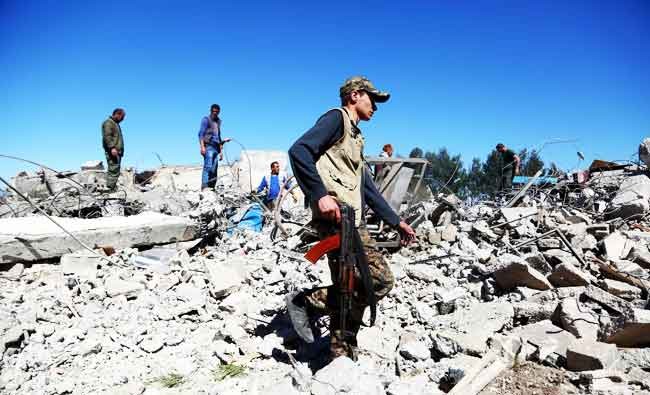
AL-MALIKIYAH, Syria: Turkish warplanes killed more than two dozen Kurdish fighters Tuesday in strikes in Syria and Iraq, where the Kurds are key players in the battle against Daesh.
Turkey said it had carried out the strikes in northeast Syria and northern Iraq against “terrorist havens,” vowing to continue acting against groups it links to the outlawed Kurdistan Workers’ Party (PKK).
In northeast Syria, strikes targeting the Kurdish People’s Protection Units (YPG) — who are leading the offensive against Daesh stronghold Raqqa — were reported to have killed 20 fighters.
In northern Iraq they killed six peshmerga fighters from the autonomous Kurdish government, usually allied with Ankara, in an apparent accident.
Iraqi government spokesman Saad Al-Hadithi said: “The Iraqi government condemns and rejects the strikes carried out by Turkish aircraft on Iraqi territory.”
The strikes underlined the complexities of the battlefields in Iraq and Syria, where twin US-backed offensives are seeking to dislodge Daesh from its last major urban strongholds.
They could also exacerbate tensions between Ankara and its NATO ally Washington, which leads an anti-Daesh coalition carrying out airstrikes in Syria and Iraq and sees the Kurds as instrumental in the fight against Daesh.
Turkey said its strikes aimed “to destroy terrorist havens targeting our country” and vowed to press the offensive “until the very last terrorist is neutralized.”
An army statement said the strikes “destroyed” shelter areas, ammunition warehouses and PKK communications facilities. It said 40 PKK fighters were “neutralized” in Iraq and around 30 in Syria.
The bombardment near the Syrian city of Al-Malikiyah saw “dozens of simultaneous airstrikes” overnight on YPG positions including a media center, a monitoring group said.
A commander for Kurdish forces urged the US-led coalition to prevent further Turkish strikes on their forces.
“We are asking the international coalition to intervene to stop these Turkish violations,” the commander told AFP. “It’s unthinkable that we are fighting on a front as important as (Daesh bastion) Raqqa while Turkish planes bomb us in the back,” the commander said.
“The YPG will not be silent on this blatant attack, and we reserve our right to defend ourselves and take revenge for our martyrs,” YPG spokesman Redur Xelil said.
The US-led coalition “has a huge responsibility and must carry out its duty to protect this area, because we are partners in fighting Daesh,” he said.


![]()
![]()
Turkish strikes kill Kurdish fighters in Syria, Iraq

Turkish strikes kill Kurdish fighters in Syria, Iraq


Latest updates


Recommended


© 2026 SAUDI RESEARCH & PUBLISHING COMPANY, All Rights Reserved And subject to Terms of Use Agreement.