Indian minister ridiculed as bizarre drought plot backfires

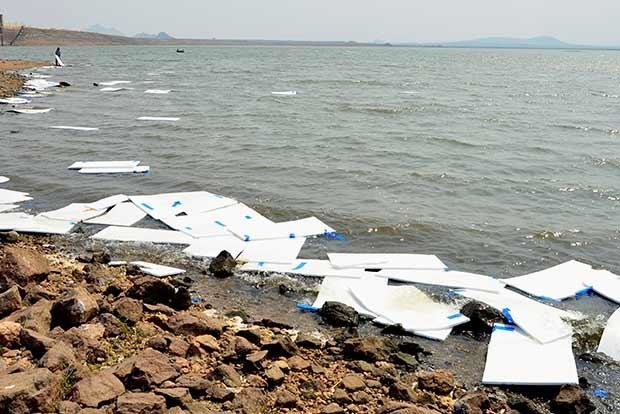
Sheets of polystyrene tossed across the surface of the water. (Twitter photo)
Updated 24 April 2017
Follow

Indian minister ridiculed as bizarre drought plot backfires

JEDDAH: An Indian politician who attempted to cover a dam in sheets of polystyrene has been left red-faced after his bizarre water-saving scheme backfired.
Tamil Nadu state minister Sellur K Raju waded into the dam with dozens of sheets of polystyrene, convinced they could help reduce water evaporation in the drought-stricken state.
But the noble yet puzzling effort went belly-up almost immediately as strong winds lifted the lightweight sheets into the air, tossing them across the surface of the water.
Footage of last Friday’s incident showed officials in rowing boats pursuing the airborne sheets, while others used rocks to try and keep them in place.
Elsewhere broken chunks of the white polymer plastic, stuck together with colored tape, were seen washed up on the dam banks.
The minister defended the hare-brained scheme — which reportedly cost one million rupees ($15,500) — saying he had been told “thermocol technology” could reduce water evaporation.
“I learnt about this (technology) from a source,” he told reporters, without elaborating.
Images of the minister flailing waist-deep in water with the unwieldy sheets attracted widespread scorn on social media, where Indians blasted the botched experiment as a waste of public money.
“Instead of using thermocol sheets to cover the entire dam, how about using a huge tarpaulin sheet to cover the sun. Problem solved,” one Twitter user wrote sarcastically.
“Tamil Nadu’s Next project, putting sunglasses to the Sun!” said another.
A third Twitter user posted a picture of a duct tape holding together a cracked street captioned: “Looks like our TN (Tamil Nadu) minister Sellur K Raju visited somewhere else too.”

The dam on the Vaigai river is a key water source for many in the southern state, where irregular rainfall has caused a prolonged drought in many parts.
Farmers desperate for relief have been resorting to extreme acts of protest to draw attention to the crisis, including wearing necklaces of human skulls, carrying live rats in their mouths and running about naked in front of Prime Minister Narendra Modi’s office.
They postponed their protest Sunday after being assured their case would be heard, but plan to return to the capital next month if their demands are not met.

(With input for AFP)


Nestle acknowledges delay before baby milk recall

Updated 5 sec ago
Follow

Nestle acknowledges delay before baby milk recall

  • The company in December recalled batches of its infant formula in 16 European countries
  • Nestle said routine checks at its Dutch plant at the end of November 2025 had detected “very low levels” of cereulide

GENEVA: Swiss food giant Nestle has acknowledged that it waited days for a health-risk analysis before alerting authorities after detecting a toxin in its baby milk at a Dutch factory.
But in an open letter to campaign group Foodwatch France Friday it denied accusations of negligence.
The company in December recalled batches of its infant formula in 16 European countries after detecting cereulide, a bacterial toxin that can cause diarrhea and vomiting.
French newspaper Le Monde reported Friday that traces of cereulide had been found in late November — 10 days before the first recalls of the product — because the company waited for a “health?risk analysis” before informing regulators.
Nestle said in a statement online that routine checks at its Dutch plant at the end of November 2025 had detected “very low levels” of cereulide after new equipment was installed in a factory.
It said there was no maximum limit for cereulide indicated by regulations.
The company halted production and launched further tests, which in early December confirmed minute quantities in products that had yet to leave the warehouse.
Nestle said it informed Dutch, European and other national authorities on December 10 and began a precautionary recall of all products made since the new equipment was installed — 25 batches across 16 European countries.

- Response to Foodwatch -

Friday’s open letter responded to claims by Foodwatch France, which a day earlier announced it was filing a legal complaint in the French courts against Nestle on behalf of several families whose babies had fallen ill.
Nestle denied Foodwatch’s suggestions that its product recall had been late without any reasonable excuse and that it had displayed “alarming negligence.”
They said they had acted in December and January as soon as they had identified there was an issue, said the company.
“We recognize the stress and worry that the recall has caused for parents and caregivers,” it said.
“To date, we have not received any medical reports confirming a link to illness associated with our products,” it added.
The company has said from the start of the affair that the recall stemmed from a “quality issue” and that it had seen no evidence linking its products to illness.
French authorities launched an investigation into the deaths in December and January of two babies who were thought to have drunk possibly contaminated powdered milk.
Nestle said in its statement that “nothing indicates any link between these tragic events in these two instances and the consumption of our products.”